
The Real-Estate Company Robbery Murders: Two Business Associates and 51 Million Yen
In March 1982, Seijiro Yamano used sham property deals to lure two executives from a business partner, killed both and took a 30-million-yen cheque and 21 million yen in cash. His death sentence became final in 1996; he died in detention in March 2026 before execution.
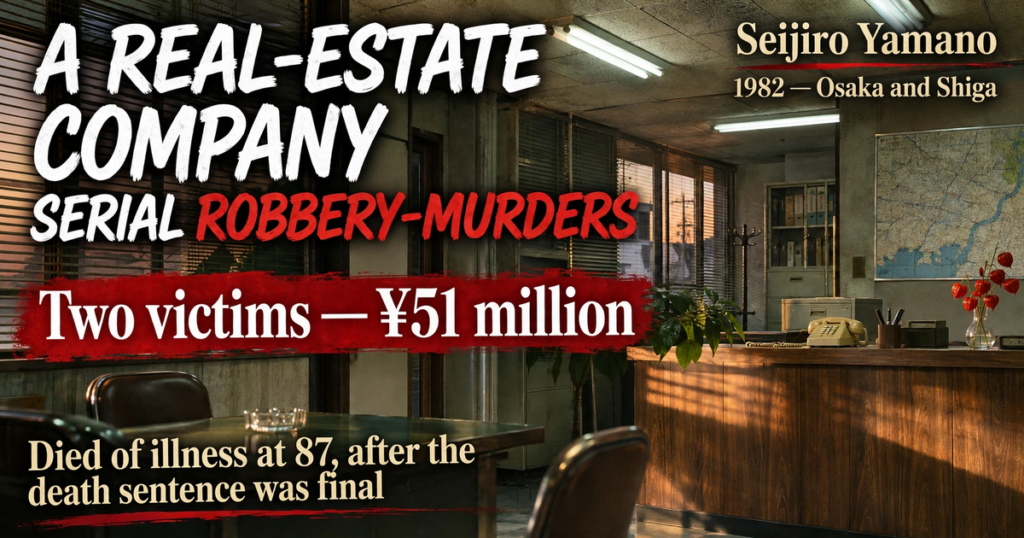
A business relationship was used to lure two men to their deaths
In March 1982, Seijiro Yamano was facing serious financial difficulties in the real-estate business he operated in Osaka Prefecture. He used an existing commercial relationship to approach two men connected with Daiken Kigyō, a real-estate company with which he had dealings. Rather than attack strangers, he presented fictitious property transactions that made it plausible for the men to meet him and bring money. Within four days, the company's president and its general affairs manager were both killed. The two offences were treated as connected robbery-murders, but they were separate events on 21 and 25 March. The courts found that Yamano exploited the trust created by business dealings to obtain a cheque and cash, then concealed the bodies.
Imono Mamoru was killed at Yamano's office on 21 March
The first offence occurred at about 12:20 p.m. on 21 March 1982. Yamano invited Daiken Kigyō president Mamoru Imono, aged 39, to Yamano's company office in Toyonaka, Osaka Prefecture, under the pretext of a property transaction. Imono brought a cheque with a face value of 30 million yen as a deposit. The court found that Yamano struck him on the back of the head with a metal bat and strangled him with a rope. Yamano took the cheque and transported the body to a wooded area in Toyono, where he buried it. The use of a sham transaction meant that the victim arrived expecting a business meeting rather than an attack.
The stolen cheque led Yamano to target another executive
After killing Imono, Yamano needed to turn the cheque into usable funds. He asked Keirō Takao, the general affairs manager of Daiken Kigyō, to cash it. Takao, aged 56, was a senior employee of the same company and had a business connection with Yamano. The attempt to convert the cheque did not end the danger. Yamano moved to take additional money from Takao. The first man's disappearance was already becoming a concern, yet only four days after the first killing Yamano arranged another meeting. The sequence shows that the second murder was not an unrelated event discovered later: the proceeds and practical consequences of the first robbery were part of the circumstances leading to the second.
Takao was killed in Shiga Prefecture on 25 March
At about 10:20 a.m. on 25 March 1982, Yamano brought Takao to a development site for holiday homes in Shiga Prefecture. The final judgment found that Yamano struck Takao several times with a metal bat and killed him. Takao had brought 21 million yen in cash as a deposit for the purported transaction. Yamano took the money and buried the body at the site. Taken together, the two robberies involved a cheque with a face value of 30 million yen and 21 million yen in cash, a total of 51 million yen. Both victims had been invited under the guise of a legitimate transaction and both bodies were buried in an effort to conceal the crimes.
The Osaka District Court imposed the death penalty in 1985
Yamano was prosecuted for robbery-murder and corpse disposal offences. The Osaka District Court sentenced him to death on 22 July 1985. It considered that he had killed two people to obtain money, had used commercial trust to lure them to the meetings and had attempted to hide the bodies. The fact that the second victim was another executive from the same company, targeted only four days after the first killing, was part of the seriousness of the case. Yamano appealed. On 11 October 1989, the Osaka High Court dismissed the appeal and maintained the death sentence. The appellate court upheld the central findings about the two killings and the amounts taken.
The Supreme Court rejected Yamano's appeal in 1996
Yamano continued to challenge the conviction and sentence. On 25 October 1996, the Supreme Court's Second Petty Bench rejected his final appeal. The death sentence was maintained and subsequently became final. The Supreme Court decision came approximately fourteen and a half years after the offences. Finality did not mean that the sentence was carried out immediately. Yamano remained in custody at Osaka Detention House as a person under a final death sentence. The long interval between finality and death is a significant part of the case's later history. It is important not to confuse a final death sentence with an execution, because the latter never occurred in Yamano's case.
Yamano died in detention in March 2026 before execution
According to the Ministry of Justice information reported in the Japanese article, Yamano complained of abdominal pain after breakfast at Osaka Detention House on 2 March 2026 and was transported to hospital with suspected intestinal obstruction. His death was confirmed at about 1:50 p.m. on 3 March. The announced cause of death was multiple-organ failure. He was 87. He died while still under a final death sentence, before the sentence could be carried out. Therefore, the correct legal description is that the death sentence became final after the Supreme Court rejected his appeal in 1996, but Yamano died in detention in 2026 and was never executed.
The case turned on the exploitation of commercial trust
The two murders were not random attacks. Yamano used his position as a business operator and the victims' familiarity with him to arrange meetings under false pretences. The first cheque was then connected to the decision to approach the second executive, who was asked to help convert it. The two deaths, the 51 million yen in property taken and the concealment of both bodies formed a continuous financial scheme. The courts considered the seriousness of killing two business associates for money, not merely the amount stolen. The case's legal timeline also illustrates why reports should distinguish the first-instance sentence, appellate dismissal, Supreme Court rejection, finality and the later death of a condemned prisoner before execution.
Original Japanese record: 不動産会社連続強盗殺人事件|山野静二郎が取引先2人から5100万円を奪い死刑確定、87歳で病死
Last updated:
Related articles
Case record
The Sakai Couple Murder: A Planned Robbery, Two Deaths and a Final Death Sentence
Case record
The Osaka Sisters Murder: A Planned Robbery, Two Deaths and a Death Sentence Final by Appeal Withdrawal
Case record
The Osaka Electrolysis Murders: Two Executives Killed in a Staged Embezzlement Disappearance
Case record