
The Himi Case: A Wrongful Conviction, a Prosecutor's Retrial Request and an Acquittal
Two sexual offences occurred in Himi, Toyama Prefecture, on January 14 and March 13, 2002. Taxi driver Hiroshi Yanagihara was convicted and sentenced to three years in prison, but later evidence pointed to another man. The prosecution itself requested a retrial in 2007. Yanagihara was acquitted on October 10, 2007, and the prosecution waived its right to appeal, making the acquittal final that day. A later civil judgment found the police investigation unlawful and ordered Toyama Prefecture to pay about 19.66 million yen.
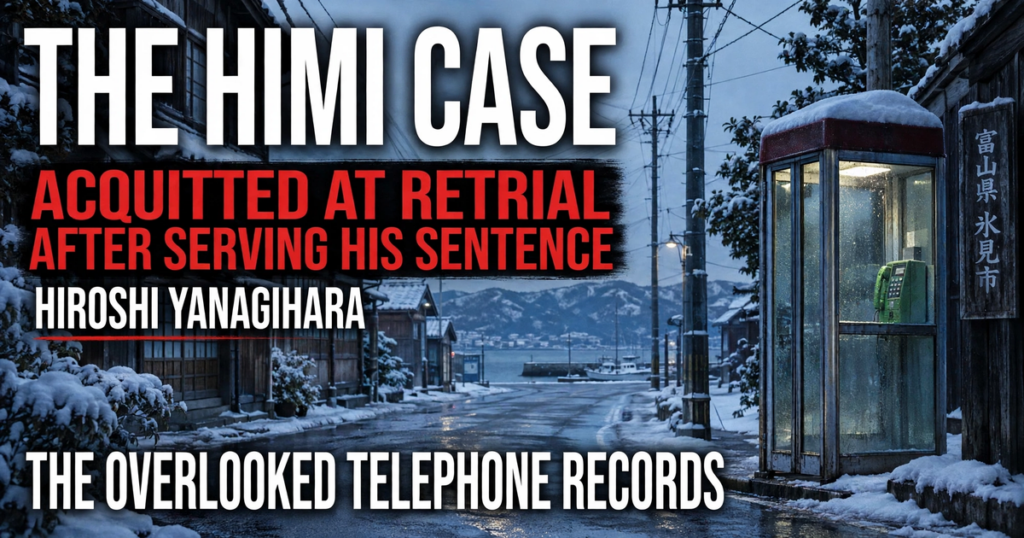
Two offences occurred in Himi in early 2002
The Himi Case concerned two separate sexual offences in Himi, Toyama Prefecture. On January 14, 2002, a man entered a home and raped an 18-year-old woman. On March 13, a man entered another home and attempted to rape a 16-year-old woman, but the offence was not completed. The investigations were linked because the incidents occurred in the same city, the methods were similar and shoe impressions at the two scenes were considered consistent with the same type of basketball shoe. The police created sketches based on the victims' descriptions and began looking for a suspect.
Taxi driver Hiroshi Yanagihara became the suspect
A former employee of a taxi company and a driving-service company was identified as resembling the sketches. That man was Hiroshi Yanagihara, a taxi driver. Police questioned him in April 2002. During questioning he eventually admitted involvement, although he later said the confession was false. He was arrested and prosecuted for the two offences. The prosecution relied on the confession, the victims' identification evidence and the similarities between the scenes. Evidence that could have contradicted the prosecution's theory was not adequately examined at the time.
The first-instance court imposed a three-year prison sentence
On November 27, 2002, the Toyama District Court's Takaoka Branch sentenced Yanagihara to three years in prison. He did not appeal, and the conviction became final. He served the sentence and was released on parole in January 2005. The finality of that original judgment did not mean the conviction was correct; it meant that the ordinary appeal period had passed without an appeal. At that stage, Yanagihara had been treated in law as the offender, even though later evidence would show that the conviction could not stand.
A different man admitted involvement in the Himi offences
The turning point came in 2006, when a man arrested in Tottori Prefecture for a separate sexual offence made statements about the Himi cases. Investigators examined those statements against other evidence. Foot impressions from the Himi scenes were compared with evidence from the man's other case, and Yanagihara's telephone records were reviewed. The records showed that during a relevant period he had made a call from his home to his brother's home, providing an alibi that had not been properly considered during the original investigation. The new evidence undermined the original conviction.
The police arrested the other suspect and the prosecution sought a retrial
In January 2007, police arrested the other man in connection with the Himi offences. On February 9, 2007, the Toyama District Public Prosecutors Office's Takaoka Branch filed a retrial request on Yanagihara's behalf. A prosecutor's retrial request is unusual because the procedure is more commonly initiated by a convicted person or defence counsel. The request reflected the prosecution's conclusion that the original conviction could no longer be maintained in light of the new evidence. On April 12, 2007, the Takaoka Branch of the Toyama District Court ordered that a retrial should begin.
Yanagihara was acquitted on October 10, 2007
At the retrial, the prosecution also sought an acquittal. On October 10, 2007, the Toyama District Court's Takaoka Branch found Yanagihara not guilty. The court considered the new evidence, including the telephone records and the shoe impressions, and concluded that he had not committed the two offences. The prosecution waived its right to appeal that same day, so the acquittal became final immediately. The original three-year conviction was thereby displaced by a final retrial acquittal. Yanagihara was legally cleared of both offences.
The acquittal and the investigation into the other man are separate legal matters
The new suspect's statements and arrest were important to the reinvestigation, but the legal result for Yanagihara is the retrial acquittal. This translation does not state that the other man was convicted of the Himi offences, because the source materials used here establish his arrest and statements but do not provide a final judgment convicting him of those particular crimes. The central legal point is that Yanagihara's original conviction was overturned in a retrial and the acquittal became final on October 10, 2007. He must not be described as a person whose guilt remained legally established.
The Supreme Public Prosecutors Office reviewed the investigation
In August 2007, the Supreme Public Prosecutors Office published a report examining prosecutorial investigative and courtroom activity in the Himi and Shibushi cases. It identified problems in assessing the reliability of statements, considering evidence that could undermine the prosecution theory and supervising investigations. In the Himi case, the review addressed the failure to give adequate weight to evidence inconsistent with Yanagihara's guilt. The report was an institutional review of prosecution practice. It did not replace the retrial judgment, but it documented lessons for future investigations.
A civil judgment found the police investigation unlawful
Yanagihara later brought a state-compensation action against the national government and Toyama Prefecture. On March 6, 2015, the Toyama District Court ordered Toyama Prefecture to pay approximately 19.66 million yen. The court found that police questioning had been unlawful, including the use of pressure and the creation of a false confession. It rejected the claim against the national government, including the allegation that the prosecutors' decision to indict was itself unlawful. The plaintiff and the prefecture did not appeal, and the judgment became final.
The case shows why a retrial acquittal must be distinguished from an original final conviction
The Himi Case moved through two very different legal outcomes. The 2002 judgment imposed a three-year prison sentence and became final because Yanagihara did not appeal. After new evidence emerged, the prosecution requested a retrial, and the court acquitted him in 2007. That acquittal became final when the prosecution waived appeal. The 2015 civil judgment then addressed the legality of the police investigation and awarded damages against the prefecture. These stages should not be compressed into a statement that the original judgment was merely reconsidered or that Yanagihara remained convicted.
Original Japanese record: 氷見事件|犯行時間帯の電話記録が見過ごされ、服役後に再審無罪となるまで
Last updated:
Related articles
Case record
The Koto Memorial Hospital Case: A Twelve-Year Sentence Overturned by Retrial, and a Death Not Proven to Be Homicide

Case record
The Ashikaga Case: How DNA Evidence and a False Confession Led to a Wrongful Conviction
Case record
The Hirosaki University Professor's Wife Murder: A Fifteen-Year Sentence Overturned by a Retrial Acquittal

Case record