
The Mitsubishi Motors Recall Cover-Up: Hidden Defect Reports, Fatal Truck Accidents and Separate Criminal Convictions
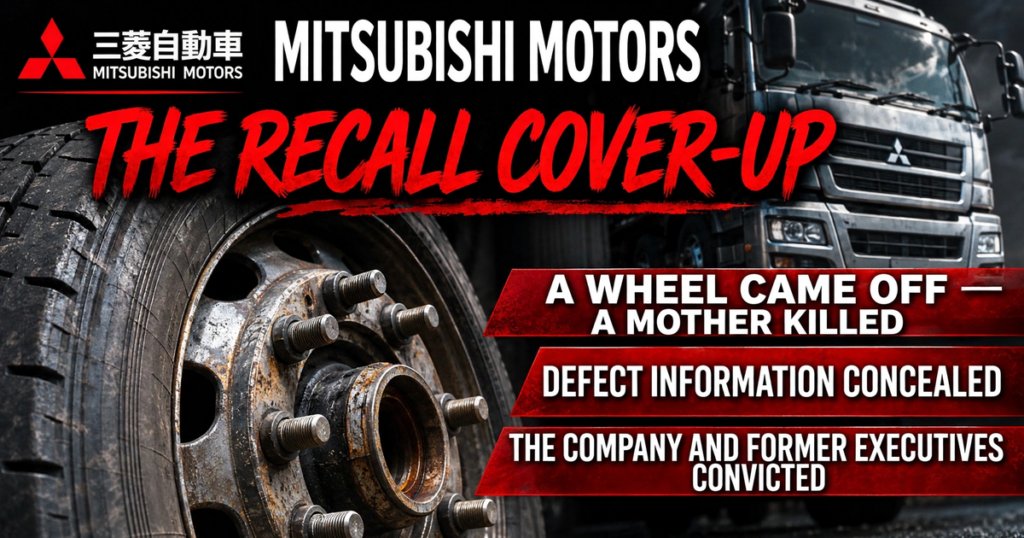
In 2000, Mitsubishi Motors admitted that it had concealed vehicle-defect information from regulators for years, using a dual system that separated information shown to the government from information kept confidential. The scandal later became linked to serious heavy-vehicle accidents. On January 10, 2002, a truck wheel detached in Yokohama and killed a 29-year-old mother, injuring her two children. A separate truck accident in Yamaguchi in October 2002 involved a clutch-housing failure and the death of a driver. Several criminal cases followed, including false reporting and professional negligence. Their defendants and outcomes must be distinguished.
A whistleblower exposed a system for hiding defect information
In June 2000, an internal tip led the Ministry of Transport to inspect Mitsubishi Motors. Investigators found that the company had divided customer complaints into information to be shown to regulators and information to be kept inside the company. The confidential category included reports that could have led to recalls or other safety measures. The practice had continued for years and was not a simple clerical mistake. It involved a system for deciding which safety information would be disclosed and which would be withheld from the authorities.
The company acknowledged years of concealed complaints and secret repairs
Mitsubishi Motors disclosed that it had used a dual system for handling defect reports and had carried out repairs without properly reporting the underlying problems. The company's public explanations in 2000 followed the ministry's inspection and the discovery of hidden complaint records. The scandal prompted recalls across multiple models and led to the resignation of president Katsuhiko Kawasoe. The issue was not limited to the number of vehicles recalled: the more fundamental problem was that regulators and customers had not been given information needed to assess serious defects.
A separate criminal case concerned false reports to the government
The Ministry of Transport filed a criminal complaint in September 2000 concerning false reports about vehicle defects. In April 2001, prosecutors filed summary indictments against Mitsubishi Motors as a company and four former executives for false reporting under the Road Trucking Vehicle Law. The case concerned information concealed during ministry inspections in March and November 1999. The company and four officials later received summary fines. This early proceeding was separate from the later hub-related false-report prosecution. The criminal case about reports to regulators was distinct from later prosecutions concerning the deaths and injuries caused by defective heavy-vehicle parts.
A truck wheel detached in Yokohama and killed a mother
On January 10, 2002, a Mitsubishi heavy truck was travelling in Yokohama's Seya Ward when the hub supporting its left front wheel fractured. The wheel, tire and brake drum came off and struck a 29-year-old woman walking on the pavement. She died from her injuries. Two children who were with her were also injured. The incident became known as the Seya accident. It brought renewed attention to earlier reports of similar hub failures and to the company's handling of those reports.
The company initially blamed maintenance, but earlier failures had been recorded
Mitsubishi Motors initially attributed the hub failures to wear or inadequate maintenance by vehicle users. However, similar failures had occurred before the fatal Seya accident. The Supreme Court later described a history of repeated hub damage and the company's internal classification of some reports as highly important safety information while keeping them confidential. The issue was whether people responsible for quality assurance should have recognised that the hub might be structurally weak and taken action, including a recall, before another accident occurred.
The false-report case went from acquittal to conviction
A separate prosecution concerned the company's report to the Ministry of Land, Infrastructure, Transport and Tourism about the hub problem. The Yokohama Summary Court acquitted the company and three former executives in 2006. On July 15, 2008, the Tokyo High Court reversed the result and found them guilty of false reporting under the Road Transport Vehicle Act. The company did not appeal, and its conviction became final. The former executives appealed, but the Supreme Court dismissed their final appeals in March 2010, making their fines final as well.
The Supreme Court upheld convictions for failing to prevent the Seya accident
The criminal case over the deaths and injuries in Yokohama was separate from the false-report case. It concerned former managers in the quality-assurance division and whether they had a duty to implement improvement measures, including a recall, after repeated hub failures. On February 8, 2012, the Supreme Court dismissed the final appeals and maintained the convictions for professional negligence causing death or injury. The Court emphasised that the hub was an important safety part and that repeated failures made the risk objectively recognisable.
A second heavy-vehicle problem involved a different part and a different fatal accident
In October 2002, a Mitsubishi heavy truck in Yamaguchi Prefecture was involved in a separate fatal accident after a clutch housing failed and the driver died. The clutch-housing issue later became part of the wider recall scandal. It should not be merged with the Seya accident: the component was different, the accident occurred in a different prefecture and the criminal proceedings involved different conduct and defendants. The wider corporate scandal included both the hub problem and the clutch-housing problem, but each had its own technical and legal record.
The scandal showed why safety information must reach regulators and customers
The Mitsubishi case is often described as one recall cover-up, but the criminal record consists of several separate proceedings. The 2000 disclosure exposed a long-running system for hiding complaints. The later hub-related false-report case concerned what the company and former executives told regulators. The Seya prosecution concerned whether quality managers failed to act on known risks and thereby contributed to a fatal accident. The Yamaguchi clutch-housing incident concerned another component. Keeping those cases separate is necessary to understand who was charged, what conduct was alleged and which judgments became final.
Original Japanese record: 三菱自動車リコール隠し事件|タイヤ脱落で母親死亡、欠陥情報の隠蔽から企業・幹部の有罪へ
Last updated:
Related articles
Case record
The Tomei Expressway Road-Rage Deaths: Why Kazuho Ishibashi Was Convicted of Dangerous Driving Causing Death or Injury Without Hitting the Victims

Case record
The Paloma Water-Heater Deaths: Twenty-Eight Carbon-Monoxide Accidents and a Failure to Act on Warning Signs
Case record
The Kabukicho Building Fire: Forty-Four Deaths, an Unidentified Fire-Setter and the Failure of Fire Management
Case record