
The Kanemi Yusho Poisoning: PCB-Contaminated Rice Oil and a Relief System Still Operating Decades Later
In October 1968, people across western Japan became ill after consuming rice-bran oil manufactured by Kanemi Warehouse. A heat-transfer fluid used during deodorisation leaked into the oil. The contamination involved polychlorinated biphenyls and, as later research showed, polychlorinated dibenzofurans formed during heating. The incident caused long-lasting health effects and led to criminal and civil proceedings with different outcomes. A 2012 law broadened the framework for patient support and recognition. As of December 1, 2025, 2,392 people had been formally recognised as Yusho patients, while the wider group exposed to the oil cannot be defined by that number alone.
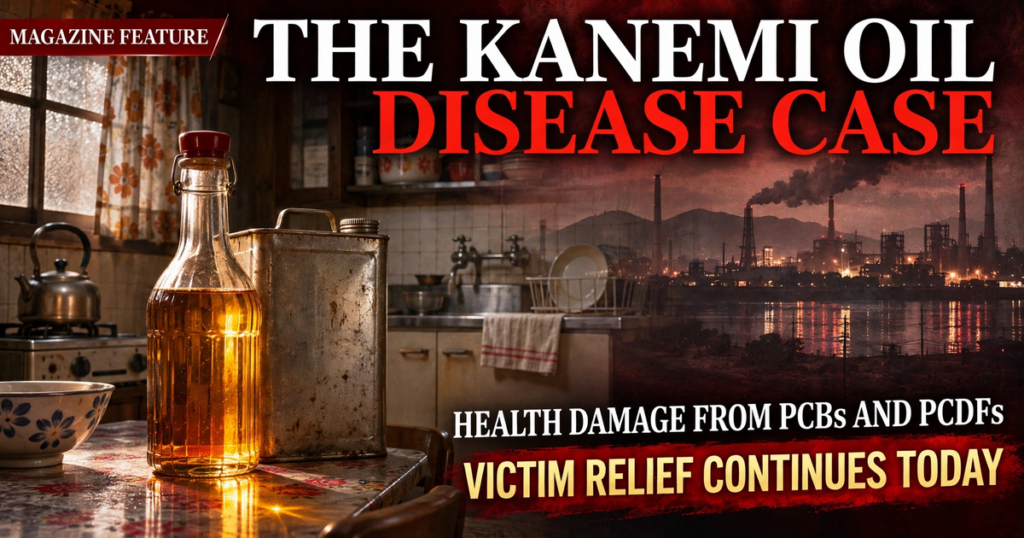
A food-poisoning outbreak emerged across western Japan in 1968
In October 1968, public-health authorities in western Japan received reports of people suffering unusual skin conditions, eye irritation, fatigue and other symptoms after eating rice-bran oil. The oil had been manufactured by Kanemi Warehouse and distributed for household use. Families could consume the same product over an extended period, so exposure was not limited to one meal or one person. Reports came from Fukuoka and neighbouring prefectures, including Nagasaki. The incident became known as Kanemi Yusho, using the Japanese term Yusho for the characteristic poisoning syndrome.
A heat-transfer fluid leaked into the rice oil during deodorisation
Kanemi Warehouse used a heat-transfer fluid in a system that heated rice-bran oil during the deodorisation process. The fluid circulated through pipes and was not supposed to come into contact with the food. Investigators found that the equipment had developed pinhole openings, allowing the fluid to leak into the oil. The contaminated product was then distributed and consumed. The chemical mixture included Kanechlor, a commercial PCB product manufactured by Kanegafuchi Chemical, now known as Kaneka. The contamination was therefore connected to the design and condition of industrial equipment used in food production.
Later research identified PCDFs as an important part of the exposure
The outbreak was first understood mainly as PCB poisoning. Research later showed that polychlorinated dibenzofurans, or PCDFs, formed when PCB-containing heat-transfer fluid was heated, also played a major role in the health effects. The mixture of persistent chemicals made the exposure more complex than an ordinary short-term food-poisoning event. The substances could remain in the body, and the effects could persist over time. The case also became important in the history of industrial chemical regulation because a substance used in manufacturing equipment had entered a product intended for human consumption.
The symptoms were systemic and could continue for years
People affected by Yusho reported skin eruptions and pigmentation changes, eye discharge, fatigue, numbness, appetite loss and other symptoms. The condition was not limited to a single visible skin disorder. Research and health surveys continued to examine systemic effects and the possibility of impacts beyond the first generation. Because the chemicals were persistent and the event had occurred decades earlier, diagnosis and recognition became difficult. Some people no longer had receipts, medical records or other documents proving that they had consumed the contaminated oil in 1968.
The reported number of people affected is not the same as the number formally recognised
At the time of the outbreak, roughly 14,000 people reported health problems, although that figure did not mean that every person had been formally diagnosed as a Yusho patient. Recognition requires an assessment under the applicable diagnostic criteria. The Ministry of Health, Labour and Welfare reported 2,392 recognised patients as of December 1, 2025. That figure is a count of people who had received formal recognition under the system, not a definitive count of everyone who may have consumed the contaminated oil. The distinction matters because old records may be missing and because the criteria and application process have changed.
Criminal proceedings and civil claims followed separate tracks
The contamination led to criminal proceedings concerning the people responsible for the factory and the manufacturing process. Separately, patients and their families pursued civil claims for compensation against Kanemi Warehouse, the chemical manufacturer and public authorities. The two tracks addressed different questions: individual criminal responsibility on one hand, and civil liability and compensation on the other. Their outcomes should not be treated as interchangeable.
A 2012 law broadened the framework for recognition and support
In 2012, the Diet enacted a law to promote comprehensive measures for people affected by Kanemi Yusho. The diagnostic criteria were revised in December of that year. Under specified conditions, family members who had lived with a recognised patient at the time of the incident and were considered likely to have consumed the same contaminated oil could be recognised even when old purchase or medical records were unavailable. The change acknowledged that a person should not necessarily be excluded from relief merely because decades had passed and ordinary documents had disappeared.
Health surveys and recognition continue
The Ministry of Health, Labour and Welfare continues to coordinate patient recognition, health surveys and support measures through prefectural authorities. The oil-poisoning research group also studies symptoms and diagnostic indicators, including measurements related to PCDF exposure. The number of recognised patients changes as applications are assessed and as the criteria are applied. The Kanemi case is therefore not simply a closed event from 1968. It remains a long-term public-health and relief issue involving persistent pollutants, evidence gathered decades after exposure and the need to support people as their health and living circumstances change.
Original Japanese record: カネミ油症事件|PCB・PCDF汚染から半世紀、認定拡大と現在も続く救済
Last updated:
Related articles
Case record
The Miike Coal Mine Explosion: 458 Dead, 839 with Carbon Monoxide Poisoning and Decades of Compensation Litigation
Case record
The JR Uetsu Main Line Derailment: Inaho No. 14 and the Sudden Gust
Case record
The Snow Brand Milk Poisoning Outbreak: A Power Failure, Heat-Stable Toxin and Two Different Patient Counts
Case record