
The Paloma Water-Heater Deaths: Twenty-Eight Carbon-Monoxide Accidents and a Failure to Act on Warning Signs
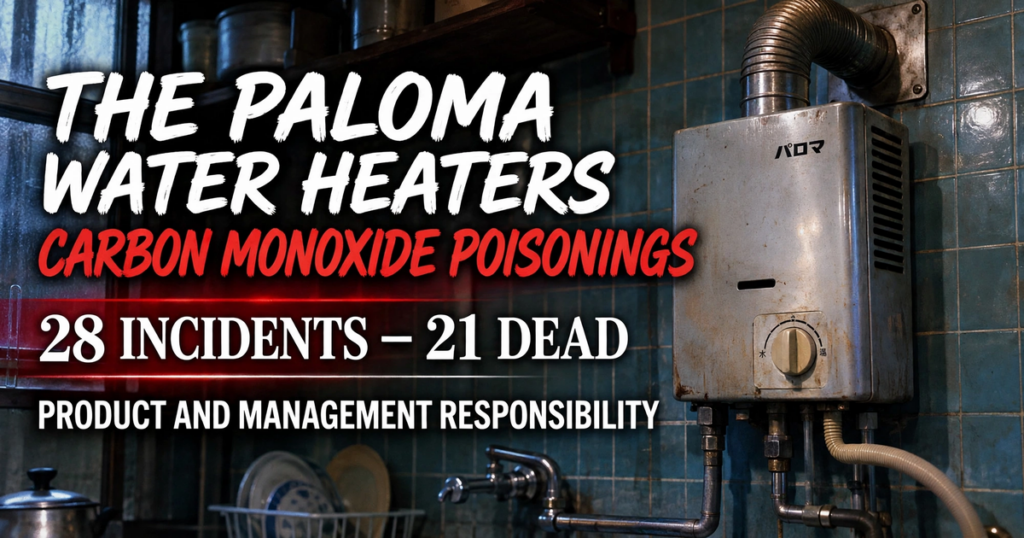
Between 1985 and 2005, 28 carbon-monoxide incidents involving Paloma indoor gas water heaters were identified, with 21 deaths. In some units, repair work had bypassed safety devices so that the heater could continue burning when the exhaust fan was not operating correctly. The pattern became public in 2006. In 2010, the Tokyo District Court convicted the company's former president and a former quality-control manager in connection with a later fatal incident. The case exposed the importance of collecting accident information across years and acting on risks even when products have been modified after sale.
A series of fatal incidents became public in 2006
In 2006, the public learned that carbon-monoxide poisoning incidents involving Paloma-manufactured indoor gas instantaneous water heaters had occurred repeatedly over two decades. The Ministry of Economy, Trade and Industry identified 28 incidents between 1985 and 2005, resulting in 21 deaths. The cases had occurred at different times and places and had not initially been understood as one connected national product-safety problem. The disclosure changed the way the public viewed the appliances and raised questions about how the manufacturer and regulators had collected and acted on accident information.
A safety device had been bypassed in some repaired units
The heaters were designed with safety mechanisms intended to stop combustion if the exhaust fan or related equipment did not operate properly. In some units, wiring had been altered during repair work so that the safety mechanism was bypassed. The heater could then continue burning even when exhaust was inadequate. Carbon monoxide, an odourless and highly dangerous gas, could accumulate indoors. The modifications were not an approved repair method. The problem involved both the people who altered individual units and the manufacturer's response to information that similar alterations and accidents had occurred.
The 2005 Minato Ward incident brought the issue into focus
A fatal incident in Tokyo's Minato Ward on November 28, 2005 became a central event in the later criminal case. An 18-year-old university student, Hiroyuki Ueshima, died from carbon-monoxide poisoning while using a Paloma water heater, and his older brother was seriously injured. Investigators examined the heater and the history of the repair work. The incident helped expose the wider pattern of accidents involving the same product family. The case was not limited to the 2005 victims, but the prosecution had to identify specific incidents that could still be charged under the applicable limitation rules.
The manufacturer faced questions about what it knew and when
The criminal investigation examined whether company executives had learned of earlier accidents and of the unauthorised modifications, and whether they should have ordered inspections, recalls or warnings. A manufacturer cannot automatically avoid responsibility simply because a product was modified after sale. The legal question was whether the company had information that created a duty to act and whether the failure to take reasonable steps contributed to a later injury or death. The case therefore concerned corporate safety management as well as the conduct of repair personnel.
The 21 deaths were not all included in the criminal charges
The total of 21 deaths describes the full group of incidents identified between 1985 and 2005. It does not mean that the defendants were criminally tried for every death. The prosecution was limited by the available evidence and the statute of limitations. The principal criminal case concerned a later incident that remained chargeable, including the 2005 Minato Ward death and injury. Keeping these categories separate is essential: the scale of the overall product-safety problem and the specific facts legally adjudicated against the defendants are not identical.
The Tokyo District Court convicted two former executives in 2010
On May 11, 2010, the Tokyo District Court convicted former company president Toshihiro Kobayashi and former quality-control manager Wataru Kamazuka of professional negligence resulting in death and injury. Kobayashi received one year and six months in prison, suspended for three years. Kamazuka received one year in prison, also suspended for three years. The court considered whether they had failed to respond appropriately to earlier accident information and the known risk created by modified safety devices. The judgment established that post-sale tampering did not automatically remove the manufacturer's duty to respond to known danger.
The government ordered inspections and strengthened product-safety reporting
After the pattern was disclosed, METI conducted inspections, requested checks and recalls, and required the company to report the status of affected models. The episode also contributed to changes in Japan's product-safety framework. A system for reporting serious product accidents by businesses was introduced, making it more difficult for a series of incidents to remain scattered across local records without being reviewed together. The case demonstrated that a manufacturer and regulators need to identify repeated failure patterns, not simply investigate each accident in isolation.
The case changed how responsibility is understood after a product is sold
Product safety does not end when an appliance leaves the factory. A device may be repaired, altered or used for many years, and accident information can accumulate across different households. A manufacturer must evaluate whether recurring incidents indicate a systemic danger and whether users need inspections or warnings. Repairers also have a duty not to disable safety devices. The Paloma incidents showed how an apparently local repair problem can become a nationwide risk when the same product and failure pattern recur. The 28 incidents and 21 deaths remain distinct from the narrower criminal case, but together they explain why the response became a major turning point in product-safety policy.
Original Japanese record: パロマ湯沸器一酸化炭素中毒事故|28件21人死亡、長期化した不正改造事故と企業責任
Last updated:
Related articles
Case record
The Uminonakamichi Bridge Crash: Three Children Killed and a 20-Year Sentence
Case record
The Expo Land Roller-Coaster Crash: A Fatigue-Cracked Axle, a Missed Inspection and Criminal Liability
Case record
The Kabukicho Building Fire: Forty-Four Deaths, an Unidentified Fire-Setter and the Failure of Fire Management
Case record