
The Expo Land Roller-Coaster Crash: A Fatigue-Cracked Axle, a Missed Inspection and Criminal Liability
On May 5, 2007, the standing roller coaster Fujin Raijin II derailed at Expo Land in Suita, Osaka. A fractured axle caused the second car to leave the track. One passenger died and 34 people were injured. Investigators found progressive metal-fatigue cracking, and the criminal case examined why flaw-detection testing had not been properly carried out. The Osaka District Court convicted senior facility managers, a technical manager and the company. The crash led to emergency inspections of roller coasters nationwide and intensified scrutiny of amusement-ride maintenance.
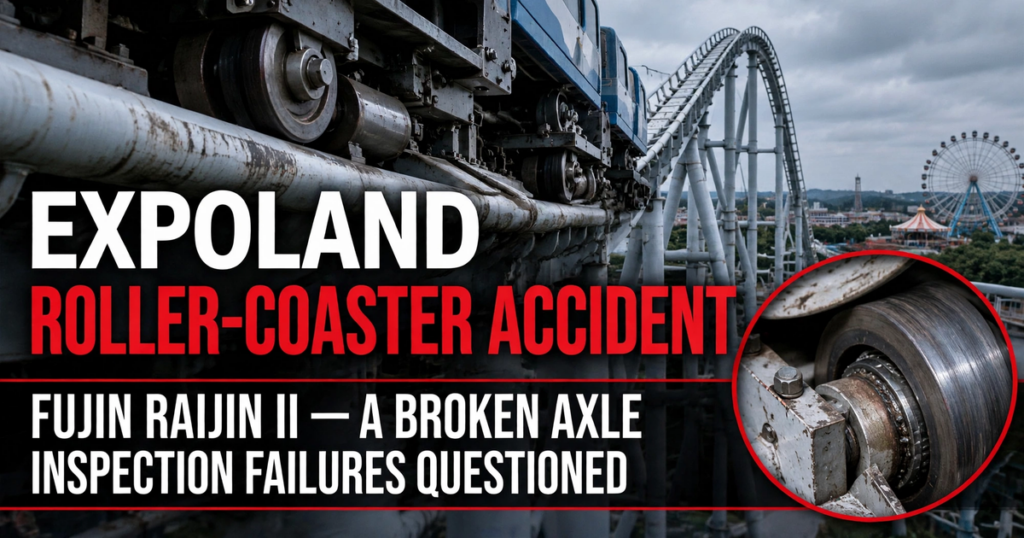
A crowded holiday ride derailed at Expo Land
At about 12:50 p.m. on May 5, 2007, during the Golden Week holiday, the standing roller coaster Fujin Raijin II derailed at Expo Land in Suita, Osaka Prefecture. The six-car train carried 22 passengers. The second car left the track after an axle fractured, causing the train and its riders to strike surrounding structures. One passenger died. A total of 34 people were injured, including 21 passengers. The accident took place at a busy amusement park, turning a holiday attraction into a major public-safety disaster.
The broken axle had failed through metal fatigue
Investigators examined the wheel assembly and found that the axle had fractured. The break was not treated as a defect that had appeared without warning at the moment of the crash. The evidence showed progressive fatigue cracking, a process in which repeated loading can cause a small crack to grow until the component can no longer withstand the forces placed on it. A crack of this kind may not be visible during an ordinary visual inspection. The technical issue was therefore whether the inspection regime included an appropriate method for detecting internal or surface flaws before the axle failed.
Flaw-detection testing was central to the safety question
The investigation focused on whether non-destructive testing, commonly called flaw detection, should have been used on the axle at regular intervals. Such testing is designed to identify cracks without destroying the component. The Japanese article records that the required inspection had not been properly carried out before the accident. The court considered whether the responsible managers had a duty to arrange suitable tests and whether a timely inspection could have identified the fatigue damage. The case was about preventive maintenance, not merely the repair of a broken part after an accident.
The court examined management responsibility as well as technical work
The criminal proceedings considered the roles of managers who supervised facility operations, inspection and maintenance. The senior facility managers were responsible for overseeing the ride and the system under which statutory inspections were approved. The technical manager was involved in inspections and the preparation of inspection reports. The court assessed each person's actual authority and duties rather than treating every employee as equally responsible. The prosecution's case was that the inspection system had failed to identify a dangerous condition that had developed over time.
The Osaka District Court imposed convictions and fines
The Osaka District Court convicted two senior managers and imposed two-year prison terms suspended for four years, together with fines of 400,000 yen. The technical manager was fined 200,000 yen, and the company itself was fined 400,000 yen. The judgment found that the failure to conduct appropriate flaw-detection testing was a breach of management duties. The penalties were not a finding that every employee at the park had committed an offence; the court identified particular duties held by the defendants and the corporate entity.
The Ministry of Land, Infrastructure, Transport and Tourism ordered nationwide checks
On May 6, 2007, the day after the accident, the Ministry of Land, Infrastructure, Transport and Tourism asked local authorities to arrange urgent inspections of roller coasters and report the results. The ministry also called on owners and operators to strengthen accident-prevention measures. The national response reflected concern that the same inspection weakness could exist at other amusement facilities. The immediate task was to determine whether axles and similar components elsewhere showed signs of fatigue or had been maintained without adequate testing.
The park closed temporarily and later ceased operating
Expo Land suspended operations after the accident while safety measures and inspections were undertaken. It later reopened, but visitor numbers did not recover sufficiently, and the park eventually closed. Its closure should be distinguished from the criminal convictions: the park's business decision and financial circumstances were not themselves the legal findings in the criminal case. The crash nevertheless became inseparable from the public debate about whether amusement operators had treated inspections as a routine administrative task rather than a critical safeguard.
The lesson was the need to inspect for damage that cannot be seen
The accident demonstrated that a ride may continue operating while fatigue damage grows inside a component. A ride's recent history of normal operation is not proof that every critical part remains safe. Visual checks, maintenance records and non-destructive testing serve different purposes, and a sound inspection programme must match the failure mechanisms of the equipment. The case also showed why a company needs clear responsibility for inspection planning, technical review and reporting. The deaths and injuries were caused by a component failure, but the criminal case examined the human and organisational decisions that allowed the risk to remain undetected.
Original Japanese record: エキスポランド・ジェットコースター事故|「風神雷神II」車軸破断と見逃された探傷検査
Last updated:
Related articles
Case record
The Sennichi Department Store Fire: 118 Deaths and the Supreme Court's Ruling on Fire-Management Duties
Case record
The Mitsubishi Motors Recall Cover-Up: Hidden Defect Reports, Fatal Truck Accidents and Separate Criminal Convictions
Case record
The Schindler Elevator Death: An Open-Door Movement, a Teenager's Death and Acquittals on Appeal
Case record