
The Tokai JCO Criticality Accident: Twenty Hours of Nuclear Fission, Two Deaths and a Breakdown in Safety Management
A criticality accident occurred at the JCO uranium-processing plant in Tokai, Ibaraki Prefecture, at about 10:35 a.m. on September 30, 1999. Workers used an unauthorised process to pour enriched uranium solution into a precipitation tank that was not designed to prevent criticality. The reaction continued for about 20 hours. Three workers received severe radiation exposure, two later died, and 666 people were recorded as exposed. The company and six employees were convicted in 2003.
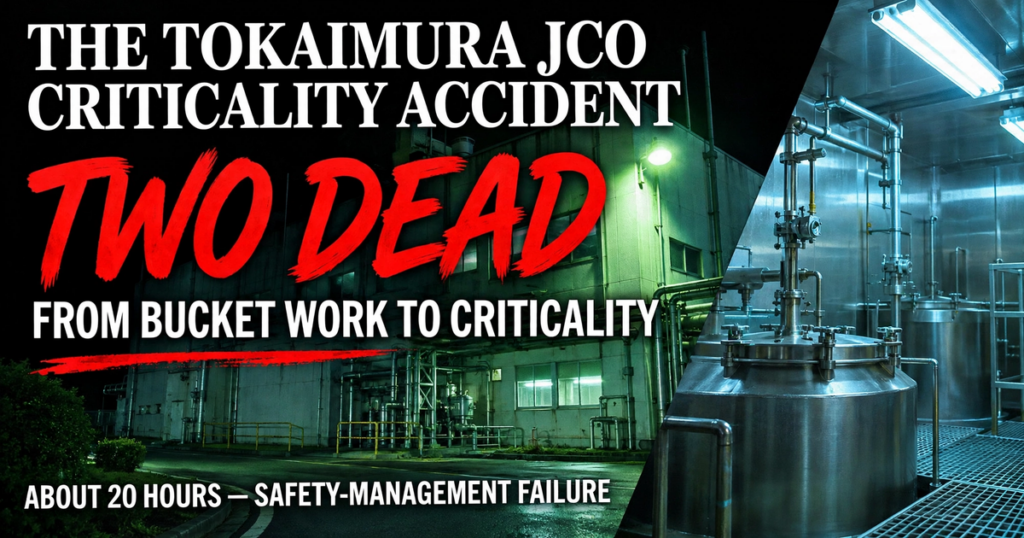
A criticality accident began during uranium processing
At approximately 10:35 a.m. on September 30, 1999, a criticality accident occurred at the JCO uranium-processing facility in Tokai Village, Ibaraki Prefecture. Workers were handling uranyl nitrate solution containing uranium enriched to 18.8 percent in the conversion test building. The solution was poured into a precipitation tank, and a self-sustaining nuclear fission chain reaction began. This was not an explosion in the ordinary sense. The criticality continued to release neutrons and gamma radiation, exposing workers and creating a radiological emergency beyond the plant itself. It became one of the most serious nuclear-fuel-processing accidents in Japan.
The authorised process had been replaced by a shortcut
The normal production procedure was designed to control the quantity and geometry of uranium solution at each stage. It used approved equipment and divided the material into limited amounts so that a critical configuration would not form. In practice, JCO workers had come to use stainless-steel containers and buckets to transfer solution, bypassing the prescribed equipment. On the day of the accident, the solution was poured directly into a precipitation tank that was not designed to prevent criticality. The departure from the written procedure was not simply an isolated improvisation by one worker; the shortcut had become an accepted workplace practice.
The precipitation tank allowed a critical configuration to form
The tank was not designed with the geometry needed to keep the uranium solution safely below criticality. The solution was more concentrated than in the ordinary process, and a quantity exceeding the controlled batch limit was introduced. The tank's shape and the surrounding cooling water contributed to conditions in which neutrons could sustain further fission reactions. The article identifies a normal limit of 2.4 kilograms of uranium per batch and explains that the actual operation exceeded the prescribed quantity. The combination of the material, the amount and the equipment geometry removed the safety margin that the normal process was meant to provide.
The reaction continued for approximately twenty hours
The workers recognised that something abnormal had occurred, but the reaction did not stop immediately. Neutrons and gamma rays continued to be emitted from the tank. On October 1, cooling water surrounding the tank was drained as part of the effort to terminate the reaction. The Japan Atomic Energy Agency's analysis places the end of the criticality at approximately 6:30 a.m., about twenty hours after it began. The prolonged reaction meant that radiation exposure was not limited to the first moments of the accident. It also required a coordinated technical response to stop the reaction while protecting people involved in the operation.
Three workers received severe radiation exposure
Three JCO employees working in the building received very high radiation doses. Hisashi Ouchi, aged 35, died 83 days after the accident. Masato Shinohara, aged 40, died 211 days after it. The third worker survived. The medical treatment and the progression of radiation injuries were documented in detail. Their deaths were not immediate, and the passage of time between the accident and the deaths should not be confused with the date of the criticality event. The accident exposed the workers to radiation at levels that produced severe and ultimately fatal injuries in two cases.
Residents were evacuated and a wider area was placed under shelter instructions
The accident required protective action outside the facility. Residents within a 350-metre radius were asked to evacuate, while people within a 10-kilometre radius were instructed to remain indoors. Schools, transport and local business activity were affected. Government reporting recorded 666 people as exposed to radiation in connection with the accident. The response demonstrated that a criticality event at a private industrial facility could require action by local authorities, emergency services and national agencies to protect surrounding communities. The emergency was therefore not only an occupational accident but also a regional public-safety event.
The company and six employees were convicted in 2003
The Mito District Court delivered its criminal judgment in 2003, finding JCO as a corporation and six employees guilty. The former plant manager received a sentence of three years' imprisonment, suspended for five years, together with a fine of 500,000 yen. JCO itself was fined one million yen. The proceedings considered more than the actions of the three workers who handled the solution at the tank. They examined the company's process management, the approval of the unauthorised procedure, employee training and the failure of managers to ensure that the safe production method was followed.
The accident exposed an organisational failure, not only a worker error
The criminal findings addressed how an unsafe method had become routine. Written safety rules existed, but the actual workplace process had been altered to save time and simplify production. When management permits a shortcut to become standard practice, the existence of a safety manual does not by itself protect workers. The accident showed how engineering safeguards, process control, supervision and training must operate together. The workers who poured the solution were part of the immediate sequence, but the court also recognised responsibility within the organisation that allowed the unsafe process to continue.
The Nuclear Emergency Preparedness Act followed within months
In December 1999, the Diet enacted the Act on Special Measures Concerning Nuclear Emergency Preparedness. The legislation strengthened the framework for reporting nuclear emergencies, coordinating national and local government responses and establishing off-site emergency response centres. The JCO accident had revealed weaknesses in how information was communicated to residents, how evacuation and shelter decisions were made and how radiation was measured outside the plant. The response therefore extended beyond technical changes at the facility. It altered the legal and administrative arrangements for dealing with nuclear emergencies that affect communities beyond the boundaries of a nuclear site.
The lasting record combines technical, organisational and public consequences
The established facts are that the criticality began at JCO at about 10:35 a.m. on September 30, 1999; it continued for approximately twenty hours; three workers received severe exposure and two died; and 666 people were recorded as exposed. The company and six employees were convicted in 2003. The accident also prompted new emergency-preparedness legislation. It should not be reduced to a story about workers using buckets. The central failure involved an unsafe process that became normalised within an organisation, the loss of criticality controls and the inability of the existing emergency system to respond quickly to an accident affecting the surrounding community.
Original Japanese record: 東海村JCO臨界事故|バケツ作業で臨界約20時間、2人死亡と安全管理の刑事責任
Last updated:
Related articles
Case record
The Shigaraki Kogen Railway Collision: Forty-Two Deaths, a Red Signal and Shared Railway Responsibility
Case record
The 1999 Tomei Expressway Drunk-Driving Crash: Two Young Sisters Killed and a Four-Year Sentence
Case record
The Nagasakiya Amagasaki Store Fire: Fifteen Deaths from Smoke on the Fifth Floor
Case record