
The Uji Cram-School Murder: Eighteen Years Reduced to Fifteen After a Diminished-Responsibility Finding
Twelve-year-old Sayano Horimoto was murdered at the Kyoshin Uji Shinmei cram school on December 10, 2005, by a part-time instructor, Yu Hagino. The Kyoto District Court imposed eighteen years in 2007, but the Osaka High Court reduced the sentence to fifteen years in 2009 after finding diminished responsibility. Neither side appealed further, and the sentence became final.
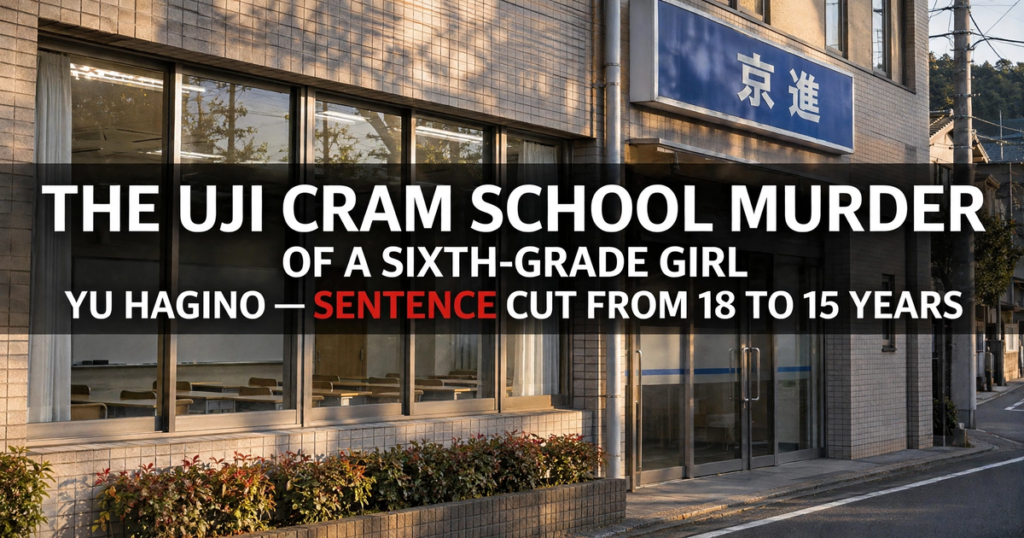
A sixth-grade pupil was killed inside a cram school
On December 10, 2005, twelve-year-old Sayano Horimoto was attending a lesson at the Kyoshin Uji Shinmei cram school in Uji, Kyoto Prefecture. She was attacked by Yu Hagino, a part-time instructor working at the school. Hagino stabbed her with a knife and killed her inside the educational facility. Police arrived after the incident and arrested him. The crime took place in a place where parents expected children to be supervised while studying. The victim was a pupil and Hagino was an adult instructor, a relationship that made the attack particularly shocking to families and the wider community.
The relationship between instructor and pupil was central to the setting
Hagino was a university student who worked part-time as an instructor. Horimoto was a sixth-grade pupil who attended lessons at the school. The instructor's role involved teaching and interacting with children in a supervised educational environment. The case raised questions about how cram schools recruit, supervise and monitor staff, and how they protect pupils inside classrooms. Those questions are distinct from the criminal responsibility of the individual who committed the attack. The criminal trial focused on Hagino's conduct and mental state; it did not, by itself, determine every question of civil or organizational responsibility that might arise for the school operator.
The trial focused on Hagino's mental condition and criminal responsibility
Hagino's mental state at the time of the killing became a major issue in the proceedings. The prosecution argued that he had full criminal responsibility and sought life imprisonment. The defence argued that hallucinations and delusions had substantially impaired his ability to understand or control his actions. The court had to distinguish a complete loss of criminal responsibility from diminished responsibility. Under Japanese criminal law, a person who has lost the relevant capacity may not be criminally responsible, while a person whose capacity is substantially impaired can still be convicted but may receive a reduced sentence.
The Kyoto District Court imposed eighteen years in March 2007
In March 2007, the Kyoto District Court found Hagino criminally responsible and sentenced him to eighteen years in prison. The court accepted that he had experienced a serious mental condition but found that he retained full criminal responsibility. It also considered his surrender and other circumstances in determining the sentence. The prosecution had sought life imprisonment, while the defence continued to dispute the degree of responsibility. Both sides appealed, so the eighteen-year term was not the final sentence. The appeal moved the case to the Osaka High Court, where the psychiatric evidence was examined again.
The Osaka High Court conducted a further assessment of the psychiatric evidence
The appeal proceedings considered how hallucinations and delusions had affected Hagino at the time of the offence. The High Court did not treat the existence of a mental disorder as automatically eliminating responsibility. Instead, it examined whether the symptoms had substantially impaired his ability to judge the wrongfulness of the conduct or to control his actions. The legal distinction was between full responsibility, diminished responsibility and complete loss of responsibility. The High Court concluded that the evidence supported diminished responsibility, a finding different from the Kyoto District Court's first-instance conclusion.
The High Court reduced the sentence to fifteen years on March 24, 2009
On March 24, 2009, the Osaka High Court overturned the eighteen-year sentence and imposed fifteen years in prison. It found that Hagino's mental condition had substantially impaired his criminal responsibility. This did not mean that he was acquitted or that the court denied that he had killed Horimoto. The conviction remained; the legal assessment of his capacity changed. The sentence was reduced by three years because the High Court applied the legal consequences of diminished responsibility. This is why the case is important in discussions of the boundary between psychiatric diagnosis and criminal responsibility.
The fifteen-year sentence became final without a Supreme Court judgment
The prosecution and the defence both had the opportunity to appeal further, but neither filed an appeal by the deadline of April 7, 2009. The fifteen-year sentence therefore became final. The finality resulted from the parties not appealing, not from a Supreme Court judgment affirming the High Court. That procedural detail should be preserved. It is inaccurate to say that the Supreme Court reduced the sentence or that the case ended in an acquittal. The final legal result was a conviction and a fifteen-year term of imprisonment based on the High Court's diminished-responsibility finding.
The case prompted questions about safety inside private education facilities
The killing of a child by a part-time instructor caused concern about how private cram schools recruit, supervise and monitor staff and how they protect pupils inside classrooms. Parents entrust children to these facilities for lessons and expect that the adults working there have been appropriately selected and monitored. The case prompted wider discussion about the safeguards schools should put in place and how they should respond to warning signs. These institutional questions are distinct from the criminal court's findings about Hagino's conduct and mental state.
The case must be described as a conviction with diminished responsibility
The established sequence is that Horimoto was killed at the cram school on December 10, 2005; Hagino was prosecuted and convicted; the Kyoto District Court imposed eighteen years in March 2007; the Osaka High Court reduced the sentence to fifteen years on March 24, 2009 after finding diminished responsibility; and neither side appealed by April 7, 2009. The final sentence was fifteen years. Diminished responsibility is not the same as insanity or acquittal, and the later sentence did not reverse the finding that Hagino committed the murder.
Original Japanese record: 宇治学習塾小6女児殺害事件|萩野裕の刑が18年から15年に変わった責任能力判断
Last updated:
Related articles
Case record
The Murder of Kyoto Seika University Student Daisaku Chiba
Case record
The Kyotanabe Police Officer Murder: A 16-Year-Old Daughter and the Family Court's Decision Not to Transfer
Case record
The Maizuru High School Girl Murder: An Acquittal Based on Reasonable Doubt
Case record