
The Sendai Arcade Truck Attack: Three Dead, Four Injured and a 28-Year Sentence Replaced by Life
On April 2, 2005, a truck struck pedestrians at an intersection and then drove through a pedestrian arcade in central Sendai. Three people died and four were injured. The district court imposed 28 years, but the Sendai High Court overturned that sentence on March 7, 2008 and imposed life imprisonment after reassessing the driver's intent.
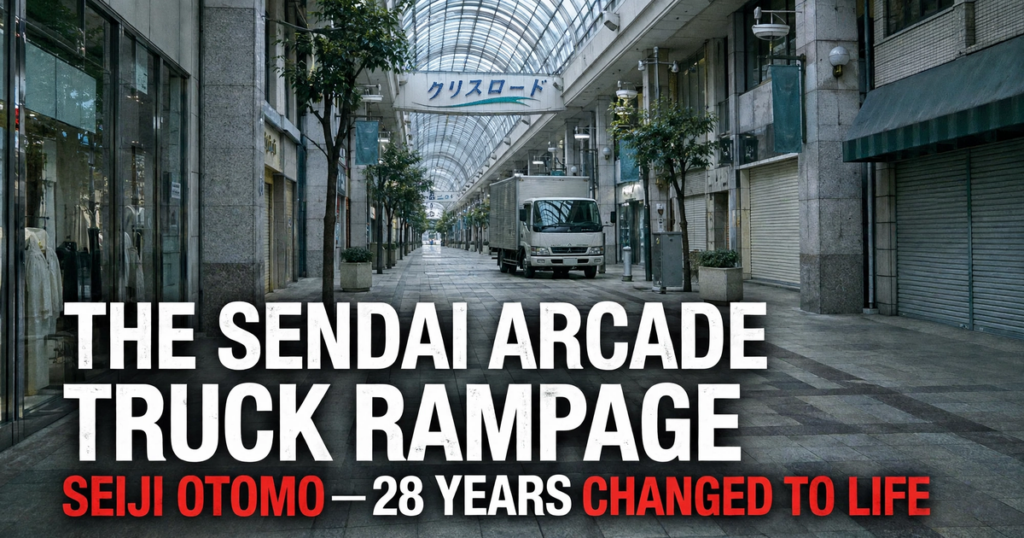
A truck entered a pedestrian arcade in central Sendai
On April 2, 2005, an ordinary truck driven through central Sendai struck pedestrians at a signal-controlled intersection and then entered a pedestrian-only arcade. The truck travelled at high speed through the shopping street, hitting people who were walking along the covered passage. The overall toll was three deaths and four injuries. The attack unfolded over a short period, but the truck continued for several hundred metres, and the driver's conduct after the first collision became central to the criminal case. The location was designed for pedestrians, not motor vehicles, and the people struck had no connection with the driver.
The first intersection collision and the later arcade attack had different legal classifications
At the first intersection, the driver failed to observe a red traffic signal and struck three pedestrians who were crossing legally. One later died and two others suffered serious injuries. That first collision was prosecuted as professional negligence causing death and injury. After the truck moved into the arcade, it struck four more pedestrians. Two died and two were injured, and the later conduct was prosecuted as murder and attempted murder. The total of three deaths and four injuries therefore arose from two stages of the same drive, but the courts did not treat every impact as the same offence.
The driver continued without stopping or taking evasive action
The first collision did not end the sequence. The driver stopped, reversed and then moved forward into the pedestrian arcade. The district court judgment described the truck travelling at roughly 50 to 60 kilometres per hour through the arcade section and continuing for about 500 metres. The Japanese source article summarizes the overall route as approximately 550 metres. The driver did not brake or sound the horn before striking pedestrians in the arcade. The court treated the sequence of steering, reversing and accelerating as relevant to what the driver understood about the situation and whether he had accepted the risk of killing people.
The driver did not stop to help the first victims
After the intersection collision, the driver did not immediately stop to rescue the injured pedestrians or report the crash to police. Those omissions formed separate road-traffic offences. The failure to stop and provide assistance was not simply a detail about the later murder charges; it was part of the legal responsibility arising from the first collision. The case therefore included professional negligence, failure to provide aid and report, murder, attempted murder and a separate fire-related offence. The charges reflected the different actions and mental states found across the short sequence.
The driver attempted suicide by setting fire to his clothing inside the truck
After the truck stopped near the end of the arcade, the driver poured light oil over his sweatshirt and used an emergency flare to ignite it. He then moved the truck into a parked refrigerated vehicle and stopped. Unable to endure the heat, he removed the burning sweatshirt and left it on the dashboard, where the fire spread and damaged the truck. The court found that the fire created a public danger because it could have spread to nearby vehicles or buildings. The act was prosecuted as arson of a structure other than a building. The driver then left the truck and walked to a nearby police box, where he reported that he had hit something.
Psychiatric evidence and criminal responsibility were examined
The driver described hearing voices and having suicidal thoughts before the incident. Two psychiatric assessments were conducted. The defence argued that schizophrenia and auditory hallucinations had deprived him of criminal responsibility or substantially reduced it. The Sendai District Court considered the assessments and his conduct before and during the drive. It found that he retained full criminal responsibility. The court accepted that his attention and judgment had been affected to some extent by his mental condition and the shock of the first collision, but it did not find that his capacity had been lost or reduced to the legal threshold for diminished responsibility.
The Sendai District Court imposed 28 years in March 2007
On March 15, 2007, the Sendai District Court sentenced the driver to twenty-eight years in prison. It found murder and attempted murder in the arcade section, professional negligence in the first intersection collision, failure to provide aid and report, and arson. The district court regarded the deaths and injuries as extremely serious, but it assessed the intent in the arcade as eventual or conditional intent rather than a definite intention to kill. It also considered the driver's mental condition and the fact that the sequence had followed the first collision. The prosecution appealed, arguing that the sentence was too lenient and that the intent had been assessed too narrowly.
The Sendai High Court changed the sentence to life imprisonment
On March 7, 2008, the Sendai High Court overturned the district court judgment and imposed life imprisonment. It placed greater weight on the driver's continued high-speed travel through a pedestrian-only arcade, the absence of braking or other avoidance measures and his awareness that pedestrians were ahead. The High Court treated the conduct as demonstrating a definite intent to kill rather than merely accepting a possible fatal result. The change from twenty-eight years to life imprisonment was therefore not based on a different death toll. It resulted from a different legal assessment of the driver's state of mind and the seriousness of the arcade attack.
The case is not accurately described as an ordinary traffic accident
The first collision was a traffic offence, but the later driving through the arcade was treated as intentional violence. That distinction is central to the case. The court's findings did not transform the first red-light collision into murder; instead, they separated the initial negligent crash from the subsequent deliberate continuation into a pedestrian area. The fire in the truck after the drive also formed a separate offence. Describing the entire event only as a 'truck accident' would omit the murder and attempted-murder convictions, while describing all seven casualties as victims of a single intentional attack would also be inaccurate.
The High Court judgment is the last confirmed stage in this record
The current Japanese source article identifies the March 7, 2008 Sendai High Court judgment as the decision that replaced the twenty-eight-year term with life imprisonment. This English record does not add an unverified Supreme Court decision or a separate finality date. The important procedural distinction is that the district court's sentence was overturned, and the life sentence came from the High Court. The case remains a significant example of how the same sequence of vehicle movements can involve different legal offences and how a court's assessment of intent can change the sentence substantially.
Original Japanese record: 仙台アーケード街トラック暴走事件|7人死傷、懲役28年が無期懲役に変わった理由
Last updated:
Related articles
Case record
The Nagoya University Student Murder: Criminal Responsibility, Earlier Poisonings and a Final Life Sentence
Case record
The Matsudo Female University Student Murder-Arson: A Death Sentence Replaced by Life Imprisonment
Case record
The Kawasaki Serial Stabbing Attacks
Case record