
The Shooting of Nagasaki Mayor Hitoshi Motoshima: A Political Assassination Attempt and a 12-Year Sentence
Nagasaki Mayor Hitoshi Motoshima was shot outside City Hall on January 18, 1990, after public controversy over his remarks about Emperor Hirohito's wartime responsibility. He survived. Kazumi Tajiri, associated with the right-wing group Seikijuku, was convicted of attempted murder and received a 12-year sentence, which became final after his appeal was dismissed.
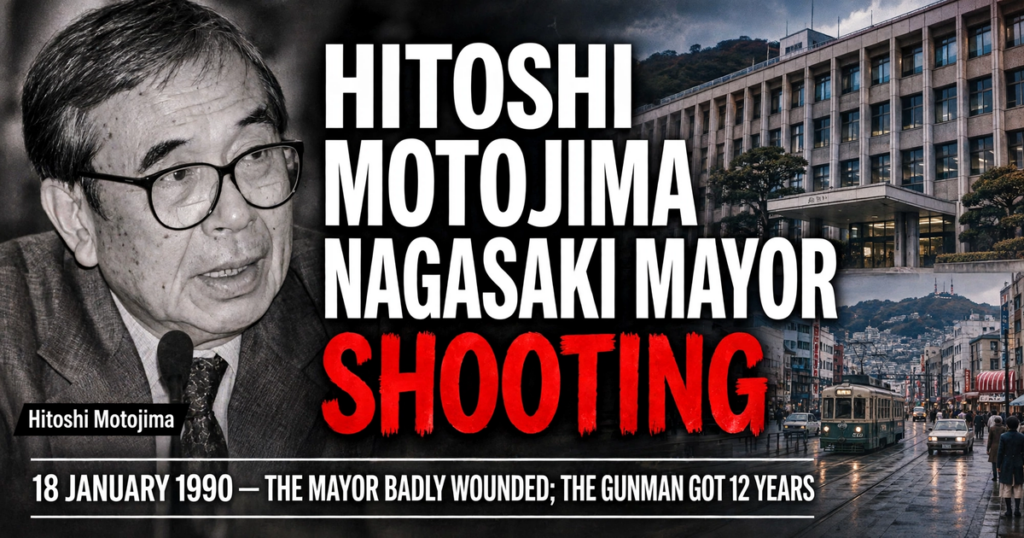
Nagasaki's mayor was shot outside City Hall
On January 18, 1990, Hitoshi Motoshima, then mayor of Nagasaki, was shot with a handgun near the entrance to Nagasaki City Hall. He suffered serious injuries but survived. The attack was an attempted murder, not a completed assassination. The shooting took place after a period of intense public controversy over Motoshima's comments about the wartime responsibility of Emperor Hirohito. The victim was a serving local-government leader, and the attack raised immediate concerns about the safety of elected officials and the protection of political speech. The case must also be distinguished from the separate 2007 shooting in which Nagasaki Mayor Iccho Ito was killed.
Motoshima's December 1988 remarks concerned the emperor's wartime responsibility
On December 7, 1988, Motoshima was asked in the Nagasaki City Assembly about the responsibility of Emperor Hirohito for the war. Drawing on his own experience in the military, he stated that the emperor bore responsibility. The remark attracted national attention and provoked strong criticism from people who rejected that historical and political position. Nagasaki's role as a city devastated by the atomic bombing gave the debate particular weight. Motoshima was speaking as a public official about a question of historical responsibility, and the controversy continued well beyond the assembly session.
The dispute escalated into threats and intimidation
The right-wing group Seikijuku opposed Motoshima's statement. Its activities and attempts to pressure media organizations were later discussed in the National Diet. The existence of political disagreement did not provide a lawful basis for violence against the mayor. Threats against a public official can create a climate in which security decisions become more difficult, but the legal question in the criminal case was whether a person had attempted to kill Motoshima. The political background helps explain why the mayor was targeted; it does not convert the shooting into a legitimate political act or establish that every action by the group was part of the attack.
The shooting followed the temporary removal of close protection
On January 18, 1990, after Motoshima's personal security detail had been temporarily withdrawn, he was shot near the entrance to City Hall. The attacker used a handgun at close range. The injuries required approximately a month of treatment, and the attack placed Motoshima's life in danger. The available public account does not require a more elaborate reconstruction of the exact movements of the mayor or the gunman than the evidence supports. What is established is that the mayor was attacked at the municipal building and survived serious gunshot injuries.
Kazumi Tajiri was prosecuted for attempted murder
The shooter was Kazumi Tajiri, who was associated with Seikijuku. Tajiri was prosecuted for attempted murder and related offences. The case concerned his individual criminal responsibility for shooting the mayor. The fact that he acted against the background of a political and historical dispute did not alter the legal classification of the conduct. Motoshima was injured but did not die, so the central offence was attempted murder. The distinction matters because some later accounts loosely describe the incident as the 'murder of a mayor', which would incorrectly suggest that Motoshima was killed.
The Nagasaki District Court imposed twelve years in prison
In December 1990, the Nagasaki District Court sentenced Tajiri to twelve years' imprisonment. The court treated the attack as a grave attempt to take the life of a public official. The sentence was not a death sentence, and Motoshima's survival was a legally significant fact. The judgment addressed the criminal act and the resulting injuries rather than deciding whether the mayor's remarks about the emperor were historically correct. That separation between political debate and criminal violence is central to understanding the case.
The appeal was dismissed and the sentence became final
Tajiri appealed, but the appeal was dismissed and the twelve-year sentence became final. The matter was also discussed in the House of Representatives Legal Affairs Committee on March 8, 1991, where members raised questions about the shooting and the activities of Seikijuku. Parliamentary discussion is a separate record from the criminal judgment. It provides evidence of the public and governmental response, but it should not be treated as a substitute for findings made by the court in Tajiri's trial.
The attack was not the 2007 murder of Mayor Iccho Ito
Nagasaki experienced a separate mayoral shooting in April 2007, when Mayor Iccho Ito was shot and killed. That case involved a different victim, a different year and a different offender. The 1990 case involved Hitoshi Motoshima, who survived, and resulted in a conviction for attempted murder with a twelve-year sentence. The similar descriptions of the two events can lead to confusion in databases and news summaries. Keeping them separate is essential to preserving the correct victim count, legal charge and outcome.
The case remains a reference point for political speech and public safety
The Motoshima shooting demonstrates the danger that can arise when political disagreement is turned into physical intimidation. A mayor's historical assessment may be criticized, challenged or rejected in public debate. It cannot lawfully be answered by an attempt to kill the speaker. The case also illustrates why the criminal proceedings, the parliamentary discussion and the broader history of the right-wing group must be treated as separate sources. The established judicial outcome is a twelve-year sentence for attempted murder, not a murder conviction and not a judgment on the historical merits of the mayor's statement.
Original Japanese record: 本島等長崎市長銃撃事件|天皇の戦争責任発言から1990年の狙撃まで
Last updated:
Related articles
Case record
The Nagasaki Abduction and Killing of a Four-Year-Old Boy: A Twelve-Year-Old Child, Juvenile Protection, and Destroyed Court Records
Case record
The Murder of Nagasaki Mayor Iccho Ito: From a Death Sentence to Life Imprisonment
Case record
The Nagasaki Stalking Murders: Two Family Members Killed, Three Police Forces Criticised and a Final Death Sentence
Case record