
The Saga Seven Women's Murders: Seven Unresolved Deaths and Three Charges Ending in Acquittal
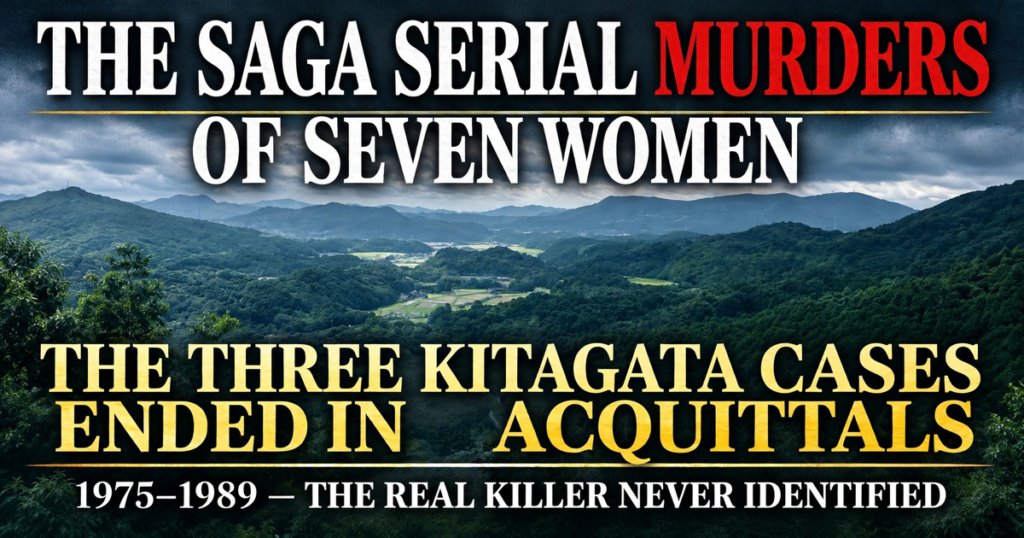
Seven women were killed in Saga Prefecture between 1975 and 1989, but no court established that one person committed all seven murders. A man charged with the final three Kitagata cases was acquitted in 2005; the Fukuoka High Court upheld the acquittal in 2007.
Seven women's deaths became known by one collective name
Between 1975 and 1989, seven women were killed in several parts of Saga Prefecture, including areas around Kishima District, Takeo and Miyaki District. The victims did not all have the same age, family circumstances or daily routines. Some disappeared on Wednesdays, and strangulation was suspected in several cases. The geographic proximity and these similarities led the incidents to be grouped under the name 'the Saga Seven Women's Murders' and to the media nickname 'the Wednesday Strangler'. That collective name, however, is not a judicial finding that one person committed all seven murders. The evidence and investigative circumstances differed from case to case, and no court established a single offender responsible for the entire series.
The seven cases did not share a single proven pattern
The first case occurred in 1975, when a twelve-year-old girl disappeared in Kitagata; her body was found several years later, in 1980. Other women disappeared or were found dead in nearby districts over the following years. One of the later early-series cases involved an eleven-year-old girl who disappeared in February 1982 and was found the next day. The victims' ages, the locations where they were last seen and the time before their bodies were discovered varied. In some cases, the passage of time made it difficult to establish the precise place or time of death, the route taken by a perpetrator or the cause of death. Similarities were important investigative leads, but they were not enough by themselves to prove that all seven deaths were connected.
Three bodies discovered in Kitagata in January 1989 became a separate prosecution
On January 27, 1989, the bodies of three adult women were discovered in woodland in the former town of Kitagata. The three had disappeared at different times: one in July 1987, another in December 1988 and the third in January 1989. Because the bodies were found in the same general location, investigators had strong reasons to examine whether the killings were connected. These three deaths became known as the Kitagata cases. They were the only three of the seven deaths that were later prosecuted together against one defendant. The earlier four cases were not included in that indictment. The fact that all seven incidents were later grouped under one title should not obscure this crucial difference in the scope of the criminal proceedings.
A man was arrested in 2002 and charged with the three Kitagata murders
More than thirteen years after the three bodies were found, police arrested a man on June 11, 2002. He had known one of the victims. Prosecutors indicted him for one murder on July 2 and added the other two cases through further indictments on July 7 and July 30. The prosecution argued that he had killed all three women and abandoned their bodies in the same wooded area. It relied on his connections with the victims, statements made during earlier questioning and other circumstantial evidence. The prosecution sought the death penalty. The defendant denied committing the murders. The trial was not a prosecution for all seven deaths; it concerned only the three women whose remains had been found together in Kitagata.
A written statement from an earlier interrogation became central to the case
A major issue was a written statement in which the defendant had appeared to admit the three killings. The statement had been prepared in 1989 while he was detained in connection with a separate stimulant-drug case. The defense argued that prolonged questioning, pressure and leading information from investigators had shaped the account. The statement's details were also challenged because they did not consistently match the physical circumstances of the deaths, the disposal of the bodies and other objective facts. The court examined whether the account contained information that only the perpetrator could have known and whether it was independently corroborated. A confession is not reliable simply because it is written in the first person or appears to acknowledge guilt.
The Saga District Court excluded the confession-related documents and acquitted the defendant
On September 16, 2004, before the final judgment, the Saga District Court ruled that the confession-related written statements and records would not be admitted as evidence. The court found that the remaining evidence did not directly connect the defendant to the three murders. On May 10, 2005, it acquitted him of all three charges. The prosecution had sought the death penalty, but the court concluded that the remaining circumstantial evidence did not prove guilt beyond a reasonable doubt. The judgment also identified serious problems in the investigation, including unlawful aspects of the questioning and poor handling of evidence. It did not declare that the three women had not been murdered; it found that the prosecution had failed to prove that this defendant was the killer.
The Fukuoka High Court upheld the acquittal in 2007
The prosecution appealed, but the Fukuoka High Court dismissed the appeal on March 19, 2007. The appellate court maintained that the evidence did not establish the defendant's guilt in the three Kitagata murders. The prosecution did not take the case further, and the acquittal became final when the appeal period expired on April 2, 2007. This was not a Supreme Court judgment. The legal result was an acquittal by the district court, affirmed by the high court, followed by the prosecution's decision not to appeal again. The defendant was therefore not a convicted serial killer who was later released; he was acquitted of the three charges brought against him.
All seven murders remain unresolved, and the earlier cases cannot be revived
The acquittal did not identify another perpetrator. The three Kitagata murders remain unsolved, and the four earlier deaths were never included in the prosecution of the acquitted man. The limitation periods for the earlier cases had already expired under the law then in force. Although Japan abolished the limitation period for murder in 2010, the reform did not revive cases whose limitation periods had already expired. It is therefore inaccurate to describe all seven murders as the proven work of one offender or to say that the acquitted defendant was responsible for them. The current legal position is that seven women were killed over fourteen years, the man charged in the final three cases was acquitted, and the offender or offenders have not been identified.
Original Japanese record: 佐賀女性7人連続殺人事件|北方事件3件の無罪と、崩れた自白立証の20年
Last updated:
Related articles

Same case · Feature
The Saga Murders of Seven Women: The So-Called “Wednesday Strangler” — From a Death Sentence Demand to Acquittal as the Confession Case Collapsed
Case record
The Kiyoshi Okubo Murders: Eight Women Killed in Forty-One Days

Case record
The Katsuta Kiyotaka Serial Murders: The Reported 22-Victim Confession, Eight Judicially Established Deaths and the Nationwide No. 113 Investigation

Case record