
The Shinjuku West Exit Bus Arson: Six Deaths and a Life Sentence After Diminished Capacity Was Found
A man set fire to a Keio Teito bus at Shinjuku Station on August 19, 1980, killing six people and injuring fourteen. The court found intent to kill but also diminished capacity, reducing the selected death sentence to life imprisonment.
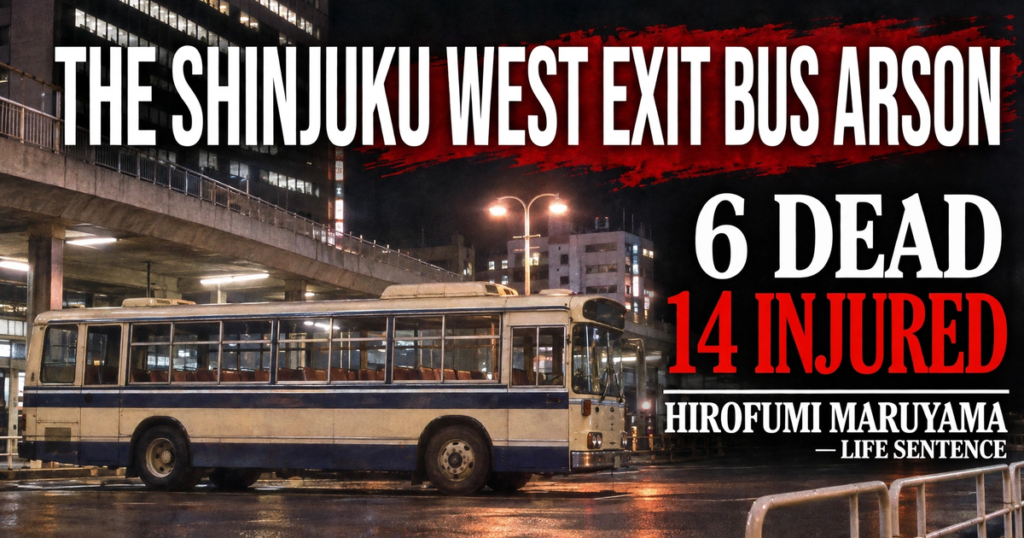
A bus waiting at Shinjuku Station was set on fire
At about 9:08 p.m. on August 19, 1980, a Keio Teito Electric Railway route bus waiting at the west exit of Shinjuku Station caught fire. The bus was bound for the Nakano depot and had more than thirty passengers aboard. Six people died and fourteen were injured, including thirteen passengers and the driver. The fire was not caused by a vehicle malfunction. The person who set it was Hirofumi Maruyama, a thirty-eight-year-old construction worker. The attack occurred in a busy transport hub and exposed passengers who had no connection to Maruyama to an immediate and severe danger.
Maruyama had bought gasoline several days earlier
The gasoline used in the attack was not purchased in a sudden decision immediately before the fire. On the night of August 15, Maruyama bought ten litres at a service station in Shinjuku and concealed it in a planting strip along the central divider near the road west of Keio Department Store. The Tokyo District Court did not find that he had already decided at that time to burn a passenger bus. It rejected both the defense's explanation that he had bought the gasoline as a gift for his workplace and the prosecution's claim that he had specifically planned a bus attack four days in advance. The court found that he had intended to set some kind of fire to attract public attention.
A dispute over a coin locker preceded the choice of the bus
On the evening of August 19, Maruyama returned to Shinjuku Station and tried to retrieve a bag from a coin locker. The rental period had expired, the bag had been moved to storage and the lock had been changed. Maruyama misunderstood the situation and believed that his belongings had disappeared. The district court treated this incident, together with earlier experiences in which he felt mocked or publicly reprimanded, as part of the immediate emotional build-up. He retrieved the gasoline he had hidden, transferred some of it to a bucket and selected the bus waiting nearby. The court did not treat the exact choice of the bus as a long-settled plan made at the time of the gasoline purchase.
The fire killed six passengers and injured fourteen people
Maruyama approached the bus carrying a container of gasoline and a burning newspaper. He threw the burning paper through the rear exit and spread approximately 3.8 litres of gasoline inside the vehicle. The fire spread rapidly through the passenger compartment. Six people died, and fourteen others were injured. One survivor, Mitsuko Sugihara, was thirty-six at the time and suffered severe burns over much of her body. The number of casualties reflects the fact that the bus was occupied and stopped at a public station. The court rejected the suggestion that Maruyama had not understood that people were inside. The bus was illuminated, and the passengers were visible.
The court found intent to kill but not complete loss of responsibility
At trial, the defense argued that Maruyama had been so emotionally disturbed that he could not properly recognize the bus or the passengers. It also argued that he had thrown the burning newspaper into the bus only because it had begun to burn his hand. The Tokyo District Court rejected the claim that he lacked intent to kill. It found that he recognized the presence of passengers and understood that they could die in the fire. However, the court also examined his mental condition, including delusions that welfare officials were pursuing or persecuting him, limited intellectual ability and the effects of alcohol. It found that his ability to judge and control his actions had been substantially impaired.
The death sentence selected by the court was reduced to life imprisonment
On April 24, 1984, the Tokyo District Court selected the death penalty for the murder offence, but then applied the mandatory reduction required for an offender whose capacity was diminished. Under the Penal Code provision then in force, the sentence was reduced to life imprisonment. The judgment did not say that the crime was minor or that Maruyama lacked all criminal responsibility. It found that he had intent to kill and that the consequences were exceptionally grave, but that his ability to act in accordance with his understanding of right and wrong had been significantly reduced. The distinction between insanity, which would have excluded criminal responsibility, and diminished capacity, which reduced the sentence, was decisive.
Both sides appealed, but the life sentence became final
The prosecution appealed because it sought the death penalty, while the defense also appealed and continued to contest the assessment of responsibility. On August 26, 1986, the Tokyo High Court dismissed both appeals and maintained the life sentence. Maruyama served his sentence at Chiba Prison. He died in custody in October 1997. Later reporting described his death as a suicide. The final sentence was therefore life imprisonment, not a death sentence. The case is often summarized as a six-death arson attack followed by a life sentence, but the legal reasoning is more specific: the court found intent to kill, rejected a complete loss of responsibility and applied the statutory reduction for diminished capacity.
The survivor's account and victim-support history remain part of the record
Sugihara survived with severe burns and later wrote about her treatment, daily life and attempts to understand the person who had attacked the bus. Her account does not excuse Maruyama's conduct; it documents the long consequences of the injuries and the work of rebuilding a life after the fire. The crime also occurred during an important period in the development of victim-support policy. Japan's Crime Victims' Benefit Payment Act had been promulgated on May 1, 1980, before the bus attack, and came into force on January 1, 1981. The law was not created because of this bus fire; the Mitsubishi Heavy Industries bombing and other earlier events were among the reasons for the system. The Shinjuku attack nevertheless exposed the practical difficulties victims faced during the period before the new law took effect.
Original Japanese record: 新宿西口バス放火事件|6人死亡、死刑求刑から「心神耗弱」で無期懲役となった理由
Last updated:
Related articles
Case record
The 2008 Akihabara Attack: Seven Deaths and the Supreme Court's Sentencing Decision
Case record
The Mitsubishi Heavy Industries Bombing and the East Asia Anti-Japan Armed Front's Corporate Bombing Campaign
Case record
The Fukagawa Random Murder Attack: Four Deaths, a Seven-Hour Hostage Crisis and Diminished Responsibility
Case record