
The Kabukicho Love Hotel Murders: Three Deaths and a Surviving Victim in 1981
Three women died in separate Kabukicho hotel incidents between March and June 1981. A fourth woman survived a similar attack. No court established that one offender committed all four incidents.
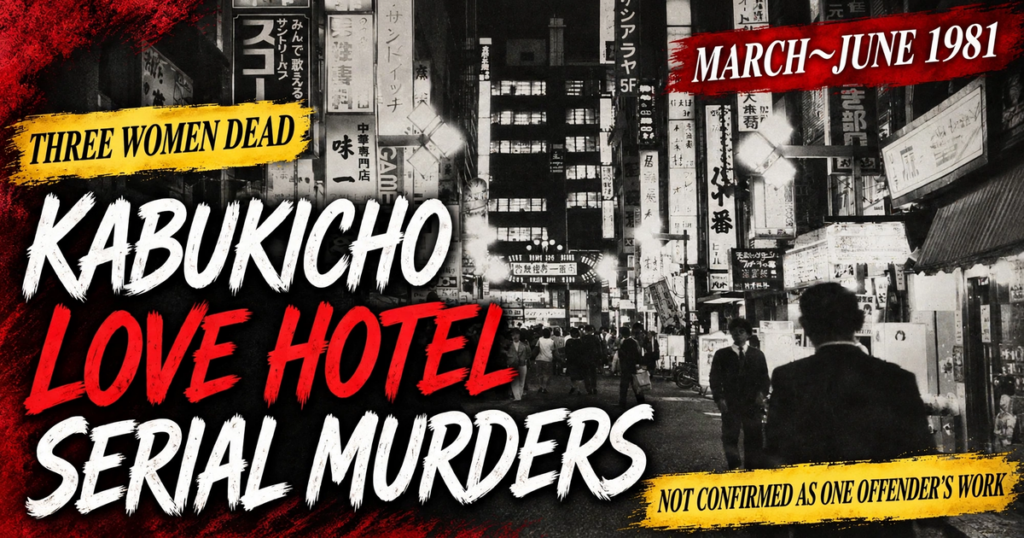
Four incidents were discussed as a connected series
Between March 20 and June 25, 1981, a series of incidents occurred in love hotels in Kabukicho, Shinjuku Ward, Tokyo. Three women died after entering hotel rooms with male companions, and a fourth woman survived a similar attack. The similarities in location, the presence of a male companion and the use of strangulation led investigators and later reporting to discuss the incidents together as the Kabukicho Love Hotel Murders. The name describes the investigative and historical grouping. It does not mean that a court established one serial offender or that all four incidents resulted in a death.
The first woman was found dead at the New El Sky hotel
The first case came to light on March 20, 1981, at a hotel called New El Sky. A forty-five-year-old woman was found dead in a room after entering with a man believed to be in his twenties. The man reportedly left the hotel alone. The woman had been strangled, and later reports stated that stimulant substances were detected in her body. The available public account does not identify the man or establish his connection to the later incidents. The first case nevertheless became one of the events examined for similarities with the deaths that followed.
The second victim at Koka Palace remained unidentified
On the night of April 25, a young woman was found dead at another hotel, Koka Palace. Later accounts estimated her age at around twenty. She had entered with a man, who left without her. The woman had been strangled with pantyhose or a similar stocking garment. Reports also stated that stimulant substances were detected. Unlike the first victim, the second woman's identity was not established in the public record. The absence of a confirmed identity made it harder to reconstruct her movements, relationships and the people she had met before entering the hotel.
A seventeen-year-old died after the June 14 incident
The third fatal incident occurred on June 14 at a hotel called Higashioka. A seventeen-year-old girl entered with a man, and the man later left alone. Accounts state that when hotel staff checked the room, the girl still showed signs of life, but she died during the subsequent response and transport. The cause of death was attributed to strangulation. Later reports described the man as young and wearing a suit. The sequence of events and the age of the victim distinguished this incident from the first two, even though the setting and general method appeared similar.
A fourth woman survived an attack on June 25
On the night of June 25, a thirty-year-old woman entered a hotel in Kabukicho with a man she had met in the district. He attempted to strangle her, but she resisted and survived. The man reportedly took cash and fled. The survivor's account was potentially important because she had seen the attacker directly. The incident occurred in the same district, within days of the third death, and involved an apparently similar method. However, the identity of the man in the surviving woman's case was not established as the same person involved in the three deaths.
Similarities and differences both matter
The three fatal cases shared a broad pattern: a woman entered a hotel with a man, the man left, and the woman was found strangled. Reports of stimulant substances in the victims also became a point of comparison. But the details were not identical. The first victim was forty-five and identified; the second was young and remained unidentified; the third was seventeen and was found alive before dying during the response. The surviving woman was thirty and escaped. The men's descriptions were not fully consistent, and the handling of personal belongings differed. Similarities justified investigation; they did not prove that one person committed every offence.
The serial-murder label is not a judicial finding
No defendant was prosecuted and convicted for all three murders as a single series. The public record does not show a criminal judgment establishing that one man committed the three deaths or the fourth attack. It is therefore inaccurate to describe a named serial killer or to treat every later hotel incident in Kabukicho as part of the same series without evidence. The distinction between a police theory, a grouping used in reporting and a fact established at trial is especially important in a case where no trial took place.
The old fifteen-year limitation period expired
At the time of the 1981 murders, the applicable prosecution limitation period for murder was fifteen years. In the absence of a legally recognized reason to suspend or interrupt the period, the three murder cases reached their deadlines during 1996. Japan later abolished the limitation period for murder in 2010, but the new rule applied to cases whose limitation periods had not already expired. It did not revive the completed deadlines in these cases. The three deaths remain unresolved, the fourth woman survived, and the identity of the person or persons responsible has not been judicially determined.
Original Japanese record: 新宿歌舞伎町ラブホテル連続殺人事件|女性3人死亡、同一犯未確定のまま時効
Last updated:
Related articles
Case record
The Nishitokyo Deaths of a Mother and Her Three Children

Case record
The Hachioji Supermarket Murders: Three Victims and an Investigation Still Open
Case record
The 1977 Cyanide Cola Murders: Two Deaths and an Unproven Link to a Separate Poisoning
Case record