
The Gunma Family Murders: Three Victims and the Search for Hiroshi Kogure
Three members of the Ishii family were killed in Mitsudera, Gunma, on January 14, 1998. Police continue to seek Hiroshi Kogure, who is wanted on suspicion of murder.
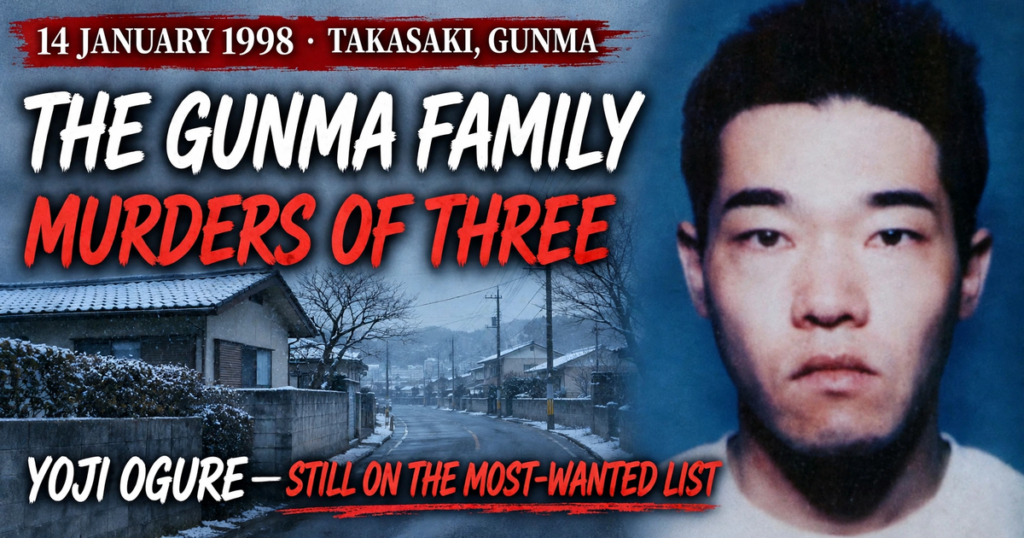
Three members of the Ishii family were killed
On the night of January 14, 1998, three members of the Ishii family were killed at their home in Mitsudera, then part of Gunma Town in Gunma District and now within Takasaki City, Gunma Prefecture. The victims were Takeo Ishii, aged forty-eight; his wife Chizuko, also forty-eight; and Takeo's mother, Tome, aged eighty-five. Their twenty-year-old daughter survived. Police identified Hiroshi Kogure, born on July 31, 1969, as a suspect and sought him on suspicion of murder. He has not been apprehended, and no criminal trial has determined his responsibility.
Kogure had known the daughter through her workplace
The relationship between Kogure and the surviving daughter predated the murders. According to her later account, she worked at a drugstore to which Kogure came as a delivery worker. He began asking her to go out with him. She accepted one invitation, but during the outing he drove in a direction away from her home, an experience that made her uncomfortable. She then declined further invitations. This account is based on the daughter's later interviews; it is not a finding made in a criminal judgment, because Kogure has never been tried.
Following and unwanted contact continued before the murders
The daughter later described being followed by car after work and receiving silent telephone calls at both her workplace and home. These incidents made her fear that Kogure was monitoring her movements. Shortly before January 14, he abruptly left his delivery job and stopped appearing at the drugstore. The daughter initially felt relieved, believing that the unwanted approaches might have ended. The police investigation later treated the alleged pattern of one-sided pursuit as relevant background to the killings. It is important, however, to distinguish the daughter's account and the police theory from facts tested in court.
The daughter encountered Kogure after returning home
On the night of the murders, the daughter returned to the family home and began climbing the stairs. She later said that someone grabbed her arm from behind. The person was Kogure. She called out loudly, hoping that her parents or grandmother would hear her, but no one came. Kogure took her toward her grandmother's room and restrained her while telling her, in substance, that he liked her. She resisted, broke free and Kogure left the house by car. When she moved through the home, she discovered that members of her family had been attacked. This account is drawn from her later testimony to journalists.
The bodies were found in different parts of the house
Reports described the bodies of the three victims as being found in the bathroom and in a closet or storage space. Police said that Takeo and Chizuko appeared to have been stabbed, while Tome was believed to have been strangled. The family had been attacked before the daughter returned. The daughter herself was not killed. These details help explain why the case is recorded as the murder of three family members, rather than as an attack on the daughter alone. A detailed description of the injuries is not necessary to understand the sequence, and the precise circumstances remain matters for an eventual criminal proceeding if the suspect is arrested.
A nationwide wanted notice became a priority search
Gunma Prefectural Police issued a nationwide wanted notice for Kogure on suspicion of murder. He was later included among suspects designated as priority wanted by the National Police Agency, a status used for serious cases in which police forces across Japan coordinate efforts to locate the person. Police publish his original photograph, dental charts showing treatment features recorded in 1995, and several age-progressed illustrations showing possible appearances with different hairstyles, facial hair, glasses and hair colour. The official description gives his height as approximately 170 centimetres. Such images are investigative aids, not proof that a person who resembles them is Kogure.
The legal context of stalking in 1998
The events took place before Japan's Stalking Regulation Act came into force. The statute was promulgated on May 24, 2000, and became effective on November 24, 2000, more than two years after the Gunma murders. Its later framework created specific police warnings, protective measures and criminal provisions for repeated stalking behaviour. Its absence in 1998 does not mean that every unwanted act was lawful: particular conduct could still have been assessed under other criminal or civil provisions if the relevant elements were established. The later statute cannot simply be applied retroactively to conduct from 1998. The distinction matters because modern descriptions of stalking should not be mistaken for a charge that was available under the same statutory framework at the time.
The current wanted status and the unresolved case
The National Police Agency's September 11, 2026 reward advertisement offers a public reward of up to three million yen for information leading to Kogure's location, arrest or resolution of the case. The current application period is November 1, 2026, through October 31, 2027. Kogure remains a suspect, not a convicted offender. The murder prosecution was not time-barred when the 2010 reform abolished the limitation period for murder, so the case remains legally capable of prosecution if the suspect is found and sufficient evidence is obtained. The three deaths, the daughter's survival and the years of alleged unwanted contact remain central to the investigation, but the motive and full sequence have not been tested at trial.
Original Japanese record: 群馬一家3人殺害事件|長女への付きまといの末に家族3人が死亡、小暮洋史は今も重要指名手配
Last updated:
Related articles
Case record
The Okegawa Stalking Murder: A Woman's Repeated Appeals for Help, Police Failures and a Final Life Sentence
Case record
The Nagasaki Stalking Murders: Two Family Members Killed, Three Police Forces Criticised and a Final Death Sentence
Case record
The Torigoe 2-Chome Murder and Arson: The Killing of an Indian Jewelry Worker and the Search for Diwakar Sethia
Case record