
The Assassination of Inejiro Asanuma: Political Violence at a Public Election Meeting
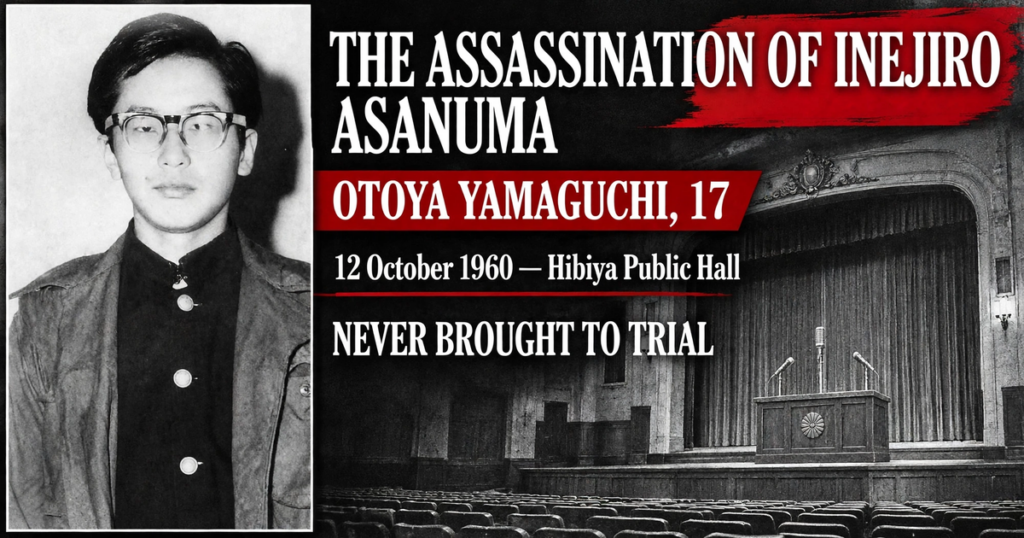
On October 12, 1960, seventeen-year-old Otoya Yamaguchi attacked Japan Socialist Party chairman Inejiro Asanuma during a televised political meeting in Tokyo. Asanuma died while being taken to hospital. Yamaguchi died in juvenile detention before the juvenile proceedings could be completed.
A party leader killed during a public political meeting
On October 12, 1960, Inejiro Asanuma, chairman of the Japan Socialist Party, was speaking at Hibiya Public Hall in Tokyo during a public meeting attended by the leaders of three political parties. The meeting took place ahead of a general election and drew a large audience and members of the press. Seventeen-year-old Otoya Yamaguchi ran from the audience onto the stage and stabbed Asanuma with a blade. Asanuma was taken toward Hibiya Hospital but died on the way. Yamaguchi was seized at the scene.
The political climate in the months before the assassination
Asanuma had become chairman of the Japan Socialist Party in March 1960, succeeding Suzuki Mosaburo. He had been active in labor and socialist politics before and after the Second World War and was a prominent opponent of the revised Japan–United States security treaty. The treaty debate had produced intense political conflict and mass demonstrations. The assassination occurred in that atmosphere, but the political context alone does not establish the full motive of the attacker or the involvement of any other person.
The attack was recorded by television cameras and press photographers
Broadcast cameras were present at the meeting, and the rush onto the stage and the stabbing were recorded. Newsreel footage preserved by the Broadcast Programming Center of Japan documents the event and the immediate reaction. A photograph taken by Mainichi Shimbun photographer Yasushi Nagao, capturing the moment of the attack, became one of the best-known press images of postwar Japan. The existence of these recordings makes the physical attack unusually well documented. It does not, however, answer every question about preparation, motive or possible assistance.
Yamaguchi was seventeen and entered the juvenile justice system
Yamaguchi was seventeen at the time. He was not immediately prosecuted as an adult in an ordinary district-court trial. Under the juvenile procedure then in force, his case entered the juvenile justice system, and he was placed in the Tokyo Juvenile Classification Home. In Japan, juvenile cases are generally referred to a Family Court, which decides the appropriate disposition. If the Family Court considers criminal punishment appropriate, it can refer the case to prosecutors for criminal proceedings. Yamaguchi died before that process could be completed.
Yamaguchi died in detention on November 2, 1960
On November 2, 1960, about three weeks after the attack, Yamaguchi died by suicide inside the Tokyo Juvenile Classification Home. His death meant that the Family Court could not complete its proceedings and that no subsequent criminal trial could be held. There was no conviction, sentence or judicial determination of his criminal responsibility. The recorded attack and the absence of a judgment are not contradictory: the first is documented by contemporary images and eyewitness accounts, while the second reflects the fact that the accused died before the judicial process was completed.
Political motive and personal responsibility were never tested in court
Yamaguchi had been involved in right-wing activity and was reported to have held strong hostility toward Asanuma's political position. Contemporary newsreel descriptions also characterized him as an anti-communist youth. Those descriptions help explain how the event was understood at the time, but they are not the equivalent of findings made after a trial. Because Yamaguchi died, no court assessed the relationship between his political beliefs and the attack, the degree of planning, his mental capacity or whether anyone else had assisted him. Later claims about a wider conspiracy must therefore be distinguished from established facts.
The assassination prompted debate about political violence and public security
Asanuma's murder during a public political meeting raised questions about the safety of political leaders, the protection of public assemblies and the threat posed by extremist violence. The National Diet later discussed right-wing violence and measures to prevent political terrorism. The incident also became a defining moment in the history of the Japan Socialist Party and postwar political debate. Asanuma had been a nationally recognized political figure, and his death removed a party leader at a moment of intense conflict over Japan's security policy.
What the surviving record can and cannot establish
The principal records include contemporary newsreels, press photographs, parliamentary proceedings and materials relating to Asanuma's political career. These sources establish the date, location, victim, attacker and immediate sequence of the attack. They do not provide the equivalent of a trial record. In particular, there was no courtroom testing of Yamaguchi's statements, no cross-examination about possible accomplices and no judgment resolving the full motive. An accurate historical account must preserve both sides of that record: the attack itself is clearly documented, while some questions about its background remain judicially unresolved.
Original Japanese record: 浅沼稲次郎暗殺事件|演説中の刺殺と17歳・山口二矢、裁判に至らなかった政治家暗殺
Last updated:
Related articles
Case record
The Yoshinobu-chan Kidnapping and Murder: A Failed Ransom Exchange and a Death Sentence
Case record
The Soka Jiro Incidents: Bombings, Threats and the Unidentified Signature
Case record
The Norio Nagayama Case: Four Murders and the Origins of Japan's Death Penalty Sentencing Standard
Case record