
The 1977 Cyanide Cola Murders: Two Deaths and an Unproven Link to a Separate Poisoning
Two people died after consuming contaminated cola in Tokyo in January 1977. A related poisoning in Osaka was never conclusively linked to the same offender.
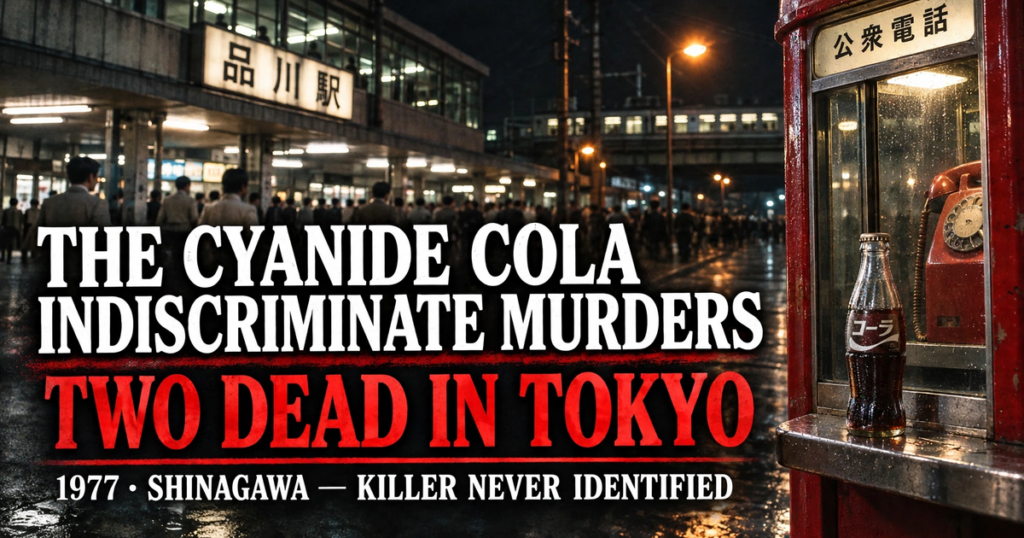
Two people died after drinking cola left near Shinagawa Station
Late on January 3 and into January 4, 1977, bottles of cola were found near public telephones around Shinagawa Station in Tokyo. A 16-year-old high-school student drank from one bottle after a co-worker took it from a telephone booth and brought it to their accommodation. He became ill and died from cyanide poisoning. On the following morning, a 46-year-old worker was found collapsed nearby. A bottle close to him also tested positive for cyanide, and he died. The Tokyo incidents therefore caused two confirmed deaths.
A third poisoned bottle was recovered before anyone drank it
Police searched the area around the first two locations and found another bottle of cola containing cyanide beneath a red public telephone at a shop approximately 600 metres to the southeast. A 15-year-old member of the shop owner's family had noticed it and intended to drink it later. Police recovered the bottle before it could cause another poisoning. Two people died, but at least three contaminated bottles were identified in the immediate Tokyo investigation. The third bottle did not create a third victim, and it should not be counted as a death.
Investigators traced bottles, production and possible poison sources
The police assigned approximately sixty-five investigators to the case, according to TBS archival reporting. They searched the surrounding area, examined the manufacturing and distribution of the cola bottles and investigated businesses that handled cyanide compounds, including metal-plating facilities. The numbers on bottle caps and other product details were used to narrow the manufacturing range. Later reporting described the large number of bottles produced in the relevant period. The inquiry did not lead to an arrest or prosecution.
A similar poisoning in Osaka did not establish a third Tokyo victim
About forty days after the Tokyo deaths, on February 13, 1977, a 39-year-old office worker in Osaka drank cola that had been left near a public telephone. He lost consciousness but survived. Cyanide was detected in the bottle. TBS archival reporting, however, notes that the Osaka incident was not identified as the work of the same offender as the Tokyo deaths. The man who survived in Osaka should not be counted as a third person killed in Tokyo, and the Osaka incident should not be described as a proven continuation of the same criminal series.
Poisoned chocolate was found in Tokyo the following day
On February 14, the day after the Osaka poisoning, chocolate containing cyanide was found at locations including the Yaesu underground shopping area near Tokyo Station and Kanda Station. But the presence of a similar poison does not by itself establish that one person was responsible. The Tokyo chocolate incidents, the Osaka cola poisoning and the two Tokyo cola deaths were investigated and discussed in relation to one another, yet no court identified a single perpetrator across them. The three categories should be presented as related or similar incidents whose common authorship remained unproven.
The offender and motive were never established
Investigators examined where cyanide compounds could have been obtained, the manufacturing and distribution of the bottles and the circumstances in which the drinks were left near public telephones. Various theories about the offender and motive appeared in later reporting. None resulted in an arrest, indictment or judicial finding. The evidence establishes that poisoned drinks were placed in public locations and that two people in Tokyo died after consuming them. It does not establish who placed the bottles, why they did so or whether the Osaka and chocolate incidents were committed by the same person.
The Tokyo killings reached the limitation deadline in 1992
The murder offences occurred in January 1977. Under the law then in force, the prosecution limitation period for an offence punishable by death was fifteen years. The Tokyo case therefore reached the limitation deadline in 1992 without anyone being charged. In 2004, the limitation period for certain serious crimes was extended from fifteen to twenty-five years, but the transitional rules did not revive cases whose earlier period had already expired. In 2010, Japan abolished the limitation period for certain fatal offences, including murder, and applied the reform to some cases that were still within the old period. The Tokyo cola case had already become time-barred in 1992.
The 2010 abolition did not reopen a case already time-barred
The distinction between the 2004 and 2010 reforms is important. The 2004 change lengthened some limitation periods but did not extend them for offences whose original period had already expired before the new law took effect. The 2010 reform removed the limitation period for specified fatal crimes, including murder, but its transitional provisions did not restore prosecution in cases where the period had already been completed. Because the Tokyo cola murders were time-barred in 1992, the later reforms did not make it possible to bring a murder prosecution decades afterward.
The phrase 'serial murders' can obscure the legal distinctions
The case has appeared under several labels, including the Cyanide Cola Murders and the Cyanide Cola Serial Murders. The broader wording may suggest that every similar poisoning in Japan was committed by one person. The confirmed Tokyo death toll is two. The third bottle was recovered before consumption; the Osaka victim survived; and the chocolate incidents were not conclusively linked to the Tokyo offender. They define what can be stated as established fact and what remains a theory about a possible connection. The name of a case should not silently convert a suspected relationship into a proven series.
What remains is an unsolved double poisoning with an expired prosecution period
The Tokyo case remains unresolved. No one was arrested or convicted for the two deaths, and the offender's identity and motive are unknown. The 1992 limitation deadline means that the 2010 abolition of limitation periods did not restore the possibility of prosecution. The Osaka poisoning and the poisoned chocolate remain similar incidents whose connection to the Tokyo deaths was not judicially established. It is that investigators could trace products and possible chemical sources without identifying the person who placed the bottles. The final record must preserve the two confirmed deaths and the uncertainty surrounding the wider group of incidents.
Original Japanese record: 青酸コーラ無差別殺人事件|東京で2人死亡、同一犯未確定の大阪・青酸チョコと時効
Last updated:
Related articles
Case record
The Soka Jiro Incidents: Bombings, Threats and the Unidentified Signature
Case record
The 1985 Paraquat Poisoning Cases: Poisoned Drinks, Vending Machines and 78 Reported Incidents
Case record
The 1995 Tokyo Subway Sarin Attack: Victims, Criminal Trials and a Continuing Legacy
Case record