
The Mitaka Railway Incident: Six Deaths and a Fourth Retrial Petition in 2026
Six people died when an unattended train crashed at Mitaka Station in 1949. The grandson of the sole convicted defendant filed a fourth retrial petition in February 2026.
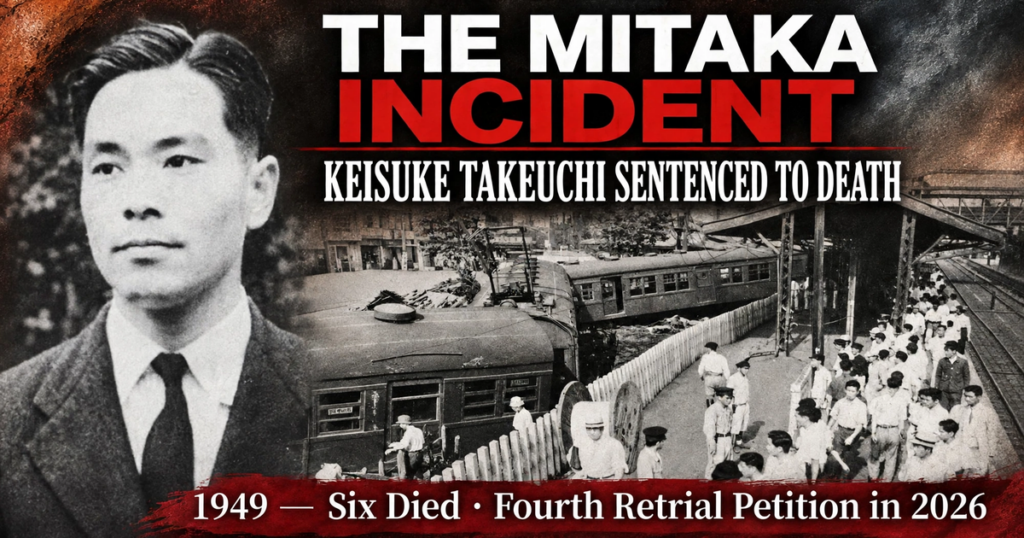
An unattended train left the Mitaka rail yard and entered the station
At about 9:23 p.m. on July 15, 1949, a seven-car electric train moved out of the Japanese National Railways Mitaka rail yard without a driver. It travelled approximately 660 metres, accelerated to more than 60 kilometres per hour and entered Mitaka Station. The train passed the stopping point, broke through the buffer stop and ran into the station-front area. Six people died and many others were injured. Investigators treated the event as a deliberate act rather than an ordinary accident because railway equipment had been manipulated. The central question became who had made the train capable of moving and whether one person could have carried out all the necessary operations.
Ten railway employees were prosecuted, but the courts convicted only Takeuchi
Police and prosecutors focused on railway employees and arrested ten workers. The prosecution initially alleged that they had acted together. The Tokyo District Court's judgment on August 11, 1950 did not accept that collective theory. It acquitted nine defendants and found Keisuke Takeuchi guilty as the sole offender, imposing life imprisonment. The nine acquittals remained in place through the appeal proceedings. The conviction of Takeuchi alone became the basis of the later death sentence and the subsequent retrial petitions.
The Tokyo High Court changed the punishment to death
The prosecution appealed, arguing that the life sentence was too lenient, while Takeuchi challenged his conviction. On March 30, 1951, the Tokyo High Court maintained the finding that Takeuchi had acted alone but changed the sentence from life imprisonment to death. The court did not restore the prosecution's original theory of a joint offence involving all ten railway employees. The Supreme Court's Grand Bench dismissed Takeuchi's final appeal on June 22, 1955. A later application to correct the judgment was rejected in December, and the death sentence became final. Reports have noted that the Supreme Court decision was divided, with an eight-to-seven vote.
The final judgment depended on a confession that changed over time
Takeuchi's statements changed during the investigation and trial. He initially denied involvement, then made a statement on August 20, 1949 accepting that he had acted alone. At other points he described a joint offence, and during the trial he alternately accepted and denied aspects of the prosecution's account. The final judgment did not rely on one statement in isolation; it considered the confession alongside physical evidence, witness accounts and the condition of the train. Later retrial applicants argued that the changing statements undermined the reliability of the confession.
The pantograph photographs became a technical issue in the retrial proceedings
A major point of dispute concerned photographs taken after the crash that showed the pantograph on the second car. The final judgment's account of the offence involved Takeuchi operating the leading car and raising the pantograph so that the train could move. The retrial applicants argued that the second car's pantograph might also have been raised before departure, which could suggest that the train's operation required actions beyond the sequence attributed to a single person. They also examined the hand brake, headlights and door-interlock equipment on other cars. The unresolved question was when the photographed condition arose: before the train moved or after the collision and derailment.
The 2019 High Court decision did not accept the technical evidence as sufficient
On July 31, 2019, Tokyo High Court rejected an immediate appeal in the second retrial proceeding. It concluded that the second car's pantograph might have been raised by the impact of the collision and that the new material did not create reasonable doubt about the final judgment. It assessed whether the condition visible in them necessarily existed before the train departed. The applicants' argument was that the technical evidence undermined the single-offender theory; the court considered that possibility but found it did not meet the legal threshold for starting a retrial when combined with the older evidence. The Supreme Court proceedings ended in April 2024 without a retrial being ordered.
Takeuchi died in custody before his first retrial request was decided
Takeuchi filed his first retrial request in February 1956. He died at Tokyo Detention House in 1967 while the request was pending, and the proceeding ended after his death. Japanese law allows certain relatives to continue seeking a retrial after a convicted person has died, so the effort to review the judgment continued through his family. His death in custody is sometimes confused with an execution, but he was not executed. The sentence remained legally final even though it was never carried out.
A third request ended after the petitioner died; a fourth was filed in 2026
Takeuchi's son filed a second retrial request in November 2011. The courts rejected it, and the Supreme Court process ended in April 2024. The son then filed a third request, but he died in October 2025 and that proceeding ended. On February 4, 2026, Takeuchi's grandson filed a fourth retrial request with Tokyo High Court. The new application again focuses on the changes in Takeuchi's statements and the technical questions surrounding the train's controls and pantographs. Supporters say that expert opinions on confession psychology and railway engineering have been submitted.
A fourth retrial request does not mean the conviction has been overturned
The Japanese source article's latest factual reference is August 26, 2026. As of that date, no order granting a retrial had been issued. The conviction and death sentence remained legally in force while his grandson sought permission to reopen the case.
The case still turns on the gap between a final judgment and the possibility of new evidence
The Mitaka Incident remains one of Japan's most contested postwar criminal cases. Six people died when an unattended train entered the station, but the person who carried out the sabotage has not been identified independently of the final conviction against Takeuchi. The courts found him guilty as a sole offender, while later applicants have challenged the confession and the technical feasibility of that account. The fourth retrial petition keeps the evidence under legal scrutiny, but it has not changed the judgment. A careful account must hold both facts together: the conviction remains final, and the family continues to seek a retrial.
Original Japanese record: 三鷹事件|竹内景助の死刑判決と自白の変遷、2026年の第4次再審
Last updated:
Related articles
Case record
The Teigin Bank Poisoning: Twelve Deaths and a Conviction Challenged for Decades
Case record
The Kodaira Murders: Ten Murder Charges, Seven Convictions and a Postwar Pattern of Predation
Case record
The Ookayama–Senju Serial Murders: A Confession-Led Indictment, Then Two Other Men
Case record