
The Tottori Suspicious Deaths: Two Robbery-Murder Convictions and Death in Custody
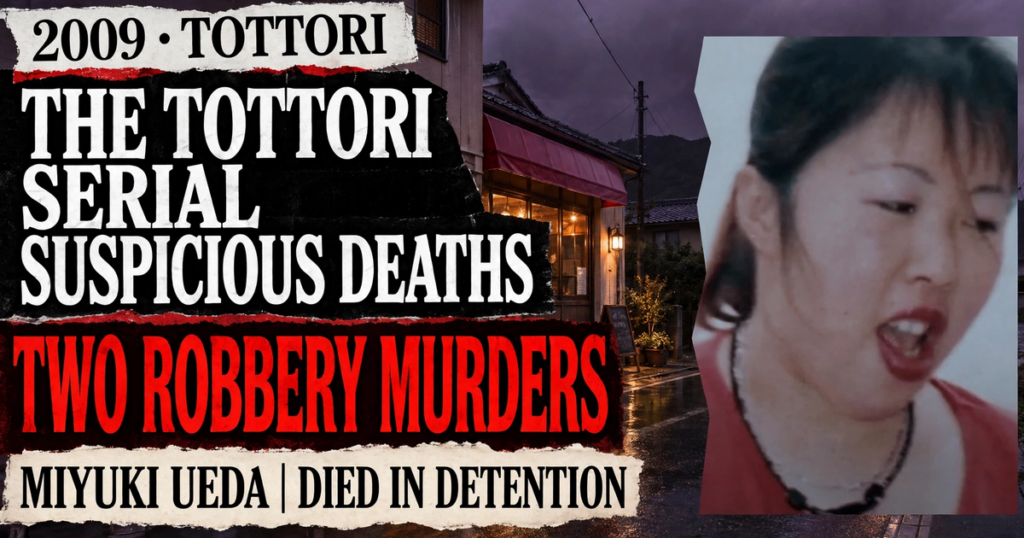
Miyuki Ueda was convicted of two financially motivated killings. She died in custody in 2023 without her death sentence being carried out.
Two men were convicted as murder victims, not every suspicious death
The case became known as the Tottori Suspicious Deaths because several men connected with Miyuki Ueda died in 2009. The final criminal judgment, however, established two robbery-murders: those of Kazumi Yabe, aged 47, and Hideki Maruyama, aged 57. Other deaths around Ueda were investigated or discussed in reporting, but they were not added to the murder convictions. The distinction matters because the death sentence was imposed for two specific killings, not for every death that occurred among her acquaintances. The two victims had different financial relationships with Ueda, and the courts examined the evidence for each death separately.
Kazumi Yabe was killed after a loan came due
Yabe had previously been in a relationship with Ueda and had lent her money. In March 2009, a written loan document recorded a debt of approximately 2.7 million yen, with repayment due at the end of that month. On April 4, Ueda met Yabe and, according to the court's findings, gave him sleeping medication or similar substances that left him disoriented. She then led him into the sea near the coast of Hokuei in Tottori Prefecture, where he drowned. His body was later found in the sea, and toxicological testing detected drug components. The court found that Ueda acted to avoid repaying the debt.
Hideki Maruyama was killed over unpaid appliance bills
Maruyama operated an electrical-appliance business in Tottori City. He had sold Ueda several appliances, including a washing machine, on deferred payment. The outstanding amount was approximately 530,000 yen. After contacting Ueda on October 6, 2009, Maruyama disappeared. The following day, his body was found in the Mani River in Tottori City. The court found that Ueda had given him sleeping medication or similar substances and led him into the water, causing him to drown. As with Yabe, the prosecution argued that the killing was intended to avoid a financial obligation. The two cases shared a pattern, but the court considered the evidence relating to each victim individually.
A fraud arrest led investigators back to the two deaths
Ueda was first arrested on November 2, 2009, in connection with a fraud investigation involving her and a man who lived with her. The arrest was not initially for either murder. As investigators examined the fraud allegations, they also revisited the deaths of Yabe and Maruyama. The post-mortem examinations had detected sleeping-medication components in both victims. Police examined how Ueda could have obtained the substances, who had last been in contact with the men, the debts and payments, and what Ueda had been doing after each disappearance. She was later arrested and indicted for the two robbery-murders. She denied killing either man throughout the criminal proceedings.
The prosecution relied on multiple circumstantial facts
No witness testified to seeing Ueda physically kill either man. The prosecution relied on toxicology, the victims' financial relationships with Ueda, their last contacts, and evidence about her movements after the disappearances. A man who lived with Ueda testified that he saw her alone shortly after the disappearances and that her body was wet. The defence challenged his credibility and suggested that he might have been involved. The Supreme Court later considered whether his account was consistent with objective evidence, including the drugs, debts and timing. The courts did not treat wet clothing or the presence of sleeping medication as conclusive in isolation; they assessed those facts together.
The District Court imposed death for the two robbery-murders
On December 4, 2012, the Tottori District Court's lay-judge panel found Ueda guilty of the two robbery-murders and imposed the death penalty. The court also considered fraud, theft and trespass charges. It found that Ueda had planned the killings to avoid repayment and payment obligations, and that she repeated the method on a separate occasion after the first killing. The court gave weight to the fact that two men had been killed at different times and in different locations, and that the motive was financial. The death sentence was not imposed simply because two people had died or because other suspicious deaths had been reported.
The Supreme Court made the death sentence final in August 2017
The Hiroshima High Court's Matsue Branch dismissed Ueda's appeal on March 20, 2014. On July 27, 2017, the Supreme Court's First Petty Bench dismissed her final appeal. The correction procedure ended on August 23, 2017, when the death sentence became final. The distinction between the Supreme Court's decision date and the date of finality is important. Ueda was then held as a person under a final death sentence at Hiroshima Detention House. The sentence was never carried out.
Ueda died in custody in January 2023, not by execution
On January 14, 2023, Ueda choked while eating in her room at Hiroshima Detention House. Staff attempted to remove the obstruction and she was taken to hospital, where she was pronounced dead. She was 49. Her death was caused by choking, not by execution. The two robbery-murder convictions and the final death sentence remained the legal outcome, but the sentence was never carried out. The case should therefore be described as a final death sentence followed by death in custody. It is inaccurate to say that Ueda was executed or to add other suspicious deaths to the two murders established by the courts. The final death sentence remained legally in force, but it was never carried out. This distinction is part of the case's final procedural history.
Original Japanese record: 鳥取連続不審死事件|矢部和実さん・圓山秀樹さん強盗殺人、死刑確定と拘置中死亡
Last updated:
Related articles
Case record
The Greater Tokyo Suspicious Deaths: How Circumstantial Evidence Established Three Murders

Case record
The Osaka Dog-Lover Serial Murders: Five Victims and the Death Sentence of Yoshinori Ueda

Case record
The Omuta Four Murders: A Family's Robbery and Killing of Four Victims, and Four Death Sentences
Case record