
The Kiyoshi Okubo Murders: Eight Women Killed in Forty-One Days
Eight women were murdered in Gunma in 1971. A missing woman's family provided a lead that helped expose the series.
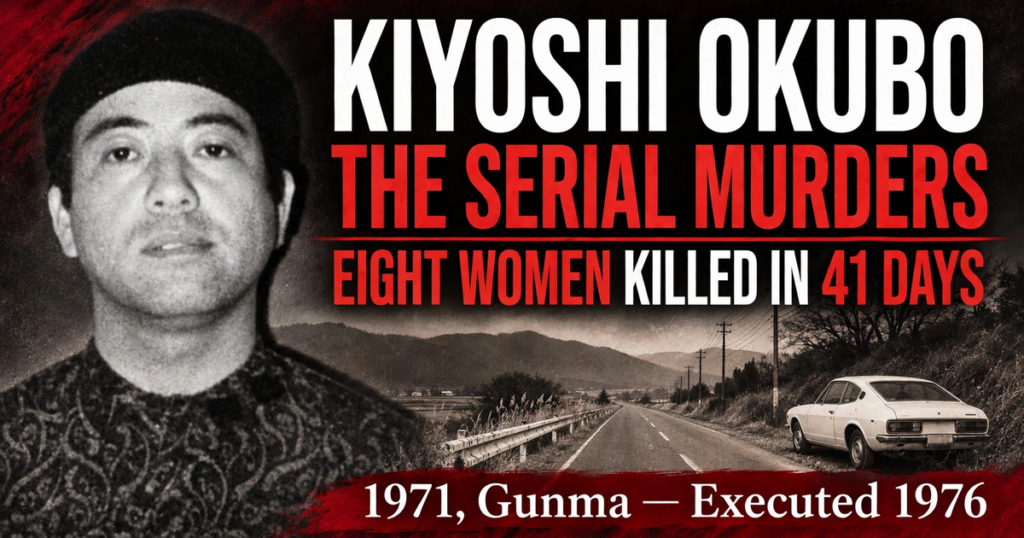
Eight young women disappeared in forty-one days
Between March 31 and May 10, 1971, eight women aged 16 to 21 were killed in separate incidents in Gunma Prefecture. Kiyoshi Okubo was 36. He had been released from Fuchu Prison in March and began driving around the prefecture in a white passenger car, approaching young women and inviting them to become models for paintings or photographs. He sometimes presented himself as an artist, poet or teacher. The victims did not all disappear from one location or on the same day. The murders formed a series over 41 days. Investigators later found that Okubo had also committed sexual offences against other women, so the eight murders were only part of the conduct examined in the criminal proceedings.
A white car and false occupations became recurring features
Okubo used the white car to approach women in public places. He offered rides or spoke about modelling, art and other subjects that could make him appear respectable. The Japanese source records that, during the roughly 73 days between his release and his detention, he approached 127 women and more than 30 entered the car. That figure does not mean that all of those women were victims of murder or sexual offences. It describes the scale of his repeated approaches. The investigation had to distinguish the eight women who were killed from the larger number of people who encountered him. His use of different occupational claims was part of the way he gained trust and moved between locations.
A family's search for a missing woman identified the car
The breakthrough began when a 21-year-old woman disappeared in early May. Her family and acquaintances searched for her. Her brother found her bicycle at a credit-union bicycle parking area. A white car arrived, and a man approached the bicycle before driving away. The brother remembered details of the vehicle, including part of its registration number. Investigators used that information to identify the owner as Okubo. Police were already concerned because of his criminal history and his recent release from prison. The family's observation connected a particular vehicle and person to a missing woman, giving the search a concrete lead rather than relying only on general descriptions of a suspect.
Searchers detained Okubo on May 13; police arrested him the next day
On the evening of May 13, 1971, members of the search party, including relatives and acquaintances of the missing woman, located Okubo and his white car in Maebashi. They restrained him and handed him over to police. Gunma Prefectural Police formally arrested him on suspicion of murder on May 14. The distinction is important: May 13 was the date he was found and detained by the searchers; May 14 was the formal arrest by police. After the arrest, Okubo began making statements about the women he had encountered. Investigators searched locations in Gunma, including wooded and developing areas, based on his statements.
The remains of all eight women were found
The searches led to the recovery of the remains of all eight women who had disappeared. The discoveries established that the missing-person cases were connected to a series of murders and abandonment of remains. The killings had taken place at different locations over several weeks, rather than as one incident. Investigators also questioned other women whom Okubo had approached and examined sexual offences separate from the murders. This distinction matters because the number of women he approached was far larger than the number of murder victims. The criminal case ultimately addressed eight murders, the handling of the remains and separate sexual offences against other women.
The trial included rape and injury offences as well as murder
The first hearing took place at Maebashi District Court on October 25, 1971. Okubo admitted the charged facts. The indictment covered the eight murders and related offences, as well as rape and rape causing injury involving other women. The case was therefore not limited to the deaths of the eight victims. The court examined the repeated approach to young women, the circumstances in which they were taken in the car, the killings and the separate sexual offences. Because Okubo admitted the charges, the central question was not whether the prosecution could identify him as the offender. The proceedings focused on the seriousness of the conduct, his criminal responsibility and the appropriate punishment.
The death sentence became final without an appeal
On February 22, 1973, Maebashi District Court sentenced Okubo to death. He did not appeal within the prescribed period. As a result, the District Court judgment became final without review by the Tokyo High Court or the Supreme Court. This is a significant procedural point. The sentence was not upheld by the Supreme Court, and Okubo did not withdraw an appeal after filing one. He simply failed to appeal the first-instance judgment before the deadline expired. The final sentence was therefore the District Court's death judgment, which became final when the appeal period passed.
Okubo was executed in January 1976
Okubo was transferred to Tokyo Detention House after the sentence became final. His execution took place on January 22, 1976, when he was 41. The case is remembered for the concentration of eight murders in 41 days, but the investigation also showed how one family's search for a missing daughter helped connect separate disappearances. The white car and the partial registration number supplied a specific lead. The family's role did not replace police investigation; it gave investigators information that could be checked and developed. The case also illustrates why an accurate record must separate the eight murder victims from the larger number of women Okubo approached and from the separate sexual offences tried in court.
Original Japanese record: 大久保清連続殺人事件|41日間に女性8人を殺害、控訴せず死刑確定・1976年執行
Last updated:
Related articles
Case record
The Katsuta Kiyotaka Serial Murders: The Reported 22-Victim Confession, Eight Judicially Established Deaths and the Nationwide No. 113 Investigation
Case record
The Genzō Kurita Murders: The Osenkorogashi Family Killings and Two Death Sentences

Case record
The Isesaki Junior-High-School Girls Murders: Robbery, Arson and a Death Sentence

Case record