
The Tochigi Lynching Murder: Two Months of Captivity, a Failed Rescue and the Police Negligence Ruling
Nineteen-year-old office worker Masakazu Sudo was abducted on September 29, 1999, held for about two months and killed on December 2. Three young offenders received prison sentences. In a separate damages case, courts found police investigative negligence but distinguished that finding from proof that proper action would certainly have prevented the murder.
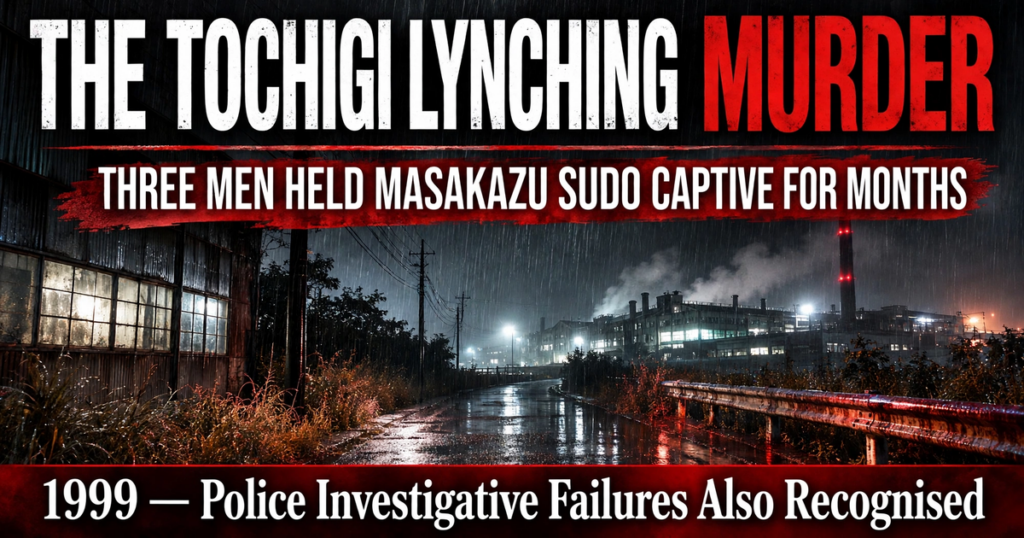
A nineteen-year-old employee was taken away in September 1999
On September 29, 1999, Masakazu Sudo, a 19-year-old company employee in Tochigi Prefecture, was taken away by a group of young men around his own age. He did not return home. Over the following two months, the group moved him between locations, assaulted him and repeatedly demanded money. His family received calls and requests for funds that did not fit an ordinary absence from home. They became concerned that he was not acting freely and repeatedly asked police to locate and protect him. The case later became known as the Tochigi Lynching Murder because the prolonged violence and extortion ended in Sudo's death.
The group used repeated demands for money to maintain control
The young men made Sudo obtain money from relatives, acquaintances and financial sources. Records discussed in the Tochigi Prefectural Assembly indicate that the total amount demanded or obtained reached approximately seven million yen. The requests did not occur as one isolated transaction. Sudo remained away from home while the group continued to exert control over him. His family was trying to understand why he needed money and why he could not return. In the later civil lawsuit, the sequence of requests and the information given to police became important because they showed that the risk was not limited to a missing-person report. There were signs of coercion and possible violence while Sudo was still alive.
The family sought police help but could not secure his rescue
Sudo's family contacted police and asked them to establish his whereabouts and intervene. They were concerned that he might be under pressure or being held against his will. The state-compensation proceedings later examined what information had reached officers, when it was received and what investigative steps were taken. The issue was not whether police knew every detail of the offenders' conduct. It was whether the reports, money demands and other warning signs were sufficient to require a more active investigation. The family's repeated attempts to obtain help became a central part of the case. Sudo was not rescued during the period when the group was holding him.
Sudo was killed and buried in a wooded area on December 2
On December 2, 1999, Sudo was killed in a wooded area of Ichikai, Tochigi Prefecture, and his body was buried there. The criminal courts found that the offenders had subjected him to prolonged violence and financial demands and then killed him because they feared the crime would be exposed. The case came to light after a young man who had joined the group later went to police and surrendered. Investigators followed his statements and located the burial site. The fact that a participant came forward after Sudo's death, rather than the earlier family reports leading to a rescue, intensified public criticism of the police response.
Three young offenders received prison sentences
The central offenders were about 19 years old at the time of the crime. Three of them were prosecuted for their roles in taking Sudo, assaulting him, demanding money and killing him. The criminal proceedings resulted in substantial prison sentences, including life imprisonment for the principal offenders. Those proceedings determined the responsibility of the young men for the crimes. They were separate from the later lawsuit against Tochigi Prefecture. The distinction matters because a finding that the offenders committed murder does not, by itself, answer whether police conduct was unlawful or whether the prefecture must compensate the family.
The family brought a separate state-compensation lawsuit
After the criminal case, Sudo's family sought damages from Tochigi Prefecture, arguing that police had failed to investigate properly despite receiving information that should have raised concern for his safety. The lawsuit asked the civil courts to determine whether police officers had breached their investigative duties and whether that breach had caused Sudo's death. These were two distinct questions. A court could find that police had acted negligently without necessarily finding that a proper investigation would certainly have located Sudo and prevented the killing. The case therefore became an important examination of the legal limits of police responsibility when a person is being held and harmed by private offenders.
The first-instance court found negligence and a direct causal link
In April 2006, the Utsunomiya District Court found that the police response had been negligent and that the failure to investigate was causally connected to Sudo's death. It ordered Tochigi Prefecture to pay approximately 96.3 million yen in damages. The court considered that the information available to police should have alerted them to a serious risk to Sudo's life and that more effective investigation could have led to his rescue. The judgment was significant for the family because it recognised that the failure to act was not merely an administrative shortcoming. The prefecture appealed, and the Tokyo High Court took a different view of the causal link.
The High Court recognised negligence but assessed the rescue chance at about 30%
On March 28, 2007, the Tokyo High Court did not reject the finding of police negligence. It did, however, conclude that the family had not proved that appropriate police action would certainly have prevented the murder. The High Court assessed the possibility that Sudo could have been rescued at approximately 30 percent. It treated the loss of that possibility as a compensable injury and reduced the award to approximately 11 million yen. The 30 percent figure did not mean that Sudo was responsible for the remaining 70 percent, nor did it divide responsibility between the offenders and police. It was an assessment of the chance that proper investigation could have prevented the death.
The Supreme Court made the reduced award final in 2009
Sudo's family appealed the High Court judgment. On March 13, 2009, the Supreme Court's Second Petty Bench dismissed the family's appeal, leaving the High Court's judgment and the approximately 11 million yen award in place. The final ruling did not say that the police had acted properly. It maintained the finding of investigative negligence but did not recognise a sufficient legal causal link between that negligence and the death itself. The prefecture's liability was therefore limited to the loss of a chance of rescue. The case is remembered for two separate failures and responsibilities: the offenders' criminal violence, and the police's failure to respond adequately to information that might have enabled intervention.
Original Japanese record: 栃木リンチ殺人事件|須藤正和さんを救えなかった2か月と県警の捜査過失
Last updated:
Related articles
Same case · Feature
The Tochigi Lynching Murder: The SOS Reached the Police, but a 19-Year-Old Was Not Saved — Sixty-Five Days of Missed Warnings
Case record
The Akashi Mummified Remains Case: A Son Hid His Father's Death and Fraudulently Collected Pension Payments
Case record
The “Itadaki Joshi Riri-chan” Fraud Case: Romance-Based Deception, a Paid Manual, and a Final Sentence of Eight Years and Six Months

Case record