
The Tochigi Lynching Murder: The SOS Reached the Police, but a 19-Year-Old Was Not Saved — Sixty-Five Days of Missed Warnings
Masakazu Sudo, a 19-year-old factory worker, was confined, assaulted and forced to hand over money by three young men between September and December 1999. His family, colleagues and a bank repeatedly brought warning signs to the police. Sudo was killed on 2 December. The later civil proceedings produced different findings about police negligence and causation: the district court found a causal link to the death, while the High Court recognised a lost chance of rescue but not legal causation of the death itself. The Supreme Court left the High Court judgment in place.
Introduction: The warnings came from the family, the workplace and a bank
Masakazu Sudo was nineteen years old when he was confined, assaulted and forced to hand over money by three young men connected with his workplace. The offences began in late September 1999 and continued until 2 December. Sudo's family, colleagues and a bank all became aware of signs that he was in danger. They contacted the police more than once.
The first request for help was not simply a report that an adult son had failed to return home. His family told police that he might be the victim of extortion. Colleagues reported that he had been injured and was being made to obtain money. A bank saw him arrive with several men, his face and hand visibly injured, and contacted the family. The family then asked police to obtain and examine the bank's security footage.
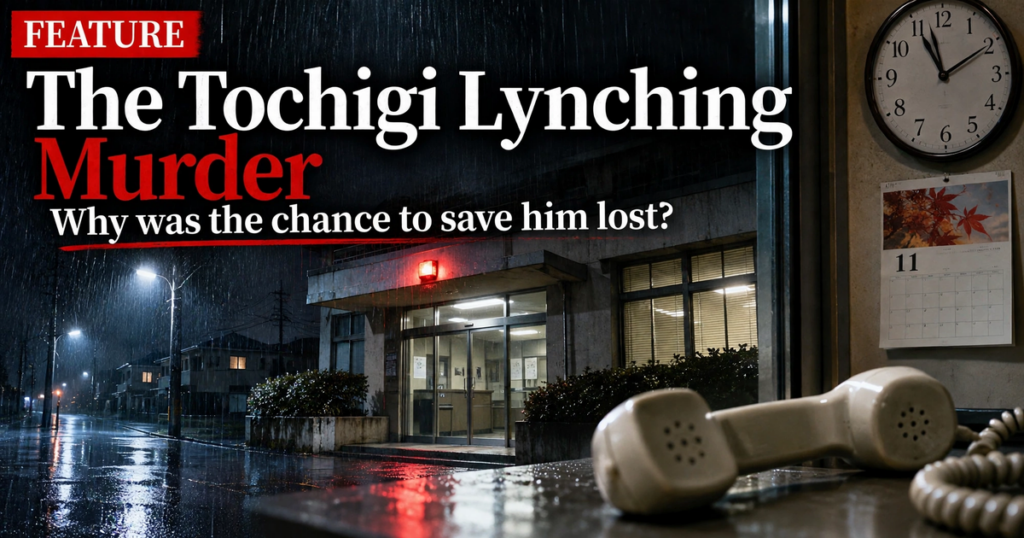
The warnings did not become an effective investigation. One officer who received a telephone call about the bank footage forgot about it and did not report it to a supervisor. On 30 November, an officer identified himself as a police officer during a telephone conversation with Sudo. The people holding Sudo learned that his family had contacted the police.
Sudo was killed in a wooded area in Tochigi Prefecture on 2 December 1999. The case later became a major example in discussions about police negligence and the responsibility of the state when officers fail to act on information indicating an imminent danger.
How the confinement began
Sudo was born on 6 May 1980. After graduating from high school, he joined a factory in April 1999. Court records described him as a diligent worker who saved 20,000 yen each month through an employee savings plan.
The central perpetrators were three nineteen-year-old young men connected with the same workplace. The principal offender had made associates borrow money from consumer-finance companies and used it for entertainment and other expenses. He then targeted Sudo as another source of money.
Sudo was given a false explanation that money was being demanded because of a traffic accident involving a member of an organised crime group. He was forced to withdraw his savings and borrow from consumer-finance companies. The court assessed the total financial loss at 6,033,000 yen. This included money obtained from friends and acquaintances, Sudo's savings, loans taken out in his name and money sent by his family. The perpetrators used the funds for entertainment, hotels, travel and other expenses.
The period of the offences was 29 September to 2 December 1999. Sudo did not remain absent from work for the entire period. He attended work for four days, from 5 to 8 October, but was then prevented from returning. The court found that the perpetrators moved him between hotels and other locations, threatened and assaulted him, and kept him under effective confinement.
On 18 October, the family asked police to search for him
On 18 October 1999, Sudo's parents visited Ishibashi Police Station with someone connected with his workplace and filed a missing-person report. They told the police that a gang member might be demanding money from him.
According to the Utsunomiya District Court judgment of 12 April 2006, the detective who first received the report understood from the family's account that Sudo might be a victim of extortion. That understanding was recorded in a violence-related consultation register. The information reaching police was therefore more than a statement that an adult son had not come home.
On 19 October, an officer interviewed a colleague and investigated the mobile-phone number of the person demanding money. By tracing the subscriber and billing information, police identified a person connected with the demand and learned that the person had a history of delinquency. The officer advised the colleague not to meet that person.
Sudo's father also visited the station on 19 October and said that he feared his son had become involved in a crime. He asked that the missing-person report not be withdrawn even if Sudo telephoned the police before returning home.
Other reports of injury and extortion reached the station
Sudo was repeatedly instructed by the perpetrators to telephone colleagues and acquaintances and borrow money. In early October, colleagues had begun to suspect that he was being taken from place to place and assaulted. They noticed injuries on his face and arms and saw that he seemed to be making requests for money at someone else's direction.
On 25 October, when Sudo met colleagues, the perpetrators surrounded the group and made him kneel and apologise while demanding money. His face was swollen, he appeared lifeless and he wore gloves that seemed to conceal injuries to his hands. The colleagues believed that he had been assaulted.
On 1 November, two colleagues accompanied by someone from the workplace went to Ishibashi Police Station. They reported that money had been handed over under threatening circumstances and that Sudo had been injured. The later district court judgment found that, if the officers had properly heard the details, they could have understood that Sudo was being assaulted and forced to obtain money.
These were not vague rumours. They were reports from people who had seen Sudo and had reason to believe that he was being controlled by others.
The bank saw his injuries, but the footage was not obtained
Between 22 and 25 November, the perpetrators took Sudo to banks in Tokyo and made him withdraw money from his own account. On 24 November, a bank employee saw that his face was swollen and that skin on the right side of his face and right hand had been scraped or burned. The injuries were visible.
The bank also became concerned about the people accompanying him. It checked the account activity and found that money deposited into Sudo's account was withdrawn by him on the same day, that several men accompanied him during the withdrawal and that he had visible injuries. The bank's security cameras recorded the visit.
On 25 November, the bank contacted Sudo's family. His family then telephoned the police station, explained that the bank had footage showing Sudo with several men and visible burns, and asked the police to obtain and review the recording.
The officer who received the call became occupied with another matter and forgot that the call had been made. The officer did not report it to a supervisor or another member of the station. The court treated this as a concrete example of important information from the family failing to become part of an organised investigation.
The footage could have helped establish Sudo's condition and identify the people accompanying him. It was a potentially useful lead for confirming his location and safety, but the necessary follow-up was not carried out.
On 30 November, a police officer spoke directly to Sudo
On 30 November, the family met relatives of the young men involved and told them that Sudo had borrowed large amounts of money, was moving around with the perpetrators and had been injured. The family then went to the police station again and asked officers to obtain the bank footage.
During the visit, Sudo telephoned his family's mobile phone. He said that the perpetrators had instructed him to ask for train fare so that he could return home. His family urged him to come back. Although he said that he wanted to return, his manner made it difficult to believe that he was speaking freely.
The family handed the phone to a police officer. The officer identified himself to Sudo as a police officer. A young man beside Sudo heard the conversation and told the perpetrators that the family had contacted the police. The district court found that, after this call, the principal offender feared that the police would discover what had happened. He dyed his hair and changed his appearance as part of an effort to escape detection.
The call was a critical moment. The police officer's identification made the perpetrators aware that the family had sought police help. But it would be inaccurate to say that the officer's words alone directly caused the murder. The 2006 Utsunomiya District Court judgment examined the subsequent vehicle accident, the perpetrators' fear of being discovered and the planning that followed. The Tokyo High Court later made a separate legal assessment of causation between police negligence and Sudo's death.
On 1 December, the perpetrators feared discovery; on 2 December, Sudo was killed
On 1 December, a vehicle driven by one of the young men involved in the offences was in a traffic accident. The other party reported it to police. The perpetrators were increasingly aware that Sudo's family was searching for him and that police might begin tracing the vehicle.
The Utsunomiya District Court judgment found that the principal offender believed that, if Sudo were found by police, the assaults and extortion would be exposed and the perpetrators would be arrested. He proposed killing Sudo to his associates, and they discussed the plan.
The police registration of a vehicle that Sudo might have been travelling in was not completed until 2 December. The court considered whether earlier registration might have allowed a vehicle inquiry to help establish his location.
On 2 December 1999, Sudo was killed in a wooded area in Tochigi Prefecture. According to the 2006 judgment, the perpetrators stripped him and strangled him with a necktie. They then abandoned his body in an attempt to conceal the crime.
The case began to unravel after one young man who had been acting with the perpetrators surrendered to the Tokyo Metropolitan Police on 4 December. Sudo's body was found on 5 December, and the principal participants were arrested. Approximately one month and a half had passed since his family first filed the missing-person report.
The criminal sentences imposed on the young men
The criminal proceedings addressed the responsibility of the young men who had confined, assaulted and killed Sudo. According to the procedural history recorded in the 2006 state-compensation judgment, the Utsunomiya District Court sentenced the principal offender to life imprisonment on 1 June 2000. The Tokyo High Court dismissed his appeal on 29 January 2001, and the judgment became final.
For the other two defendants, the Utsunomiya District Court delivered judgments on 18 July 2000. One received life imprisonment and the other an indeterminate sentence of between five and ten years. Those judgments also became final.
The criminal trials determined what offences the perpetrators had committed and what punishment they should receive. The later state-compensation case asked a different question: whether police officers had failed to exercise investigative powers despite knowing of the danger, and how that failure was legally connected to Sudo's death. The same incident was considered in two different types of proceedings, with different defendants and different issues.
The police response was raised in the Diet
On 16 November 2000, the response of Tochigi Prefectural Police was discussed in the House of Councillors Committee on Local Administration and Police. Diet member Susumu Yanase pointed to the missing-person report, repeated consultations and requests for investigation from the family, and the failure of Ishibashi Police Station to examine the possibility of a crime or to report the information properly to the station chief.
The chair of the National Public Safety Commission responded that it was regrettable that Ishibashi Police Station had not taken a sincere and proactive approach and that the result had been such a tragic incident. The National Police Agency also expressed the view that officers needed to stand in the position of the person seeking help and assess the background and potential development of the matter.
The Diet discussion shows that the issue was not treated merely as one officer's mistake. It raised questions about how police assess whether a consultation involves a crime, how information is shared within a station and how separate reports are combined into an overall assessment of danger. The public record does not support adding unverified dates or numbers for apologies or disciplinary action, so those details are not asserted here.
The family asked the courts to hold the prefecture responsible
Sudo's parents brought a damages action against the perpetrators, their parents and Tochigi Prefecture. The issue was not limited to the perpetrators' responsibility. The family argued that the police had failed to conduct necessary investigations even though they had repeatedly reported the danger, and that the prefecture should be liable under the State Redress Act.
Sudo's mother died on 11 September 2002 while the litigation was underway. His father and sister continued the family's claim. The prolonged proceedings added another burden to the family after the criminal case.
The civil case had to decide not only whether police had been negligent but also whether appropriate investigative action would have prevented Sudo's death. Negligence and legal causation are separate questions. A court can find that police failed in a duty without necessarily finding that the failure legally caused the death itself.
The Utsunomiya District Court found that police could have saved him
On 12 April 2006, the Utsunomiya District Court found that Tochigi Prefectural Police had been negligent in their investigation. It also found a causal relationship between that negligence and Sudo's death and ordered the prefecture to pay approximately 96.33 million yen.
The judgment did not simply say that police were responsible because the result was tragic. It examined the Police Act and the Police Duties Execution Act and considered the circumstances in which an officer may have a professional duty to exercise police powers. In general, such a duty may arise where an act harming life or bodily integrity is underway or a concrete danger is imminent, the officer knows or could readily know of the situation, exercising police powers could prevent the harm and the action is reasonably easy to take.
The court found that the danger to Sudo existed throughout the period of confinement and assault. In particular, on 1 November, proper interviews with the colleagues could have revealed that Sudo was being assaulted and forced to obtain money.
The court identified steps police should have taken: interviewing colleagues and acquaintances, investigating possible extortion or assault, locating the perpetrators and securing Sudo's safety. The workplace had already indicated a willingness to cooperate, so the court found no major obstacle to beginning those inquiries.
The district court concluded that there was a high probability that appropriate use of police powers would have secured the perpetrators and saved Sudo's life. It therefore recognised a causal connection between the police failure and the death.
The Tokyo High Court recognised a lost chance of rescue, not causation of the death
The Tokyo High Court reached a different conclusion on appeal on 28 March 2007. It continued to recognise police negligence but did not find that the negligence had a legally sufficient causal relationship with Sudo's death itself. Instead, it assessed that appropriate investigation might have prevented the crime with a probability of approximately thirty per cent and awarded compensation for the loss of that chance.
The expression "a thirty per cent chance of rescue" can be misunderstood. It does not mean that Sudo was only thirty per cent worthy of being saved, that he was responsible for the remaining seventy per cent or that the perpetrators' and police's responsibilities were divided into a ratio of three to seven. The court was assessing the probability that Sudo might have avoided being killed if police had acted properly.
The High Court considered that, even if an investigation had begun, the perpetrators were moving Sudo between locations, knew that a missing-person report had been filed and were changing where they stayed. It was therefore not certain that police would have found him before the murder. The court distinguished the unlawfulness of police inaction from proof that the inaction caused the death.
The family appealed to the Supreme Court. On 13 March 2009, the Supreme Court's Second Petty Bench dismissed the family's appeal. The Tokyo High Court judgment, recognising investigative negligence but denying causation of the death itself and awarding approximately 11 million yen for the lost chance of rescue, became final.
It is therefore inaccurate to say that the Supreme Court independently decided that the chance of rescue was thirty per cent. The Tokyo High Court made that assessment, and the Supreme Court's dismissal of the appeal left the High Court judgment in place.
Why did the warnings fail to become an investigation?
The central problem was not that police had received no information. The family, workplace, colleagues and bank had gradually supplied information indicating that Sudo might be the victim of a crime. The courts examined whether the police had connected those pieces of information and recognised the danger.
By 19 October, officers had investigated the identity of a person connected with the money demands and knew of a prior delinquency history. On 1 November, colleagues reported extortion and injuries. On 25 November, the family telephoned about bank footage showing Sudo with several men and visible injuries, but the call was not reported to a supervisor.
Information must be recorded, passed to the appropriate officers and connected with other reports if it is to lead to action. The failure in this case involved the organisation's handling of information after it was received.
The case does not mean that police have an absolute obligation to prevent every crime. The duty to exercise investigative powers depends on the imminence and specificity of the danger, the information officers knew or could have obtained, the measures available and the possibility of avoiding the harm. The Utsunomiya District Court considered those factors and found that the failure to act was unlawful in this case.
The continuing lesson is how to assess a missing-person report when there are also signs of extortion, injuries, coercive companions and unusual communications. A report should not be treated as an ordinary case of an adult who has chosen not to return home if the surrounding facts point to a serious risk.
Criminal responsibility and administrative negligence are separate
The Tochigi case involved two forms of legal responsibility. The perpetrators' criminal responsibility for confining, assaulting and killing Sudo was established through criminal judgments, including life sentences. The prefecture's responsibility concerned whether police had failed to exercise their powers despite receiving information about the danger.
The Utsunomiya District Court in 2006 found negligence and a causal relationship with the death. The Tokyo High Court in 2007 continued to find negligence but denied legal causation of the death itself, awarding compensation for the lost chance of rescue. The Supreme Court's dismissal of the family's appeal in 2009 made the High Court judgment final.
The difference between the district court and the High Court was not merely the amount of compensation. It concerned how far the law should recognise a causal relationship between the police failure and the death. Any account of the case must preserve that difference.
Sudo was held for approximately two months. His family and people at his workplace repeatedly sought help, and police had received some of the information. Those facts must be considered alongside the final legal conclusions rather than being replaced by a simplified statement that the police either had no responsibility or were legally responsible for the death itself.
At a glance
Victim: Masakazu Sudo, born 6 May 1980, aged 19. Period of offences: 29 September to 2 December 1999. Perpetrators: three nineteen-year-old young men connected with his workplace. Court-assessed financial loss: 6,033,000 yen. Murder: 2 December 1999, in a wooded area in Tochigi Prefecture. Criminal sentences: principal offender, life imprisonment on 1 June 2000; appeal dismissed on 29 January 2001; the other two received life imprisonment and an indeterminate sentence of five to ten years on 18 July 2000. State-compensation proceedings: Utsunomiya District Court, 12 April 2006, found negligence and causation and awarded approximately 96.33 million yen; Tokyo High Court, 28 March 2007, found negligence but denied causation of the death itself and awarded approximately 11 million yen for loss of a chance of rescue; Supreme Court, 13 March 2009, dismissed the family's appeal, leaving the High Court judgment final.
Original Japanese feature: 栃木リンチ殺人事件【特集】|警察へ届いていたSOS――19歳の青年を救えなかった65日間
Last updated:
Related articles
Same case · Case record
The Tochigi Lynching Murder: Two Months of Captivity, a Failed Rescue and the Police Negligence Ruling
Case record
The Akashi Mummified Remains Case: A Son Hid His Father's Death and Fraudulently Collected Pension Payments
Case record
The “Itadaki Joshi Riri-chan” Fraud Case: Romance-Based Deception, a Paid Manual, and a Final Sentence of Eight Years and Six Months

Case record