
The Tokyo–Saitama Child Abduction and Murder Case: Four Victims and a Long Trial Over Criminal Responsibility
Four girls aged four to seven were abducted and killed in Saitama and Tokyo between August 1988 and June 1989. Tsutomu Miyazaki was arrested in a separate child-sexual-offence case, convicted of the four murders, and executed in June 2008.
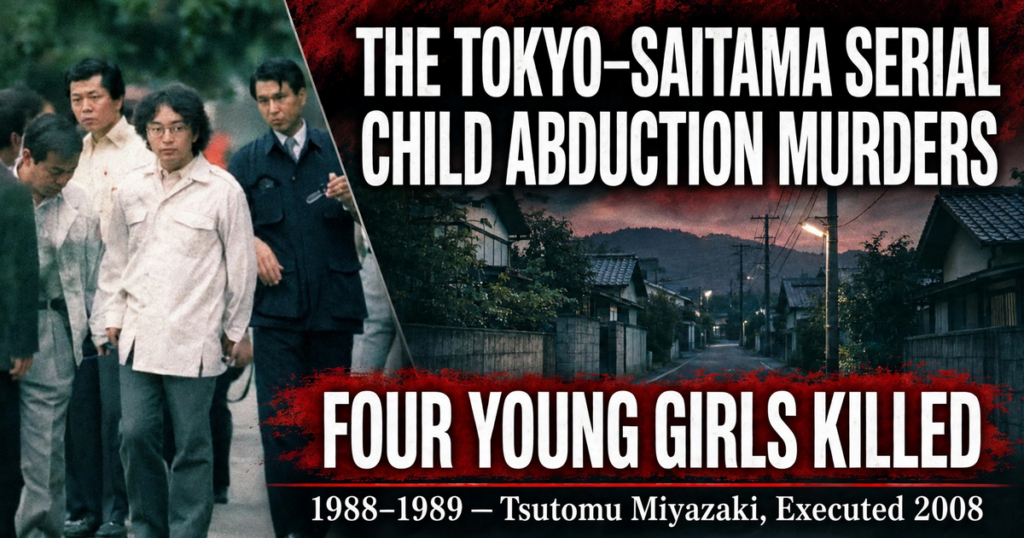
Four girls disappeared in separate incidents over ten months
Between August 22, 1988, and June 6, 1989, four girls aged between four and seven were abducted and murdered in Saitama Prefecture and Tokyo. The victims were Mari Konno (今野真理), aged four; Masami Yoshizawa (吉沢正美), aged seven; Erika Namba (難波絵梨香), aged four; and Ayako Nomoto (野本綾子), aged five. The incidents occurred in different municipalities and on different dates. The first disappearance was in Iruma City, Saitama, in August 1988. Another girl disappeared in Hanno in October, a third in Kawagoe in December, and the fourth in Koto Ward, Tokyo, in June 1989. The cases were later connected through the investigation of Tsutomu Miyazaki. Each disappearance involved a separate family, search and investigation.
Letters and remains sent to families and the media widened the case
In February 1989, several months after the first girl's disappearance, a box containing bone fragments was left at the home of one victim's family. Documents were also sent to media organizations, including the Asahi Shimbun, under the name 'Yuko Imada'. The letters appeared to refer to the series of crimes and attracted substantial public attention. They became part of the atmosphere surrounding the investigation, but they were not the only evidence considered in the later criminal trial. Investigators examined statements, disposal locations, belongings, photographs and video material to connect Miyazaki to each separate offence. The existence of a dramatic letter does not by itself establish who wrote it; the courts assessed it alongside the wider evidence.
Miyazaki was arrested in a separate case on July 23, 1989
The immediate breakthrough did not come from the four murder investigations. On July 23, 1989, Miyazaki was arrested in the Hachioji area after being caught committing a sexual offence against another young girl. That offence was separate from the four murders. During questioning, he made statements about another child's killing, and searches conducted in line with his statements led to the discovery of remains. Police in Tokyo and Saitama then pursued the connections between Miyazaki and the four earlier disappearances. He was not arrested at the outset for all four murders. The investigation developed case by case after the separate arrest, and prosecutors brought charges as evidence linking him to each victim was assembled.
The investigation connected the four cases through several kinds of evidence
Police examined the locations where the girls had disappeared, the places where remains or belongings were found, Miyazaki's movements and the statements he made after his arrest. The investigation also considered letters sent to families and media organizations, as well as photographs and video materials seized during searches. These items were not all of equal evidentiary value. The court had to determine whether each murder could be attributed to Miyazaki through reliable evidence, rather than assuming that a confession or one unusual item established every count. The four crimes had different dates, places and discovery histories. The final judgment treated them as separate acts within a series, and the prosecution had to connect the defendant to each one.
Psychiatric assessments disagreed about his condition
The trial began in March 1990 and continued for years. One major reason was the dispute about Miyazaki's mental condition at the time of the crimes. Psychiatric assessments offered differing views. Some described personality abnormalities while concluding that his ability to understand and control his conduct remained intact. Others discussed dissociative symptoms or psychiatric illness and considered whether his capacity had been diminished. The legal question was not simply what diagnosis could be assigned. The court had to determine whether he could understand the wrongfulness of his acts and act in accordance with that understanding. A psychiatric diagnosis and criminal responsibility are related but distinct concepts. The court examined his behaviour before, during and after the crimes as well as the expert reports.
The Tokyo District Court imposed a death sentence in 1997
On April 14, 1997, the Tokyo District Court sentenced Miyazaki to death. The court accepted the assessment that he had retained full criminal responsibility. It considered the repeated abductions and killings, the young ages of the victims, the way he approached them and his conduct after the crimes. The trial had involved 38 court sessions, and the time required to assess criminal responsibility was one reason the proceedings lasted so long. The court did not treat media speculation about his hobbies, reading or video collection as proof of motive or legal responsibility. The sentence was based on the evidence of the offences and the court's assessment of his capacity at the time.
The High Court and Supreme Court upheld the conviction
Miyazaki appealed. On June 28, 2001, the Tokyo High Court dismissed the appeal and maintained the death sentence. The High Court also upheld the conclusion that he had full criminal responsibility. On January 17, 2006, the Supreme Court's Third Petty Bench rejected his final appeal. The defence then filed an application to correct the judgment. That application was rejected in February 2006, and the death sentence became final. It is therefore more precise to distinguish the Supreme Court's dismissal of the appeal in January from the finality of the judgment after the correction application was rejected the following month.
Miyazaki was executed in June 2008
On June 17, 2008, Miyazaki's death sentence was carried out at Tokyo Detention House. He was executed along with two other people whose death sentences had become final. Questions about his psychiatric condition and the long trial continued to be discussed after the execution, including in parliamentary questions about the timing of executions and the status of possible retrial preparations. However, a lawyer's preparation for a retrial request is not the same as a court ordering a retrial. At the time of execution, the conviction and death sentence remained legally effective. The execution ended the state's power to carry out that sentence against Miyazaki, but it did not erase the harm to the four victims' families or the separate nature of each case.
Original Japanese record: 東京・埼玉連続幼女誘拐殺人事件|4人の女児被害と責任能力をめぐる長期裁判、宮崎勤の死刑執行
Last updated:
Related articles

Same case · Feature
The Tokyo–Saitama Serial Abductions and Murders: Tsutomu Miyazaki, Four Girls Killed and a Fifth Victim — Sixteen Years of Disputed Psychiatric Assessments
Case record
The Akira Nishiguchi Case: Five Murders, a Nationwide Manhunt and a Child's Crucial Observation

Case record
The Norio Nagayama Case: Four Murders and the Origins of Japan's Death Penalty Sentencing Standard
Case record