
The Matsumoto Sarin Attack: A Chemical Strike on a Residential Area and the First Reporter Who Came Under Suspicion
On June 27, 1994, Aum Shinrikyo members released sarin in a residential area of Matsumoto, killing eight people and affecting about 140 under the current official count. First reporter Yoshiyuki Kono and his family were exposed to the nerve agent but became the focus of early suspicion.
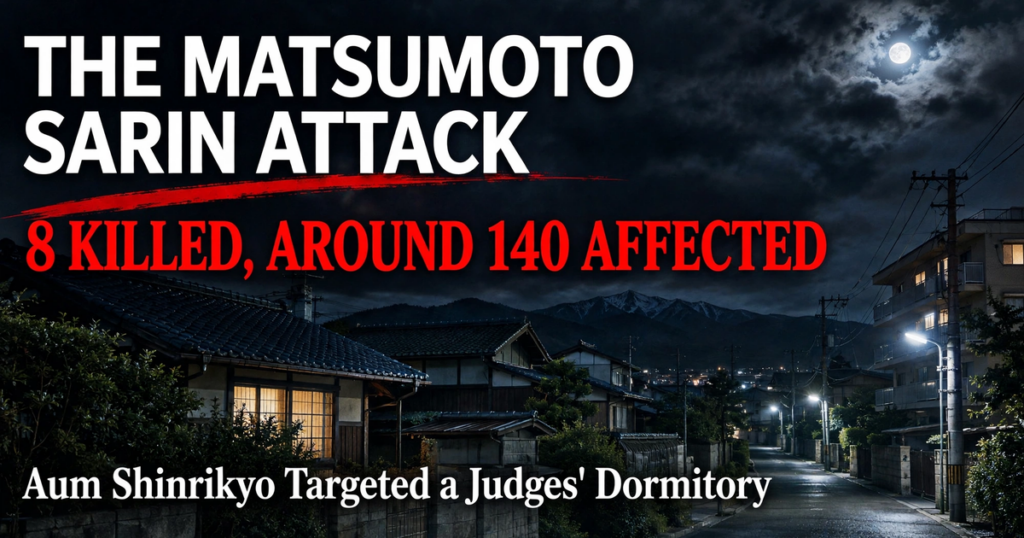
Sarin was released in a residential area of Matsumoto
On June 27, 1994, members of Aum Shinrikyo released sarin in a residential area of Matsumoto, Nagano Prefecture. Residents fell ill and emergency services faced an unfamiliar toxic exposure. The identification of sarin became central to the investigation and the later court proceedings.
The intended target was a court, not the neighbourhood's residents
The Public Security Intelligence Agency's archive records that Aum had been involved in a dispute concerning construction of a facility in Matsumoto and had received unfavourable judicial decisions. Around June 20, 1994, Chizuo Matsumoto, known publicly as Shoko Asahara, instructed senior members to release sarin near the Matsumoto court and examine its effects. The attack therefore combined hostility toward the judicial process with the organization's interest in testing the chemical agent it had produced. On the afternoon of June 27, seven members left Yamanashi Prefecture and reached Shiojiri, Nagano Prefecture, at about 8 p.m. By the time they arrived, the court was closed. They changed the target to the court officials' and judges' dormitory, with approval from the organization's leadership.
Residents and responders faced an unidentified toxic exposure
Residents in the area were exposed without warning. Police and emergency services initially did not know the identity of the substance and had to respond while treating people who were already ill. Identifying the agent and tracing the group responsible became central investigative tasks.
The casualty figures changed as the consequences became clearer
The current public summary records eight deaths and approximately 140 victims of sarin poisoning. The 1995 National Police Agency White Paper, published closer to the incident, recorded seven deaths and approximately 270 people who reported symptoms and received hospital treatment. These figures use different counting methods. The earlier number describes people who sought medical attention after reporting symptoms, while the later figure reflects a narrower official victim count based on subsequent records and recognition. The death toll also changed after the incident as a victim who had been seriously affected died in 2008. It would be misleading to describe one figure as simply false. A careful account identifies which source and definition each number represents.
Yoshiyuki Kono, the first person to report the emergency, came under suspicion
Yoshiyuki Kono lived near the affected area and was the first resident to report the emergency. His wife had been severely exposed to sarin, and other members of his family were also affected. Because Kono's home and the area immediately around it were considered closely connected with the location where symptoms appeared, police obtained a judicial warrant and searched the home and nearby property. They also questioned Kono. The search was carried out before the identity of the offender was known. Kono was not responsible for the attack and was never convicted. The investigation's focus on him became a major source of public criticism because a person who had reported the emergency and whose family had been poisoned was treated as a possible suspect.
The search was lawful under the warrant, but the family suffered serious secondary harm
The 1996 National Police Agency White Paper stated that the warrant-based search and questioning had been conducted appropriately as investigative procedures. It also recorded that police regretted the considerable distress and inconvenience caused to Kono. After his name became public, news coverage intensified suspicion against him. Kono later described receiving silent telephone calls, harassment and threatening letters directed at his family. This history requires two questions to be kept separate: whether investigators had a legal basis to search a location thought to be connected with the chemical release, and what harm followed when public reporting made the first reporter appear responsible. The fact that Aum was later identified does not automatically make every early investigative step unlawful, but it does not erase the secondary harm experienced by Kono and his family.
Police suspicion shifted toward Aum as chemical evidence accumulated
Police initially lacked experience in investigating the use of sarin as a criminal weapon. The 1995 White Paper records that approximately 100 officers were sent to the scene and that a formal investigation headquarters was established at Matsumoto Police Station on June 28. Chemical specialists from the National Research Institute of Police Science assisted with analysis. In the following months, investigators examined unusual odours and soil samples near Aum facilities in Yamanashi. By November 1994, testing had identified chemicals that could be produced when sarin decomposes. Police also learned that the organization had purchased large quantities of precursor chemicals through dummy companies. These findings strengthened suspicion of Aum, although the available material was not yet considered sufficient for a large compulsory search of its facilities.
The March 1995 searches and later reforms changed the investigation
A separate case involving the abduction and death of a notary-office official became the immediate trigger for a large-scale search of Aum facilities on March 22, 1995. The searches and subsequent investigation revealed more about the organization's chemical-weapons programme and its role in the Matsumoto and Tokyo attacks. Police later strengthened their ability to investigate chemical incidents, including specialist units, chemical expertise, protective clothing and gas-detection equipment. A 1996 amendment to the Police Act also improved coordination in investigations involving organised crime across prefectural borders. The Matsumoto attack thus had consequences beyond the criminal proceedings against Aum members. It exposed weaknesses in the response to unknown toxic substances and closed organizations, while leaving a lasting example of the harm that can occur when a first reporter is publicly treated as a suspect before evidence has been established.
Original Japanese record: 松本サリン事件|裁判官宿舎を狙ったサリン散布と、第一通報者に疑いが向いた初動
Last updated:
Related articles
Case record
The 1995 Tokyo Subway Sarin Attack: Victims, Criminal Trials and a Continuing Legacy
Case record
The Yodo-go Hijacking: Red Army Faction Seizes Japan Airlines Flight 351 and Diverts It to North Korea
Case record
The Shimonoseki Station Random Attacks

Case record