
The 2008 Akihabara Attack: Seven Deaths and the Supreme Court's Sentencing Decision
On June 8, 2008, Tomohiro Kato drove a truck into pedestrians in Akihabara and then attacked people with a knife. Seven people were killed and ten were injured. He was arrested at the scene, sentenced to death by the Tokyo District Court in 2011, and his sentence became final after the Supreme Court dismissed his appeal on February 2, 2015. The sentence was carried out on July 26, 2022.
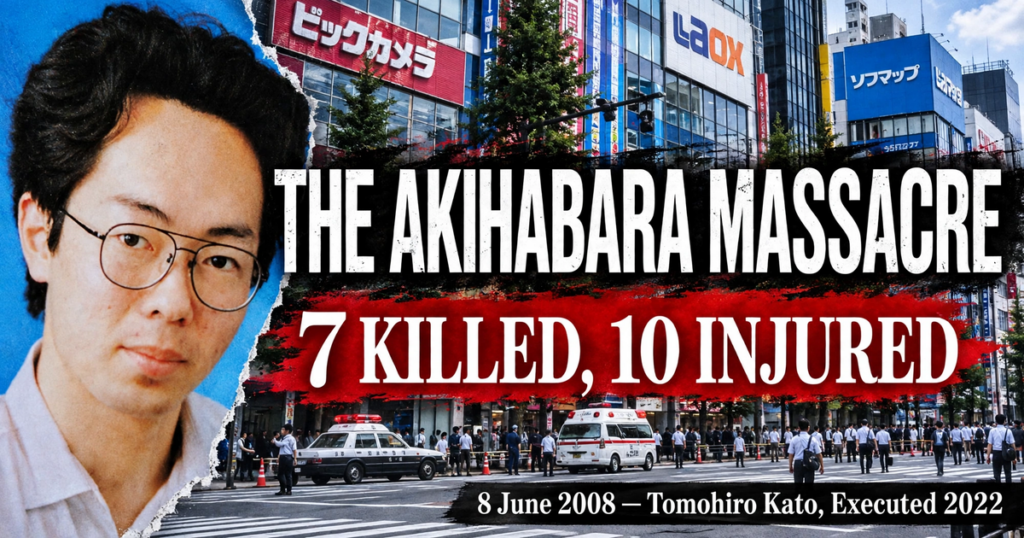
A truck entered the pedestrian area on a Sunday
At about 12:33 p.m. on Sunday, June 8, 2008, a truck driven by Tomohiro Kato entered the pedestrian area of Akihabara in Chiyoda Ward, Tokyo. The truck struck people on the street, killing three and injuring two. Kato then stopped the vehicle, got out and attacked pedestrians with a knife. Four more people were killed and eight were injured in the knife attacks. The Supreme Court’s judgment recorded a total of seven deaths and ten injuries. Kato was twenty-five at the time. The attack unfolded within minutes in a crowded shopping district where people had gathered on a holiday. The use of a vehicle followed by a knife was not treated by the courts as a random sequence of unrelated acts.
The seven people who died were individuals with different lives
The seven people killed were 川口隆裕, aged nineteen; 藤野和倫, nineteen; 中村勝彦, seventy-four; 小岩和弘, forty-seven; 宮本直樹, thirty-one; 武藤舞, twenty-one; and 松井満, thirty-three. The Japanese source gives their names and ages but does not provide readings for every name, so the original characters are retained rather than guessing pronunciations. Contemporary reporting described them as including students, company employees and a cook. Some had come to Akihabara to shop or spend time with family; others had personal or work-related reasons for being there. The list of names and ages matters because the figure of seven deaths can otherwise become an abstract statistic. The ten injured people were also part of the legal findings. The judgment separated the deaths and injuries caused by the truck from those caused by the knife.
Kato had prepared the vehicle and knife before reaching Akihabara
Kato was working as a temporary employee in Shizuoka Prefecture. In the days before the attack, he bought knives in Fukui Prefecture and arranged to rent a truck. On the morning of June 8, he drove toward Tokyo and continued posting messages on an internet bulletin board from his mobile phone. Some posts referred to killing people in Akihabara, while others described his movements. The timing of the posts and the journey was considered evidence that the plan existed before he arrived at the scene. The Supreme Court described the attack as carefully prepared rather than as an impulsive outburst that began only after he reached the shopping district.
The Supreme Court did not reduce the motive to one workplace dispute
Public discussion often links the attack to unstable employment or a problem at Kato’s dispatch workplace. The Supreme Court’s account was more complex. It referred to his growing dissatisfaction with society, feelings of isolation and belief that he had been harassed on the internet and at his workplace. Kato thought that people who had mistreated him should be made to understand the consequences of their actions. He then chose to direct violence at strangers who had no connection to those disputes. The court considered his internet activity as part of the formation of his anger and as a record of the advance planning. It did not treat online conflict, employment insecurity or the conduct of other people as an excuse for the murders.
He was arrested at the scene and the case proceeded to trial
Kato was subdued by police officers who arrived at the scene and was arrested immediately. The investigation did not involve a long search for an unidentified offender. Police had the truck, knife, online posts and movement records, and they examined his mental condition through psychiatric assessment. The central issues at trial concerned his responsibility, the extent of his planning and the appropriate sentence for the seven deaths and ten injuries. The defence raised his background, relationships and mental state as matters relevant to responsibility and sentencing. The courts examined whether he understood the nature and wrongfulness of his actions and whether he could plan and carry them out.
The Tokyo District Court imposed the death penalty in 2011
In March 2011, the Tokyo District Court sentenced Kato to death. It placed weight on the deliberate selection of an area crowded with unrelated pedestrians, the preparation of a truck and knife, the continuation of the attack after the vehicle stopped, and the result of seven deaths and ten injuries. The fact that Kato had no prior criminal record was considered, but the court concluded that it did not outweigh the seriousness of the crime. A death sentence is not determined automatically by a victim count; courts examine the motive, planning, manner of attack, consequences and other sentencing factors. In this case, the District Court found that the combination of preparation, strong intent and the scale of harm justified the maximum penalty.
The High Court and Supreme Court upheld the sentence
The Tokyo High Court dismissed Kato’s appeal in September 2012. On February 2, 2015, the Supreme Court’s First Petty Bench dismissed his final appeal. The Supreme Court upheld the lower courts’ assessment that the attack had been planned in advance and carried out with a strong intent to kill. It considered the fact that Kato had no previous convictions, but found that the deliberate attack on unrelated members of the public, the two methods of assault and the resulting deaths and injuries outweighed that mitigating factor. The death sentence became final on February 2, 2015. This was a decision on the merits of the appeal, not a withdrawal by Kato.
The sentence was carried out in 2022, but the effects continued
Kato’s death sentence was carried out at the Tokyo Detention House on July 26, 2022. He was thirty-nine. The criminal proceedings and the execution ended the legal process against him, but they did not end the effects on the victims’ families and survivors. In 2009, following the attack, restrictions on certain double-edged knives were strengthened through amendments to the Swords and Firearms Control Law. The pedestrian zone in Akihabara was suspended and later reopened in 2011 after safety measures were reviewed. The case continues to raise questions about online threats, public-space security and emergency response, but those social issues should be distinguished from the Supreme Court’s findings about Kato’s individual responsibility.
Original Japanese record: 秋葉原通り魔事件|7人死亡・10人負傷、最高裁が認定した動機と加藤智大の死刑執行
Last updated:
Related articles
Same case · Feature
The Akihabara Street Attack: Why “A Man Driven to the Edge by the Internet” Is Not an Explanation — The Anger Examined by the Supreme Court
Case record
The Ikeda Elementary School Attack: Eight Children Killed, a Death Sentence and Lasting Changes to School Safety
Case record
The Kakogawa Seven Murders
Case record