
The Iwao Hakamada Case: From Death Row to a Final Acquittal
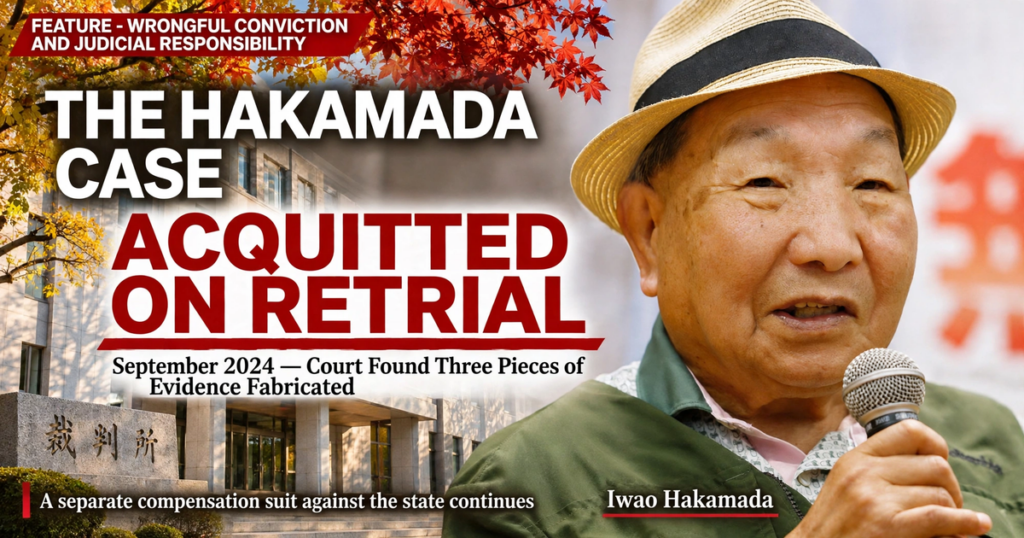
Four members of a miso company executive’s family were killed in Shimizu in June 1966. Iwao Hakamada was arrested in August, convicted and sentenced to death. After a retrial was granted and the case returned to court, the Shizuoka District Court acquitted him in September 2024, finding that three items of evidence had been fabricated. The prosecution did not appeal, and the acquittal became final on October 9, 2024.
Four members of a family were found dead after a fire
At about 1:30 a.m. on June 30, 1966, a fire broke out at a home that also served as the office of a miso manufacturer in Shimizu City, Shizuoka Prefecture, now part of Shizuoka City. The bodies of company executive Fujio Hashimoto, his wife Chieko, their younger daughter and their son were found inside. The victims had multiple stab wounds, and police investigated the incident as a robbery-murder and arson. Iwao Hakamada, a live-in employee of the same company, became the principal suspect. He was arrested on August 18, 1966, after blood and traces of a combustible mixture were reportedly found on pyjamas in his room. Hakamada later denied committing the crime and maintained his innocence during the trial.
The confession and the pyjamas became central to the prosecution
The interrogation of Hakamada was prolonged. He initially made statements admitting the crime, but later said that the confession had been forced. Many statements were prepared during the investigation. At the first trial, however, the Shizuoka District Court did not admit the police-created statements because of concerns about their voluntariness; it admitted only one statement prepared by prosecutors. The pyjamas found in Hakamada’s room were initially presented as the clothing he had worn during the crime. The prosecution relied on the confession and physical evidence to connect him to the killings. The later retrial would examine both the circumstances in which the confession was obtained and the reliability of the physical evidence used to support the conviction.
The discovery of the five garments changed the prosecution’s case
On August 31, 1967, approximately fourteen months after the killings, five items of clothing stained with blood were found in a miso tank at the company. The prosecution changed its theory of the clothing worn during the crime, moving from the pyjamas to what became known as the five garments. The colour of the bloodstains, the size of the garments and the question of whether the clothes could have remained submerged in miso for more than a year became major issues. On September 11, 1968, the Shizuoka District Court sentenced Hakamada to death. The Tokyo High Court rejected his appeal. The Supreme Court dismissed his final appeal on November 19, 1980, and the death sentence became final on December 12 of that year.
A retrial request took decades to succeed
Hakamada filed his first retrial request in 1981, but it was rejected by 2008. In the same year, his sister Hideko filed a second request. The defence focused on the appearance of the bloodstains on the five garments and whether the clothing could genuinely have been immersed in miso from shortly after the crime. Experiments and expert opinions were submitted to challenge the prosecution’s account. On March 27, 2014, the Shizuoka District Court ordered a retrial and suspended the execution of the death sentence and detention. Hakamada was released that day, nearly forty-eight years after his arrest. Release did not mean acquittal: prosecutors appealed, and the Tokyo High Court initially overturned the retrial order. In 2020, the Supreme Court set aside that decision and returned the matter for further examination. In March 2023, the Tokyo High Court again recognised the right to a retrial, allowing a new trial to proceed.
The retrial judgment identified three fabricated items of evidence
On September 26, 2024, the Shizuoka District Court acquitted Hakamada in the retrial. The court found fabrication in three areas: a confession statement prepared by prosecutors, the five garments said to have been worn during the crime, and a piece of cloth seized from Hakamada’s family home to connect the trousers to him. Regarding the five garments, the court concluded that bloodstains would not have retained the observed red appearance after more than a year in miso. It found that the stains had been added or altered near the time the clothing was discovered. The judgment therefore rejected the central physical evidence on which the final conviction had depended. The findings went beyond a conclusion that the evidence was merely weak; the court found that the evidence had been fabricated by investigative authorities.
The prosecution did not appeal, and the acquittal became final
The Prosecutor General, Naomi Unemoto, expressed strong disagreement with aspects of the retrial judgment but announced that the prosecution would not appeal. The decision took account of the extraordinary length of time required to reach the retrial and the circumstances of the case. Because the prosecution did not exercise its right to appeal, Hakamada’s acquittal became final on October 9, 2024. Shizuoka Prefectural Police apologised to Hakamada and his sister in October. On October 21, the police chief visited them and apologised directly for the burden caused by the arrest and the long period before the acquittal. The legal result is therefore final: Hakamada was acquitted in the retrial, and the prosecution did not challenge that judgment.
Criminal compensation was awarded for 17,389 days in detention
After the acquittal became final, Hakamada sought criminal compensation for the time he had been detained. On March 24, 2025, the Shizuoka District Court ordered compensation of approximately ¥217 million for 17,389 days of detention, applying the statutory daily maximum. The court noted that about thirty-three years of the detention had been under a final death sentence and referred to the severe physical and psychological suffering involved. Criminal compensation is a statutory payment for detention following an acquittal. It is separate from damages for unlawful conduct by police or prosecutors. The compensation decision therefore did not resolve the separate question of institutional responsibility for the evidence and interrogation practices that led to the conviction.
Civil claims remain separate from the final criminal acquittal
On October 9, 2025, Hakamada filed a damages action in the Shizuoka District Court against the national government and Shizuoka Prefecture, seeking approximately ¥600 million. The claim concerns alleged evidence fabrication, unlawful interrogation and disclosure issues, and the failure to correct the wrongful conviction over many years. A separate action seeks ¥5.5 million from the state over the Prosecutor General’s statement after the acquittal. At hearings in 2026, the parties continued to dispute the meaning and effect of that statement. As of the Japanese article’s August 26, 2026 update, the main state-compensation action remained pending. The acquittal is final, but civil proceedings concerning responsibility and compensation continue. The acquittal also does not establish that another named person was responsible for the four killings; no different person has been convicted of the family’s murders.
Original Japanese record: 袴田事件|再審無罪で認定された3つの証拠捏造と国賠訴訟の現在
Last updated:
Related articles
Case record
The Fukawa Case: Two Men Exonerated After 44 Years
Case record
The Ashikaga Case: How DNA Evidence and a False Confession Led to a Wrongful Conviction
Case record
The Shimada Case: A Death Sentence Overturned After 35 Years as Confession and Forensic Evidence Collapsed
Case record