
The 1995 Tokyo Subway Sarin Attack: Victims, Criminal Trials and a Continuing Legacy
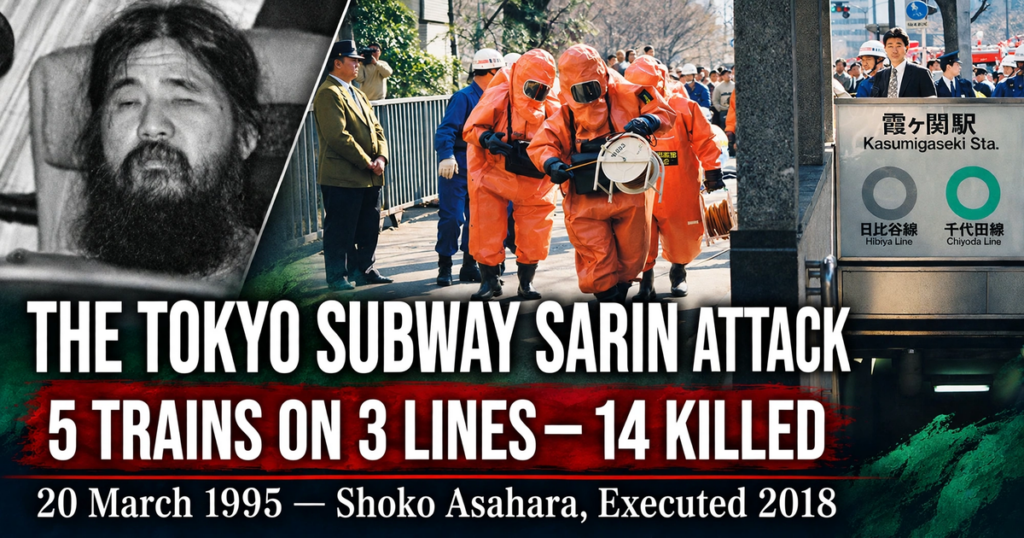
On March 20, 1995, members of Aum Shinrikyo released sarin on five trains across three Tokyo subway lines serving Kasumigaseki. Fourteen people ultimately died, and official and other sources use different injury totals because they count different groups and periods. The criminal proceedings ended in January 2018, and all thirteen people whose death sentences had become final were executed that year.
A coordinated attack during the morning commute
At about 8:00 a.m. on March 20, 1995, sarin was released on five subway trains travelling through central Tokyo toward Kasumigaseki. The trains ran on three lines: the Hibiya, Chiyoda and Marunouchi lines. The attack took place during the morning rush hour, when large numbers of commuters were travelling to work. The liquid sarin evaporated inside the carriages, exposing passengers and people who entered the trains or stations to the nerve agent. The attack was carried out by members of Aum Shinrikyo, a religious organization that had developed chemical weapons. The eventual death toll was fourteen, including a victim who remained in long-term medical care for many years and died in 2020. The attack became one of the most serious acts of chemical terrorism in a major city.
Kasumigaseki was selected to disrupt an expected police operation
According to materials from the National Police Agency and the Public Security Intelligence Agency, Aum Shinrikyo leaders feared that a large-scale police search of the organization’s facilities was approaching. The group was already suspected of involvement in the Matsumoto sarin attack and the murder of a notary-office official. Chizuo Matsumoto ordered the operation, and Yoshihiro Inoue coordinated it. Kasumigaseki was a strategic target because it served government ministries, the National Police Agency and other central institutions. Five executioners were assigned to separate trains heading toward the area. The timing was chosen to coincide with the crowded morning commute.
The investigation identified separate organizational roles
The Japanese record describes preparations at an Aum facility on the morning of the attack. Five members carried out the attack across the Hibiya, Marunouchi and Chiyoda lines. Investigators and courts also distinguished the roles of others who coordinated and supported the operation.
Sarin spread through the trains and exposed rescuers
Passengers, station staff and responders were exposed before the substance could be identified. The effects of the attack extended across multiple stations and hospitals. These exposures continued to shape medical follow-up and the way officials counted victims.
The death and injury totals depend on the counting method
The death toll has appeared as twelve, thirteen or fourteen in different accounts. Earlier reports used twelve, and later official summaries commonly referred to thirteen. In March 2020, a victim who had lived with severe effects for twenty-five years died from complications attributed to the sarin exposure. Including that death brings the total to fourteen. The number of people injured or affected also varies. The Public Security Intelligence Agency has used a figure of more than 5,800 based on people recognised for compensation under the relief law by March 2010. A separate count cited by victims’ organizations refers to 6,286 people whose applications were rechecked by police. A figure of approximately 6,300 is close to that second count. These numbers are not necessarily contradictory; they use different definitions and dates. The source therefore distinguishes the fourteen deaths from the various injury and victim totals.
Raids, arrests and the individual criminal cases
Two days after the attack, on March 22, police searched Aum facilities in Kamikuishiki Village and elsewhere in connection with the notary-office official’s murder and the group’s activities. Investigators used protective clothing and gas masks because they feared further exposure to chemical substances. The investigation expanded to the organization’s chemical-weapons development, sarin production and chain of command. Matsumoto was arrested on May 16, 1995. Other members involved in production, transportation, coordination and execution were also arrested and prosecuted. Courts considered each defendant’s acts and responsibilities across the subway attack and other Aum crimes. Matsumoto received a death sentence, which became final in 2006. The criminal proceedings involving the group continued for more than two decades; the final proceedings in the connected Aum cases ended by January 2018.
Thirteen final death sentences were carried out in July 2018
On July 6, 2018, the death sentences of Matsumoto and six other former Aum members were carried out. On July 26, the remaining six people whose death sentences had become final were executed. In total, all thirteen people with final death sentences in the Aum-related cases were executed that month. The executions marked the end of the criminal process for those defendants, but they did not end the effects of the attack. Survivors have continued to live with physical and psychological consequences, and families have continued to provide care. A completed sentence and the end of a trial are legal events; they do not mean that the injuries, bereavement or need for support have disappeared.
Medical records and successor organizations remain current issues
The attack has also become an important source of knowledge for emergency medicine and chemical-terrorism preparedness. In 2025, the Ministry of Health, Labour and Welfare began work to preserve medical and rescue records from the incident. At a meeting in March 2026, the ministry reported that approximately 1,400 paper medical records had been preserved through digitisation and related work. Oral histories from three medical workers who responded at the time were also being made available. Meanwhile, the National Police Agency reported in 2026 that groups descended from Aum had about thirty facilities in fifteen prefectures and approximately 1,600 members. These organizations include Aleph, the group known as Yamada-ra no Shudan, and Hikari no Wa. Authorities continue monitoring them under the relevant legislation. The attack is therefore a concluded criminal case but not a closed public-safety or victim-support issue.
Original Japanese record: 地下鉄サリン事件|3路線5列車の同時攻撃、14人死亡と31年後も続く医療・教団対策
Last updated:
Related articles
Case record
The Mitsubishi Heavy Industries Bombing and the East Asia Anti-Japan Armed Front's Corporate Bombing Campaign
Case record
The Matsumoto Sarin Attack: A Chemical Strike on a Residential Area and the First Reporter Who Came Under Suspicion
Case record
The 2008 Akihabara Attack: Seven Deaths and the Supreme Court's Sentencing Decision

Case record