
The Sendai Elderly Couple Robbery Murders: A Five-Year Suspension in the Supreme Court and a 19-Year Path to Finality
On February 20, 1986, an 82-year-old man and his 75-year-old wife were killed in Sendai, Miyagi Prefecture. Postal savings certificates and other property were stolen, and their bodies were abandoned in a pine grove in the city. The defendant, Morio Horie, knew the husband. His death sentence was imposed in 1988 and upheld in 1991, but proceedings in the Supreme Court were suspended in 1993 over his ability to participate in the appeal. The case resumed in 1998, and the death sentence became final on September 26, 2005.
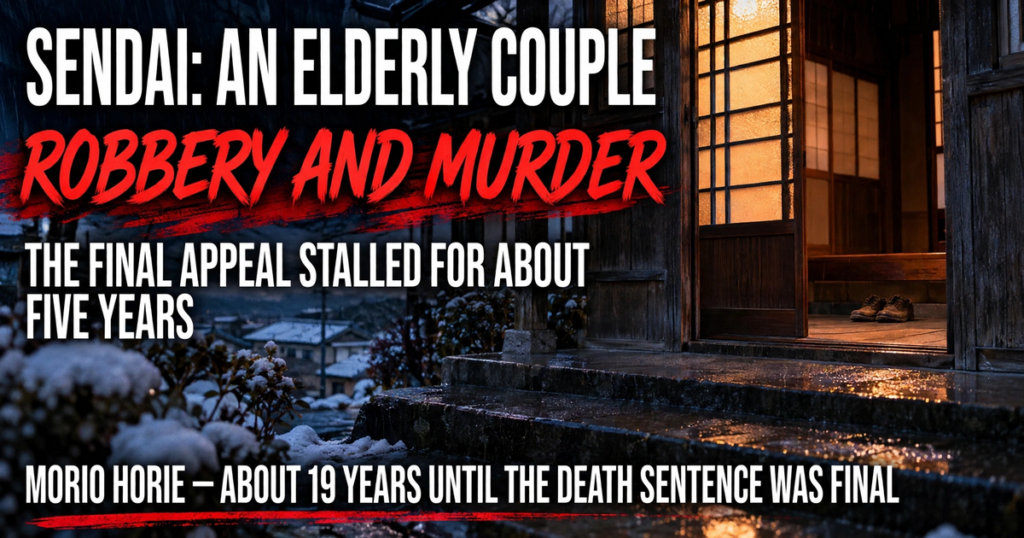
The victims were an elderly couple known to the defendant
The incident occurred on February 20, 1986, in Sendai, Miyagi Prefecture. The victims were an 82-year-old man and his 75-year-old wife. Horie Morio knew the husband and had visited the couple's home. The Supreme Court found that, through those visits, Horie came to believe that the man kept substantial amounts of cash and other valuables at home. He then planned to kill the couple and take their property. This was not a robbery of a house selected by chance. The defendant used an existing acquaintance to learn about the household and identify it as a target.
The robbery was planned before the attack
The prosecution established that Horie prepared for the attack and intended to obtain money and property by killing the couple. The Supreme Court treated the incident as a planned robbery-murder rather than an argument that unexpectedly escalated into violence. The victims had no conduct that could justify the attack. The financial motive was considered an aggravating feature, not a reason for leniency. The case also involved the abandonment of the bodies, which was charged separately from the killings. The legal record therefore covered the plan to take property, the deaths of both victims and the subsequent concealment.
The husband was struck and strangled
On February 20, Horie attacked the 82-year-old man at the couple's home. The Supreme Court found that he used prepared metal bars or similar reinforcing steel to strike the man's head and other parts of his body several times. He then strangled the victim with an electrical cord. The attack was not treated as a spontaneous response to a quarrel. The court found that the defendant had already formed the plan to kill the couple and take their property. The method of attack, including the use of prepared objects and the electrical cord, was considered when the courts assessed the seriousness of the offence.
The wife was killed after returning home
After the husband had been killed, his 75-year-old wife returned to the house. Horie attacked her with the same metal bar, striking her head and other parts of her body several times. She too was killed. The attack therefore did not end with the first victim. The second death brought the number of victims to two and formed part of the same robbery plan. Horie then took postal savings certificates and other property. The Supreme Court treated the killings and taking of property as a connected robbery-murder, rather than as two unrelated homicides followed by an independent theft.
The bodies were carried to a pine grove
Horie did not leave the bodies at the home. He transported them to a pine grove in Sendai and abandoned them there. The abandonment of the bodies was charged in addition to robbery-murder. The prosecution and courts considered the movement of the bodies as part of the concealment after the killings. The property taken included fixed-term postal savings certificates. The case thus involved a sequence of preparation, the killing of both members of the household, the taking of financial instruments and the disposal of the bodies. The archive does not establish a more precise value for all property taken, so no unsupported total is added.
The first two courts imposed and upheld death
The Sendai District Court sentenced Horie to death on September 12, 1988. He appealed, but the Sendai High Court dismissed the appeal on March 29, 1991, maintaining the death sentence. The case then proceeded to the Supreme Court. The ordinary appellate stages had therefore upheld the first-instance punishment before the unusual procedural issue arose in the final appeal. The Supreme Court was not initially deciding whether the killings had occurred; it had to address whether Horie was mentally capable of understanding the proceedings and participating in his defence.
The Supreme Court suspended proceedings over litigation capacity
Horie indicated in March 1992 that he wished to withdraw his final appeal. The court ordered psychiatric assessment because a defendant sentenced to death must understand the significance of abandoning an appeal and be able to participate meaningfully in the proceedings. On May 31, 1993, the Supreme Court's Second Petty Bench suspended the proceedings under Article 314(1) of the Code of Criminal Procedure after finding that Horie was in a state of insanity for the purpose of continuing the trial. The issue was his capacity at the time of the appeal, not whether he had been criminally responsible when the murders occurred in 1986.
The proceedings resumed in 1998 and the death sentence became final in 2005
On March 17, 1998, the Supreme Court concluded that Horie was no longer in a state of insanity and cancelled the suspension order. The appeal proceedings resumed. On September 26, 2005, the Supreme Court's Second Petty Bench unanimously dismissed his final appeal. It rejected the constitutional, factual and sentencing arguments and maintained the death sentence. The Court distinguished the long procedural interruption from the underlying criminal responsibility. The final judgment considered the planned robbery-murder, the two deaths, the abandonment of the bodies and the absence of prior convictions, but found no basis to alter the sentence.
Why the case took about nineteen years to reach finality
Approximately nineteen years passed between the killings in February 1986 and the Supreme Court's dismissal in September 2005. A major reason was the suspension of proceedings from May 1993 until March 1998 while Horie's ability to participate in the appeal was assessed. Criminal responsibility at the time of the offence and litigation capacity during a later appeal are different legal questions. The case is notable because the Supreme Court had to consider the latter before completing its review of the death sentence. The final outcome was a death sentence that became final in 2005; this translation does not add an execution date not established by the Japanese article.
Original Japanese record: 仙台老夫婦強盗殺人事件|上告審が約5年間停止、堀江守男の死刑確定まで19年
Last updated:
Related articles

Case record
The Sendai Yakuza Executives Serial Murders: Two Deaths in One Month and One Death Sentence
Case record
The Yuji-chan Kidnapping-Murder: A Six-Year-Old Lured with an Insect and a Ransom Demand of 20 Million Yen

Case record
The Four-Prefecture Four-Murder Case: Twelve Years for the First Killing and Death for Three Later Murders
Case record