
The Matsuyama Case: The Quilt Stains That Failed to Sustain a Death Sentence
Four members of a farming family died in a house fire in 1955. Yukio Saito was convicted and sentenced to death, but a retrial exposed serious problems with the blood evidence and confession. He was acquitted in 1984.
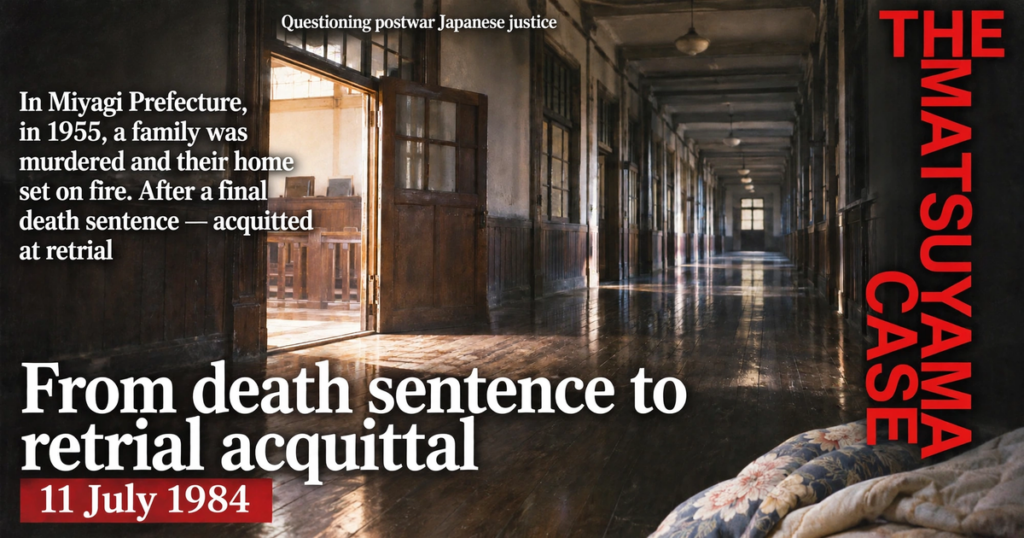
A family of four died when their home burned in October 1955
In the early hours of 18 October 1955, a fire destroyed a farmhouse in Matsuyama Town, then part of Shida District in Miyagi Prefecture and now within Osaki City. The remains of four members of the same family were found in the ruins: the head of the household, his wife, their son and one of their daughters. The bodies showed injuries caused by a sharp instrument, so investigators treated the incident as both a multiple homicide and an arson. The fire had consumed much of the house, making the reconstruction of events difficult. The case became known as the Matsuyama Case, after the town where the killings occurred.
Yukio Saito was arrested in a separate assault investigation
Yukio Saito was 24 when police arrested him on 2 December 1955 on suspicion of an unrelated assault. During subsequent questioning, he made statements admitting involvement in the killings. He later withdrew those statements and denied the crime in court. The way the confession had been produced became an important issue in the retrial. Accounts of the case describe prolonged questioning and pressure from a person placed in the same detention cell, who encouraged Saito to admit the offence and supposedly explain the truth later at trial. That account must be treated as part of the evidence about how the confession was formed, not as a judicial finding that every detail of the interrogation was proved.
The original conviction treated the confession and bloodstains as mutually supporting
The prosecution relied on Saito's statements and on forensic examination of a quilt taken from his home. A piece of fabric around the quilt's collar appeared to contain stains identified as human blood, including blood of a type said to be consistent with one of the victims. The original court viewed the stains as support for Saito's account that he had been splashed with blood during the attack. By contrast, the clothing he was said to have worn during the crime did not show blood. The prosecution's explanation was that those garments had been washed. The retrial would later examine whether the quilt evidence was as reliable as the original judgment had assumed.
The death sentence was upheld through the ordinary appeals
The Furukawa Branch of the Sendai District Court sentenced Saito to death on 29 October 1957. The Sendai High Court dismissed his appeal on 26 May 1959, and the Supreme Court rejected his final appeal on 1 November 1960. The death sentence formally became final on 22 November 1960, according to the government's later account to the Diet. Saito remained in custody under a final death sentence. The ordinary trial process was therefore over, but he continued to seek a retrial. In Japan, a retrial is an exceptional procedure for reopening a final conviction; it is not simply another appeal in which the same arguments are repeated. New evidence and the reliability of the original fact-finding become central.
An undisclosed forensic report challenged the blood evidence
A major development came when a forensic report prepared during the original investigation but not submitted at the trial was disclosed during the second retrial petition. The report by a Miyagi Prefectural Police forensic technician stated that human blood was not present on the reverse side of the quilt. The technician also testified that the stains on the collar piece were fewer than the later analysis suggested. A subsequent examination by researchers at Tohoku University reported numerous bloodstains. The conflicting descriptions raised a basic question: what had actually been present on the quilt when the police first examined it? Evidence presented as scientific confirmation could no longer be accepted without examining its history and reliability.
The Sendai District Court ordered a retrial in December 1979
On 6 December 1979, the Sendai District Court ordered a retrial. It considered that the value of the earlier bloodstain examination had been substantially weakened and that the confession might contain false elements. The prosecution appealed, but the Sendai High Court dismissed the immediate appeal on 31 January 1983. The prosecution did not take the matter to the Supreme Court, and the retrial order became final. The retrial then examined the quilt, the absence of blood on the clothing attributed to Saito, and the circumstances in which the confession had been made. The court was no longer being asked to accept the original relationship between the confession and the physical evidence without question.
The retrial court acquitted Saito on 11 July 1984
On 11 July 1984, the Sendai District Court acquitted Saito and ordered the suspension of his detention. The prosecution did not appeal, and the acquittal became final on 25 July. Saito had been held for nearly 29 years. The decision was the third postwar Japanese retrial acquittal of a person whose death sentence had already become final, following the Menda and Saitagawa cases. The result did not depend on proving exactly who committed the murders. It was enough that the evidence against Saito could not sustain a conviction. That distinction is central to understanding a criminal acquittal: the prosecution must prove the defendant's guilt, not merely present a theory that appears plausible.
The case exposed the danger of treating a forensic label as certainty
The Matsuyama Case is remembered for the way a small piece of bedding became a central part of a death sentence, and for how the later disclosure of an earlier report changed the evaluation of that evidence. The lesson is not that forensic science is inherently unreliable. Rather, a scientific conclusion must be examined through the sample's condition, the method used, the records made at the time and the limits of what the result can establish. Saito received criminal compensation of 75,168,000 yen after his acquittal. He died in 2006, but the compensation could not restore the years he had lost. The case remains part of the history of Japan's four major death-row retrial acquittals, alongside Menda, Saitagawa and Shimada.
Original Japanese record: 松山事件|死刑確定を覆した掛け布団の血痕と再審無罪
Last updated:
Related articles

Case record
The Sendai Arcade Truck Attack: Three Dead, Four Injured and a 28-Year Sentence Replaced by Life
Case record
The Nagoya University Student Murder: Criminal Responsibility, Earlier Poisonings and a Final Life Sentence
Case record
The Hokuryo Clinic Case: Five Patient Emergencies, a Life Sentence and a Disputed Drug Analysis
Case record