
The Nishinari Yakiniku Restaurant Manager Killing: From an Assault Arrest to a 17-Year Custodial Sentence
Kishimoto (岸本隆浩), a 45-year-old restaurant manager, was found dead in Nishinari Ward on 5 January 2026. Sakai (酒井竜行) was first arrested for assault, then indicted for murder and sentenced to 17 years' custody at first instance on 18 September 2026.
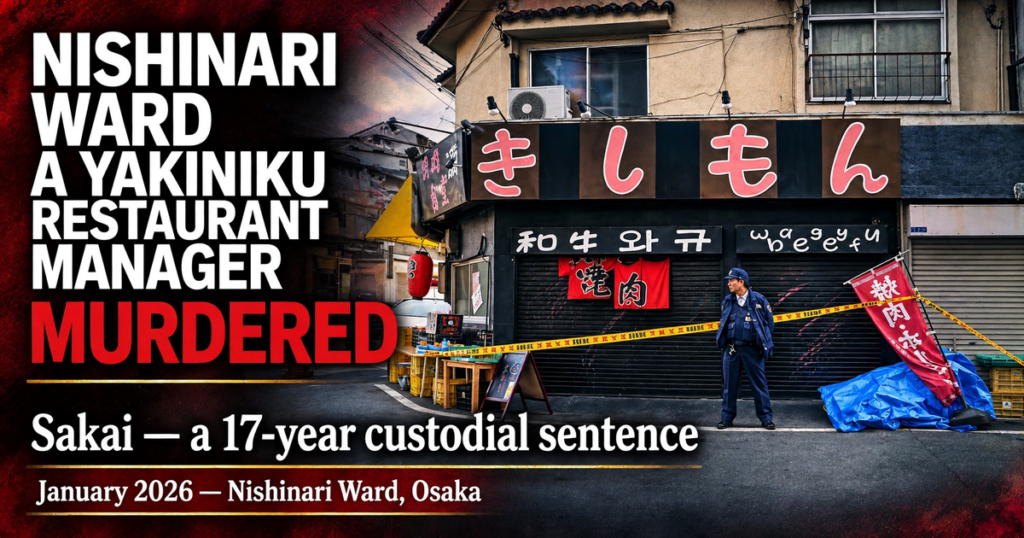
A restaurant manager was found collapsed at daybreak
At approximately 6:55 a.m. on 5 January 2026, the owner of a yakiniku restaurant in Tenkachaya-kita 1-chome, Nishinari Ward, Osaka, found the restaurant manager, Kishimoto (岸本隆浩), collapsed inside the premises. The owner called emergency services. Kishimoto was taken to hospital, where his death was confirmed. He was 45. The location was a restaurant in a district with other shops and businesses. The discovery led Osaka Prefectural Police to investigate the circumstances of the death and the events that had occurred at the restaurant before the owner found him.
The first arrest was for assault, not murder
Police initially arrested Sakai (酒井竜行), a man connected with the same restaurant, on suspicion of assault. At the time of the arrest, the authorities had not yet publicly announced a murder indictment. This distinction is important because an arrest charge reflects the suspicion for which police initially secured the suspect, while later prosecutorial decisions may follow further investigation. The initial arrest should not be retrospectively described as an arrest for murder. The investigation continued to examine the injuries, the cause of death and the relationship between the assault and Kishimoto's death.
The autopsy changed the focus of the investigation
Early reports referred to injuries to Kishimoto's head and face. The autopsy later identified a fatal wound to his back caused by a sharp object, reported as a knife-like implement. The wound reached the lung and was reported to have caused fatal blood loss. This finding changed the focus of the investigation from the visible assault injuries to the stabbing and its relationship to the death. The medical examination was important in establishing the alleged cause of death, but it did not by itself identify who inflicted the wound or establish the defendant's intent.
Police officers reportedly encountered an argument earlier that day
Reports concerning the indictment said that police officers had encountered Kishimoto and Sakai arguing on the day of the incident. The officers reportedly attempted to intervene, but the two men declined assistance. This reported encounter is part of the public chronology, but the source does not provide a complete account of what happened after the officers left or exactly how the later violence unfolded. It would be inappropriate to invent a motive or to assume that the argument itself proves the prosecution's account. The precise sequence and the circumstances of the stabbing remain matters for evidence in the criminal proceedings.
The prosecutor indicted Sakai for murder on 26 January
On 26 January 2026, the Osaka District Public Prosecutors Office indicted Sakai for murder. The indictment alleged that he struck Kishimoto in the face and then stabbed him in the back with a kitchen knife, causing his death. The change from the initial assault suspicion to a murder charge reflected the investigation's assessment of the injuries and the fatal stabbing. An indictment is a formal accusation that begins the criminal trial process; it is not a finding of guilt. The public record must therefore refer to Sakai as a defendant charged with murder, not as a person convicted of murder.
Sakai reportedly denied an intent to kill
The Japanese source reports that Sakai denied having intended to kill Kishimoto during police questioning. At trial, the defence argued that Sakai had acted in self-defence after Kishimoto dropped a knife, while the prosecution argued that Sakai had initiated the attack and deliberately stabbed him in the back. The court later rejected the self-defence argument and found that Sakai had acted with intent to kill.
The relationship and motive were not fully established in public reporting
Kishimoto was the restaurant manager and Sakai was a person connected with the same establishment. Reports indicated that the two had argued, but the precise cause of their disagreement and the full history of their relationship were not publicly established in the source material. The case should not be filled out with speculation about employment disputes, personal conflict or financial issues. A detailed account can explain what is known about the workplace connection and the reported confrontation while making clear that the motive and the complete sequence remain unresolved in the public record.
The procedural status must remain open
The Japanese source's chronology stopped at the indictment and stated that no judgment had been reported as of 27 August 2026. Later reporting records a first-instance judgment at Osaka District Court on 18 September 2026: Sakai received a 17-year custodial sentence (拘禁刑). The court rejected the defence's self-defence argument and found the murder charge proved. Japan's new custodial-sentence system took effect on 1 June 2025, replacing the former categories of imprisonment and penal servitude. The 17-year term is a first-instance sentence; no appellate outcome had been confirmed in the sources checked by 22 November 2026.
Original Japanese record: 大阪・西成区焼き肉店長殺害事件|岸本隆浩さん死亡、傷害逮捕から殺人起訴へ
Last updated:
Related articles

Case record
The Dotonbori Three-Victim Stabbing

Case record
The Takatsuki Murder of Naoko Takai
Case record
The Osaka Two-Child Starvation Case: Sakurako and Kaede Left Alone for About 50 Days, and Three Reports Failed to Protect Them

Case record