The Hiroshima Serial Insurance Murders
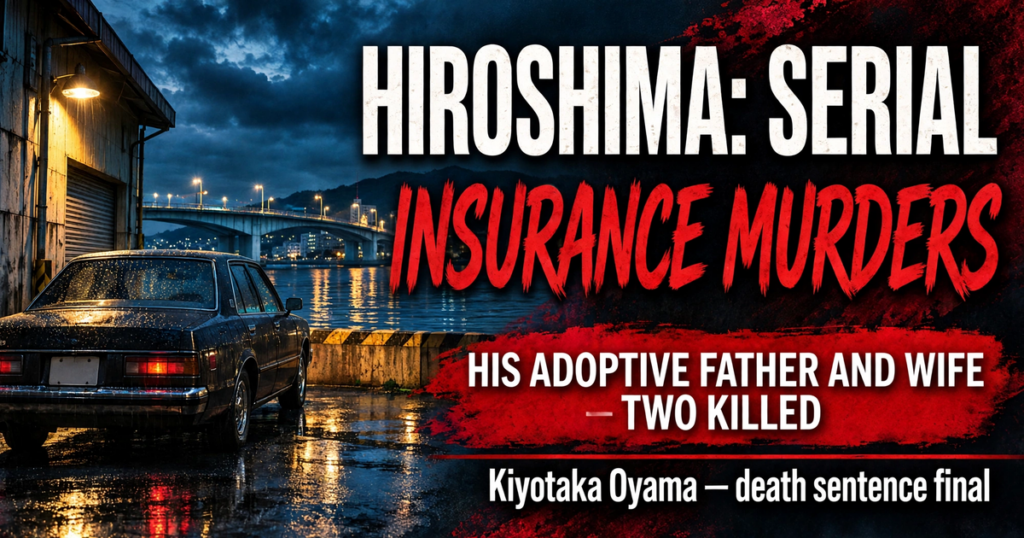
Kiyotaka Oyama was convicted of killing his adoptive father and his wife in separate incidents in 1998 and 2000. Although both deaths were disguised as accidents and followed by insurance claims, the Supreme Court distinguished the motives for the two killings. It upheld the death sentence in 2011, while a supplementary opinion addressed the unusual plea for mercy made by the defendant's son, who was also the victim's child.
Two deaths were staged as accidents
The case involved two killings in Hiroshima Prefecture, one in October 1998 and the other on 1 March 2000. The victims were Kiyotaka Oyama's adoptive father and his wife. In the first incident, a vehicle was made to collide with a concrete-block wall so that the death would appear to have resulted from a traffic accident. In the second, the wife's body was taken to a quay with the children and thrown into the sea, creating the appearance of an accidental death at sea. Both incidents involved efforts to disguise homicide after the victim had died, but the Supreme Court did not treat the motives as identical.
The adoptive-father killing was tied to control of a company and insurance money
The Supreme Court's judgment described a dispute over the liquidation of a company in which Oyama served as liquidator and was also a joint guarantor for its debts. Oyama and his adoptive father disagreed about how the company should be wound up. The court found that Oyama wanted to take control of the company from his adoptive father and obtain the proceeds of a life-insurance policy on the father's life. He called the older man to a deserted place at night, struck his head with a dumbbell and then put him in a vehicle. Oyama drove the vehicle into a concrete-block wall to make the death look like a traffic accident.
The accident story was used to obtain insurance proceeds
The first killing was not simply a death followed by an opportunistic insurance claim. The court found that the accident scenario had been planned in advance. The adoptive father had helped raise Oyama as if he were his own child and had provided financial support connected with the company. The Supreme Court described the motive as highly profit-driven and the method as carefully prepared. Oyama received a substantial insurance payment after the death, but the money did not remain in his hands. It passed to a third party, a fact that later became important to the explanation for the second killing.
The motive for killing his wife was different
The Supreme Court distinguished the wife's murder from the adoptive-father case. After the first insurance payment had gone to a third party, Oyama continued telling his wife that he would be able to recover the money. The court found that he feared she would discover the lie, lose trust in him and leave. Rather than face that prospect, he decided to kill her. The wife was not killed simply because Oyama expected to collect the same insurance proceeds that had motivated the first murder. Although insurance fraud followed her death as well, the court identified the fear of exposure and abandonment as the direct motive for the killing.
The wife was drugged and drowned in a bathtub
According to the Supreme Court judgment, Oyama prepared a sleeping medication in advance and mixed it into his wife's drink. While the two were bathing, she began to fall asleep. He pressed her face into the bathwater. When she awoke and resisted, he continued holding her under the water until she drowned. The court treated the use of the prepared medication and the continuation of the attack after she resisted as evidence of planning and persistence. This was not an accidental drowning or a death that occurred before Oyama became involved.
The children were drawn into the attempt to disguise the second death
After killing his wife, Oyama arranged the body to make it appear that she was sleeping. He told the children that he was going to look for a place for night fishing and took them with him by car to a quay, where he disposed of her body in the sea. At the time, the son was 12 and the daughter was eight. The Supreme Court's supplementary opinion gave particular attention to the son because he was both the defendant's child and a bereaved family member. The children were not merely relatives who learned about the crime later; they had been drawn into conduct used to support the false account of their mother's death.
Other fraud and document offences were part of the criminal proceedings
The prosecution before the Supreme Court covered more than the two murders. After the killings, Oyama stole a driver's licence from the home of a woman with whom he was in a relationship. He used the document to open a bank account and obtain a passbook, and he fraudulently obtained mobile phones from two retailers. The case also included forgery and use of private documents, as well as multiple credit-card frauds involving cards obtained improperly. These offences explain why the Supreme Court case title listed fraud, theft, forgery, murder and abandonment of a corpse. The two killings remained the central sentencing offences, but the wider pattern was part of the record.
The district and high courts imposed and upheld a death sentence
The Hiroshima District Court sentenced Oyama to death on 27 April 2005. The Hiroshima High Court dismissed his appeal on 16 October 2007. The courts treated the planning, the accident disguises, the insurance claims and the circumstances of both killings as serious aggravating features. On 7 June 2011, the Supreme Court's Third Petty Bench dismissed the final appeal in Case No. 2007 (A) 2275. The official judgment stated that the adoptive-father killing was motivated by control of the company and insurance money, while the wife's murder arose from Oyama's fear that his deception would be exposed.
The son's plea for mercy was considered but did not change the result
During the appeal, the son asked the court not to impose the death penalty on his father. This was not a routine plea by a defendant's relative: the son had lost his mother to the defendant and had also been used in the attempt to create a false account of the mother's movements. After the first-instance judgment, he began corresponding with his father and visiting him, and he appeared as a character witness in the high-court proceedings. Justice Mutsuo Tahara's supplementary opinion described the emotional complexity of the son's position. The Supreme Court nevertheless concluded that the seriousness of the offences and the circumstances of the killings meant the death sentence had to be upheld.
Original Japanese record: 広島連続保険金殺人事件|養父と妻の事故死偽装、長男の死刑回避訴えを経て死刑確定
Last updated: