The Hamamatsu Sanezadai Family Murders: Dissociative Identity Disorder, Full Criminal Responsibility, and a 30-Year Sentence
On the evening of 8 March 2022, three members of a family were killed at a home in Sanezadai, Hamamatsu: the defendant's maternal grandfather, aged 79; maternal grandmother, aged 76; and older brother, aged 26. The defendant, Yamada Yutaro, argued that dissociative identity disorder and a separate personality state meant he could not control his actions. The district court accepted that he had the disorder and experienced dissociation, but found that his ability to understand and control his conduct was not substantially impaired. He received 30 years in prison, not life imprisonment; the Supreme Court dismissed his appeal on 10 April 2026.
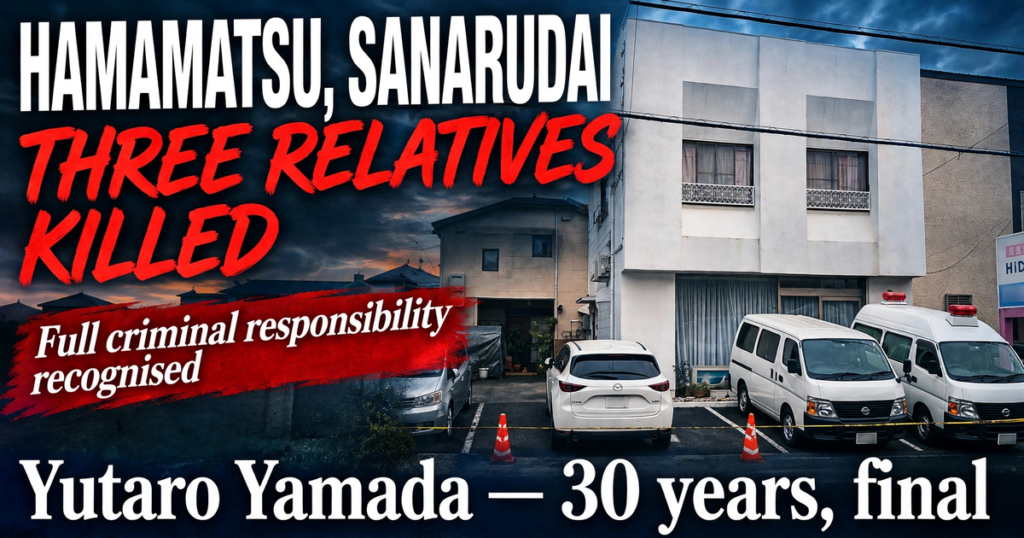
Three relatives were killed in a Hamamatsu home
On the evening of 8 March 2022, three members of a family were killed at a home in Sanezadai, Hamamatsu City, Shizuoka Prefecture. The victims were the defendant's maternal grandfather, aged 79; maternal grandmother, aged 76; and older brother, aged 26. The killings took place over a period of roughly two hours, beginning shortly after 7 p.m. The case was prosecuted as three murders. The defendant's father was also present in the house and survived. The distinction between the three people who died and other family members who were present is important when describing the indictment and the final judgment.
The court reconstructed the events between 7:13 p.m. and 9:30 p.m.
The district court found that the defendant used a hammer and a metal hammer to attack his grandparents and older brother. The first two victims were attacked between approximately 7:13 p.m. and 9:30 p.m.; the older brother was attacked during a later part of that period. The court found that the defendant moved between parts of the house and continued to act while other family members were present. After the older brother was killed, the father managed to take a hammer from the defendant and escape. The defendant later returned to the house. The court treated the events as three separate killings carried out by the same defendant.
The surviving family members called emergency services
After the attack, the defendant's twin brother called the police emergency number 110 at about 9:34 p.m. and the ambulance and fire service number 119 at about 9:38 p.m. The three victims were taken to hospital but died. The father had been able to take the hammer away and survive. The defendant's conduct after the killings, including washing items and making statements that could make the father appear responsible, was considered by the court when assessing who had committed the offences. The judgment did not add a murder charge for the father to the three murder counts that resulted in conviction.
The defendant's background was examined at trial
The defendant had entered the Shizuoka Prefectural Police in April 2018 and left the force in June 2019 because of mental and physical difficulties. He later returned to the family home. The district court heard evidence about his childhood and family relationships, including a history of violence and abuse. Those matters were relevant to the development of his anger and mental condition, but the court did not treat them as a justification for killing. The prosecution and defence presented competing psychiatric assessments. The court had to determine not only whether a diagnosis existed, but how it affected the defendant's ability to understand and control his conduct at the time of the offences.
The defence relied on dissociative identity disorder
The defence argued that the defendant had dissociative identity disorder and that another personality state, described as “Bowie,” had carried out the killings while the defendant's ordinary personality could not control it. He said that he did not remember committing the murders. The defence relied on one psychiatric assessment and argued that he was either not criminally responsible or had diminished responsibility. The prosecution relied on a second assessment and argued that, even if dissociation had occurred, the defendant's ability to understand the nature of his actions and control his behaviour had not been substantially impaired.
The district court accepted the diagnosis but found full responsibility
The district court did not reject the diagnosis of dissociative identity disorder. It also accepted that the defendant had experienced a dissociative state during the offences. However, it found that the impairment of his ability to understand his actions and control his behaviour was not severe enough to remove or substantially reduce criminal responsibility. The court examined the continuity of his actions across the three killings, his preparation and explanations to family members, his interactions with the victims, and his conduct afterward. The legal question was not whether he had a mental disorder, but whether the disorder had caused a legally significant loss of capacity at the time of the crimes.
The prosecution sought life imprisonment, but the court imposed 30 years
On 15 January 2025, the Shizuoka District Court Hamamatsu Branch sentenced Yamada to 30 years' imprisonment. The prosecution had sought life imprisonment. The court regarded the deaths of three people and the violence used as extremely serious, but it also considered the defendant's young age, lack of prior convictions, the effect of his childhood experiences and the fact that his mental condition had reduced his ability to regulate his emotions, although not to the level of diminished responsibility. The court did not find an exceptionally elaborate premeditated plan. It selected the maximum fixed-term sentence of 30 years rather than life imprisonment.
The Tokyo High Court upheld the sentence in October 2025
Yamada appealed, continuing to challenge the findings about his identity as the perpetrator and his criminal responsibility. On 30 October 2025, the Tokyo High Court dismissed the appeal. It found no unreasonable reasoning in the district court's assessment of the evidence and psychiatric opinions. The High Court did not deny that dissociation and the disorder existed. It upheld the conclusion that the defendant's capacity had not been impaired to the degree required for diminished responsibility under Japanese criminal law. The 30-year sentence therefore remained in place after the appellate judgment.
The Supreme Court dismissed the appeal on 10 April 2026
The defendant then appealed to the Supreme Court. On 10 April 2026, the Supreme Court's Second Petty Bench dismissed the appeal. The 30-year sentence became final. The Supreme Court did not conduct a new trial or replace the lower courts' factual findings with a different account. The final result was that Yamada was convicted of three murders and sentenced to 30 years' imprisonment. The case should not be described as a life sentence, and the father should not be added as a fourth murder victim or as a person for whose attempted murder the defendant was finally convicted.
Three murders, not four, were included in the final conviction
The father was present and was attacked or placed in danger during the incident, but the final judgment's offences concerned the maternal grandparents and older brother. The district court discussed the possibility that the defendant had intended to kill his father and the possibility that the intent had receded; it did not resolve that question as a separate murder count. The three murder convictions were for the deaths of the 79-year-old grandfather, 76-year-old grandmother and 26-year-old brother. This distinction is important because the number of family members present at the scene is not the same as the number of murder victims or convictions.
Original Japanese record: 浜松市佐鳴台親族3人殺害事件|解離性同一症と完全責任能力、無期求刑から懲役30年確定
Last updated: