
Korean Air Flight 858 Bombing: Death Sentence, Then Pardon
On 29 November 1987, Korean Air Flight 858 was bombed over the Andaman Sea, killing all 115 passengers and crew. South Korean authorities determined that it was an act of state terrorism by North Korean agents. Kim Hyon-hui's death sentence became final in March 1990, and she received a special pardon in April of that year.
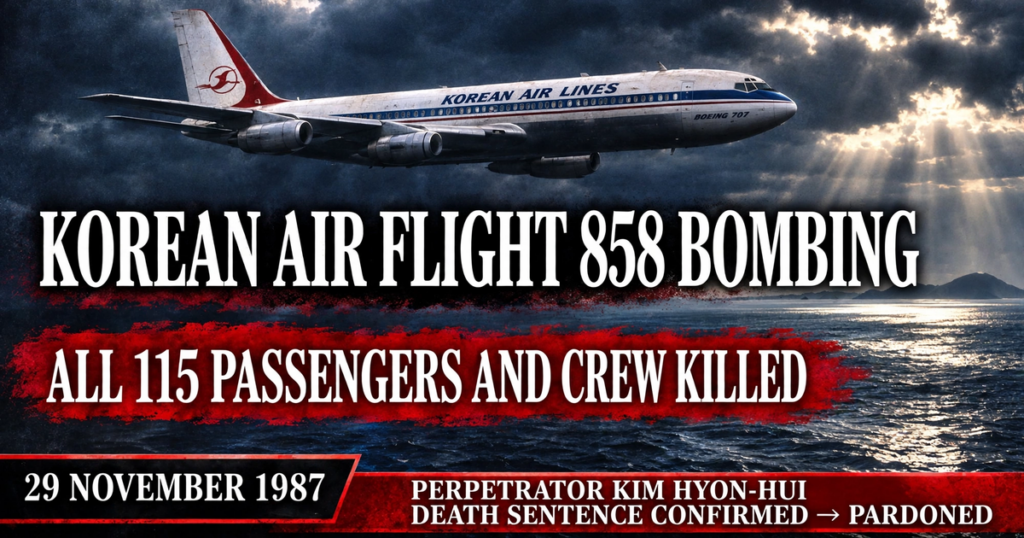
Introduction: The Korean Air Flight 858 bombing and its legal aftermath
On Sunday, 29 November 1987, Korean Air Flight 858, bound for Seoul, South Korea, from Baghdad, Iraq, was bombed over the Andaman Sea. All 115 people aboard, comprising 104 passengers and 11 crew members, died. There were no survivors. Most of the passengers were workers returning to South Korea after completing their employment in the Middle East.
South Korean authorities determined that the incident was an act of terrorism committed by two North Korean agents. Kim Hyon-hui confessed to the crime and stated that its purpose had been to disrupt the Seoul Olympics scheduled for the following year. Her death sentence became final in March 1990, but President Roh Tae-woo granted her a special pardon in April of that year. North Korea denied involvement in the incident, and a South Korean government investigation in 2005 acknowledged that the incident had been exploited for political purposes while rejecting the theory that it had been fabricated. In 2020, the reported discovery of an aircraft believed to be Flight 858 prompted the bereaved families to renew their calls for its recovery and for the truth about the incident to be established.
At a glance
Case: Korean Air aircraft bombing (Korean Air Flight 858 bombing).
Date: Sunday, 29 November 1987.
Location: Over the Andaman Sea.
Aircraft: Korean Air Flight 858, Boeing 707-320B, registration HL7406.
Scheduled route: Baghdad – Abu Dhabi – Bangkok – Seoul (Gimpo International Airport).
Casualties: All 115 aboard died, comprising 104 passengers and 11 crew members; no survivors.
Perpetrators: Kim Hyon-hui (aged 25 at the time) and Kim Seung-il, according to the findings of the South Korean authorities.
Defendant: Kim Hyon-hui.
Indictment: Friday, 3 February 1989, for violations of the National Security Act, the Aviation Act and the Aircraft Operation Safety Act.
Trial: Death sentences at both first instance and on appeal; the sentence became final in the Supreme Court of South Korea on Tuesday, 27 March 1990.
Special pardon: Granted by President Roh Tae-woo on Thursday, 12 April 1990.
Subsequent developments: The South Korean government rejected the fabrication theory in 2005. In 2020, the discovery of a fuselage believed to belong to Flight 858 was reported.
Many passengers on Flight 858 were workers returning home from the Middle East
Korean Air Flight 858 was an international service from Saddam International Airport in Baghdad, Iraq, to Gimpo International Airport in Seoul, South Korea, with scheduled stops in Abu Dhabi in the United Arab Emirates and Bangkok in Thailand. Many of the passengers on the service of 28–29 November 1987 were South Korean workers returning home after working abroad in the Middle East.
Nine of the 104 passengers were flight crew members travelling as passengers rather than performing duties on the flight, a practice known in aviation as deadheading. They comprised three captains, three first officers and three flight engineers. These nine people were counted as passengers, separately from the eleven crew members responsible for operating Flight 858.
A DC-10-30 had originally been scheduled to operate the service, but a change of aircraft resulted in the use of a Boeing 707-320B instead. The aircraft, registered as HL7406, had been manufactured in 1971. It had a history of belly-landing accidents, one in Busan in September 1977 and another at Gimpo Airport on 2 September 1987.
The aircraft disappeared over the Andaman Sea, and all aboard were confirmed dead
Flight 858 lost contact after its last communication with the air traffic control authorities in Rangoon (now Yangon). The final communication concerned its flight altitude and anticipated waypoints. South Korean authorities concluded that an explosion had occurred aboard the aircraft in flight, causing it to break apart in mid-air. The loss of the aircraft was officially confirmed at 14:05 Korean Standard Time on 29 November, and a search for it was conducted in the Andaman Sea.
Wreckage and other material from the aircraft began to be discovered on 10 December. On Saturday, 19 December 1987, twenty days after the incident, all 115 people who had been aboard were confirmed dead. No intact bodies were found, although DNA analysis enabled the identification of some of the human remains that had been recovered.
On 10 March 1990, a section of the outer skin from the upper fuselage, recovered from the seabed, was identified conclusively as wreckage from aircraft HL7406 because it bore the emblem of the Seoul Olympics. The flight recorders, commonly known as black boxes, were not found, however. The South Korean authorities pursued the investigation through examination of the wreckage recovered from the sea and seabed, as well as through their investigation of Kim Hyon-hui, who had been detained in Bahrain.
South Korean authorities determined that explosives aboard Flight 858 had destroyed the aircraft
The investigation by the South Korean authorities concluded that the loss of Flight 858 had been caused by explosives brought aboard the aircraft. During questioning, Kim Hyon-hui stated that she was personally responsible for bringing the explosives aboard. On the basis of this statement and other evidence, the South Korean authorities determined that the aircraft had been bombed by North Korean agents.
Flight 858's last communication with Rangoon air traffic control concerned its flight altitude and anticipated waypoints. Contact was subsequently lost, and the aircraft broke apart in mid-air over the Andaman Sea. Because the flight recorders were never found, there remained limitations on the ability to verify the cause of the loss using recorded flight data.
Two North Korean agents used forged Japanese passports
According to the announcement by the South Korean authorities, the perpetrators were two North Korean agents, Kim Hyon-hui and Kim Seung-il. Kim Jong-il was said to have issued a handwritten order on 7 October 1987 directing the bombing of a Korean Air aircraft in order to prevent South Korea from hosting the Seoul Olympics on its own and to obstruct applications from other countries to participate. The South Korean investigation concluded that this order lay behind the incident.
The two agents' overseas activities in November of that year involved several countries in Europe and the Middle East. Abroad, they posed as a Japanese father and daughter. Kim Seung-il used a forged Japanese passport in the name of Hachiya Shinichi, while Kim Hyon-hui used one in the name of Hachiya Mayumi. Kim Hyon-hui was 25 years old at the time and had received instruction in Japanese language and culture in North Korea.
South Korean authorities determined that both agents had been involved in the bombing of Korean Air Flight 858. Following the incident, their use of forged Japanese passports led to their detention by the Bahraini authorities. Because they had pretended to be Japanese nationals, the Japanese government also became involved in the question of extradition in connection with violations of Japan's Passport Act.
The use of forged Japanese passports led to detention in Bahrain
On Tuesday, 1 December 1987, Kim Hyon-hui and Kim Seung-il were detained by the local authorities at Bahrain International Airport for possessing forged Japanese passports. The grounds for their detention were the passport offences, not an arrest on suspicion of the aircraft bombing. A check of the passport number used by Kim Hyon-hui revealed that it was identical to the number of a passport issued to a man living in Tokushima City, Japan, confirming that her passport was a forgery.
During questioning, both attempted suicide by poisoning. Kim Seung-il died, but Kim Hyon-hui survived. Because Kim Seung-il, one of the two people identified as perpetrators, had died, the subsequent criminal investigation and trial focused on Kim Hyon-hui. Kim Seung-il did not stand trial.
On 5 December 1987, the Japanese government waived its right to request extradition for violations of the Passport Act, the Japanese legislation governing passports. Under the Montreal Convention concerning offences against the safety of civil aviation, the country in which an aircraft is registered also has jurisdiction to prosecute relevant offences. Flight 858's aircraft was registered in South Korea, where Kim Hyon-hui would subsequently face criminal proceedings.
Kim Hyon-hui confessed during questioning by the Agency for National Security Planning
On Tuesday, 15 December 1987, Kim Hyon-hui was handed over to South Korea's Agency for National Security Planning (ANSP), the country's intelligence agency at the time. Initially, she claimed to be a woman named 百華恵 (Bai Huahui) from Heilongjiang Province, China, and denied involvement in the aircraft bombing. This account of her identity differed from the identity recorded in the forged Japanese passport.
During questioning over successive days, the ANSP pointed out inconsistencies in her statements. Kim Hyon-hui subsequently acknowledged that she was a special agent belonging to the Investigation Department of the Central Committee of the Workers' Party of Korea and confessed to the bombing of Korean Air Flight 858. This confession formed part of the basis on which the South Korean authorities determined that the incident was an act of state terrorism by North Korea.
The day after Kim Hyon-hui was handed over to South Korea, 16 December 1987, was polling day in the election of South Korea's thirteenth president. Roh Tae-woo won the election. The transfer of custody on the eve of the presidential election later became one of the issues in the controversy over the political use of the incident.
The stated objective of the attack was to disrupt the Seoul Olympics
Kim Hyon-hui had been recruited as an agent while enrolled in the Japanese Language Department of Pyongyang University of Foreign Studies. Her training at Kumsong Political and Military University focused on impersonating a Japanese national and included instruction in Japanese language and culture from a woman known as Lee Eun-hye.
This woman is believed to be Yaeko Taguchi, a Japanese woman believed to have been abducted from Japan by North Korea. Kim Hyon-hui's testimony thus also linked the Korean Air bombing to the issue of the abductions of Japanese nationals. In addition to the use of forged Japanese passports, her testimony brought to light the involvement in the education of an agent of a woman believed to be a Japanese abduction victim.
According to the results of the South Korean investigation, the purpose of the attack had been to prevent South Korea from hosting the Seoul Olympics scheduled for 1988 on its own and to obstruct other countries' applications to participate. After the incident, however, the Soviet Union and China announced their formal participation in the Seoul Olympics. While South Korean authorities identified North Korea's intention to disrupt the Games as the motive, North Korea denied involvement in the incident itself.
President Roh Tae-woo granted a special pardon sixteen days after the death sentence became final
On Friday, 3 February 1989, Kim Hyon-hui was indicted for violations of the National Security Act, the Aviation Act and the Aircraft Operation Safety Act. The indictment was the formal bringing of criminal charges, distinct from the earlier detention and transfer of custody. The South Korean courts imposed the death penalty both at first instance and on appeal. On Tuesday, 27 March 1990, the Supreme Court of South Korea upheld the death sentence, making it final.
However, on Thursday, 12 April 1990, sixteen days after the death sentence became final, President Roh Tae-woo granted Kim Hyon-hui a special pardon. The measure reflected a political decision to keep her alive as a “living witness” to the incident. The bereaved families protested against the pardon, but the death sentence was not carried out. A special pardon is an act of executive clemency, distinct from a judicial reversal of a conviction. The pardon did not overturn the final conviction, and the findings of the criminal courts concerning the crime remained in force.
In June 1991, Kim Hyon-hui published a memoir entitled Kim Hyon-hui's Complete Confession: Now, as a Woman (a translation of the Japanese title). In 1997, she married a member of South Korea's Agency for National Security Planning, now known as the National Intelligence Service, and had children. The different outcomes represented by the final judicial death sentence and the presidential pardon left a conflict between the political decision to preserve the life of a witness to the incident and the position of bereaved families who sought enforcement of the sentence.
The United States cited the Korean Air bombing in designating North Korea a state sponsor of terrorism
The Korean Air bombing also affected United States policy towards North Korea. On 20 January 1988, the United States designated North Korea a state sponsor of terrorism. The grounds cited for this designation were the bombing of Korean Air Flight 858 and the Rangoon incident of 1983. The Korean Air bombing thus became an international diplomatic issue concerning state terrorism by North Korea.
The United States lifted its designation of North Korea as a state sponsor of terrorism on 11 October 2008, but redesignated the country in 2017. North Korea, meanwhile, has continued to deny involvement in the Korean Air bombing and has not apologised for it. Many years after the incident, the findings of the South Korean courts concerning the crime and the position maintained by North Korea remain at odds.
The South Korean government acknowledged the political use of the incident but rejected the fabrication theory
From immediately after the incident, the North Korean authorities publicised the claim that it had been a plot by South Korean intelligence agencies. The Japan Socialist Party and others also advanced the theory that it had been staged by the South Korean side. The circumstances of Kim Hyon-hui's transfer to South Korea on the eve of the presidential election were another factor behind the controversy concerning the relationship between the incident and politics. In 2005, the South Korean government investigated whether the fabrication allegations were true and announced its conclusion that, although it was true that the incident had been used for political purposes, the incident itself was genuine. The investigation acknowledged its political exploitation but rejected the theory that the bombing itself had been fabricated.
On 11 March 2009, Kim Hyon-hui met the elder brother and child of Japanese abduction victim Yaeko Taguchi in Busan, South Korea. On that occasion she stated, “I was the one who carried out the Korean Air bombing. There is no doubt that it was terrorism by North Korea.” Even approximately nineteen years after her death sentence became final and she received a special pardon, Kim Hyon-hui continued to acknowledge her own responsibility for the crime and explicitly rejected the fabrication theory.
Nevertheless, controversy surrounding the incident continued. On 23 July 2018, bereaved family members filed a criminal complaint against Kim Hyon-hui, alleging that her criticism of a family association that claimed the incident had been staged by Chun Doo-hwan as an act of anti-communist terrorism amounted to defamation. On 26 July 2018, it was reported that South Korean police had begun an investigation. The complaint concerned alleged defamation arising from criticism of the family association; it did not overturn the findings of the 2005 South Korean government investigation or the final judgment against Kim Hyon-hui.
After reports of the fuselage's discovery in 2020, bereaved families called for its recovery
In 2020, South Korea's Munhwa Broadcasting Corporation (MBC) reported that the fuselage of an aircraft believed to be Korean Air Flight 858 had been discovered on the seabed off Myanmar. New information concerning the aircraft was thus reported more than thirty years after the incident, but the fuselage had not been officially confirmed to belong to Flight 858.
In response to the report, bereaved family members called for the fuselage to be recovered and for the truth about the incident to be established. The South Korean government also moved to investigate. With the flight recorders still missing, the bereaved families sought further clarification of the incident through an examination of the aircraft.
Bereaved families continue to seek the truth after the final death sentence and special pardon
The Korean Air bombing was determined by the South Korean authorities to have been an act of state terrorism by North Korean agents, and it also became one of the grounds for the United States' designation of North Korea as a state sponsor of terrorism. Kim Hyon-hui confessed to the crime, and her death sentence became final in March 1990, but she received a presidential special pardon in April of that year. Although the death sentence was not carried out as a result of the pardon, her conviction was not overturned.
The South Korean government's investigation in 2005 acknowledged the political exploitation of the incident while rejecting the theory that it had been fabricated. North Korea, however, continues to deny involvement, and the controversy over the fabrication theory persists. In this incident, which claimed the lives of all 115 people aboard, the bereaved families protested against Kim Hyon-hui's pardon and, following the 2020 reports of the discovery of a fuselage, called for its recovery and for the truth about the incident to be established. Even many years after the bombing, the examination of the aircraft and further clarification of the incident sought by the bereaved families remain outstanding issues.
Original Japanese record: 大韓航空機爆破事件|115人全員死亡、死刑確定から特赦へ――金賢姫の自白と北朝鮮の否定
Last updated:
Related articles
Case record
Dhaka JAL Hijacking (1977): Japan's Extra-Legal Decision
Case record
The Yodo-go Hijacking: Red Army Faction Seizes Japan Airlines Flight 351 and Diverts It to North Korea
Case record
The Shooting of Nagasaki Mayor Hitoshi Motoshima: A Political Assassination Attempt and a 12-Year Sentence
Case record