
Sasago Tunnel Ceiling Collapse
On 2 December 2012, ceiling panels collapsed inside the Sasago Tunnel on the Chuo Expressway in Yamanashi Prefecture, killing nine people and injuring two. A civil court ordered NEXCO Central and its subsidiary to pay more than 443.71 million yen in damages. Criminal investigations ended in April 2020 without any indictment.
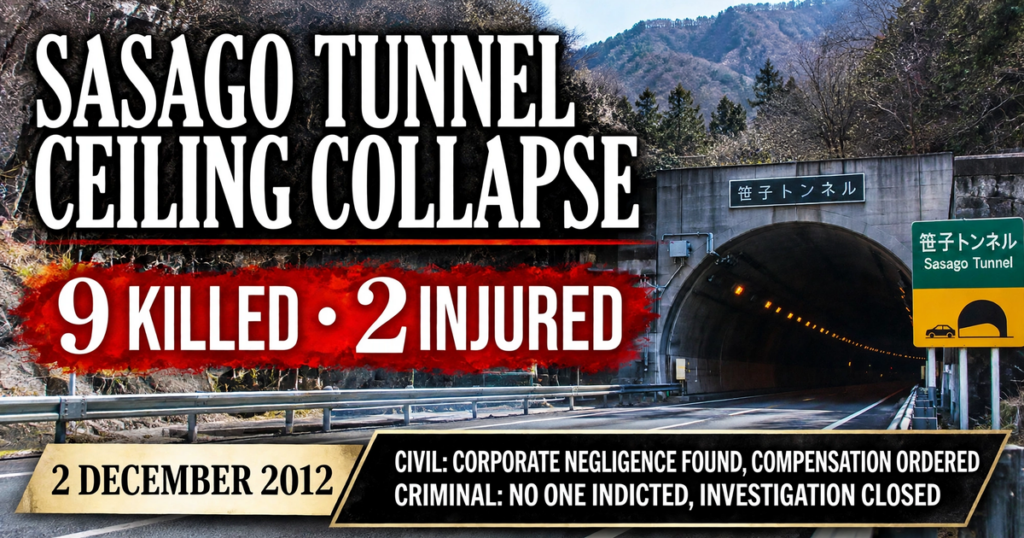
Introduction: The Sasago Tunnel ceiling collapse and its legal aftermath
At around 8:03 a.m. on 2 December 2012, ceiling panels collapsed in the Tokyo-bound bore of the Sasago Tunnel on the Chuo Expressway in Sasago, Otsuki City, Yamanashi Prefecture, killing nine people and injuring two. An investigation committee established by the Ministry of Land, Infrastructure, Transport and Tourism (MLIT) estimated that insufficient strength in the bolts supporting the ceiling panels, deterioration of the adhesive over time and other factors had combined to cause the accident. It also identified shortcomings in the inspections and maintenance arrangements in place before the collapse.
On 22 December 2015, the Yokohama District Court found negligence on the part of Central Nippon Expressway Company (NEXCO Central) and its subsidiary, ordering them to pay the bereaved families more than 443.71 million yen in total. Claims for damages against individual executives who held office at the time of the accident were dismissed, however, and no one was indicted in the criminal proceedings. The civil litigation and criminal proceedings reached different outcomes concerning the companies' negligence in maintenance, the foreseeability of the accident for individuals and the causal relationship between negligence and the collapse.
At a glance
Case: Sasago Tunnel ceiling collapse.
Date: Sunday, 2 December 2012, at around 8:03 a.m.
Location: Sasago, Otsuki City, Yamanashi Prefecture; the Tokyo-bound bore of the Sasago Tunnel on the Chuo Expressway, approximately 1.5 km from the Tokyo-side portal.
Casualties: Nine fatalities and two injuries.
Operator: Central Nippon Expressway Company Limited (NEXCO Central).
Tunnel: Opened to traffic on 20 December 1977. The Tokyo-bound bore is 4,784 metres long and the opposite bore 4,717 metres long. The tunnel employed a transverse ventilation system.
Cause: The collapse was estimated to have resulted from multiple factors, including insufficient strength in adhesive anchor bolts at the tunnel crown dating back to design and construction, and deterioration of the adhesive over time. Deficiencies in pre-accident inspections and maintenance arrangements were also identified.
Civil litigation: On 22 December 2015, the Yokohama District Court ordered two companies to pay more than 443.71 million yen in total; the judgment became final. A settlement with a woman who survived the accident was reached on 8 February 2016. On 30 May 2017, the Supreme Court's dismissal of the final appeal made the rejection of individual executives' liability for damages final.
Criminal proceedings: Police referred the cases of eight individuals to prosecutors on 30 November 2017. On 23 March 2018, prosecutors declined to indict all eight for insufficient evidence. Following a Committee for Inquest of Prosecution resolution that non-prosecution was inappropriate, prosecutors again declined to indict two inspection personnel for insufficient evidence on 9 April 2020, ending the investigation. No one was indicted.
Institutional impact: The government designated 2013 as the first year of infrastructure maintenance and formulated a Basic Plan for Infrastructure Longevity. The Road Act enforcement regulations were amended in 2014 to mandate periodic inspections every five years. The Expressway Renewal Project began in fiscal 2015.
Current situation: Full reopening on 8 February 2013. Memorials unveiled on 13 April 2019. A safety awareness training facility was shown to the media and bereaved families on 25 March 2021. A memorial ceremony is held annually on 2 December. In late December 2024, a document containing 57 internal observations on the causes and background of the accident was disclosed to the bereaved families for the first time.
At 8:03 a.m., ceiling panels collapsed along approximately 138 metres
At around 8:03 a.m. on 2 December 2012, ceiling panels collapsed in the Tokyo-bound bore of the Sasago Tunnel on the Chuo Expressway, in Sasago, Otsuki City, Yamanashi Prefecture. The panels measured 5 metres across and 1.2 metres deep, were approximately 8 or 9 centimetres thick, and weighed about 1.2 metric tonnes each. Approximately 270 panels, including partition panels, collapsed along a stretch of about 138 metres, folding over one another in a V-shaped formation. The affected section was approximately 1.5 kilometres from the Tokyo-side portal.
Three vehicles traveling through the tunnel were buried beneath the panels, and two of them caught fire. Nine people died and two were injured. The nine fatalities comprised five men and women in their twenties traveling in a rented van, three occupants of a passenger car (a man and a woman in their seventies and a woman in her sixties), and a male truck driver in his fifties. Rescue operations continued until 3 December. The collapse rendered the ventilation ducts and smoke extraction equipment inoperative. Hot smoke filled the tunnel, preventing rescue teams from approaching the accident site.
Ventilation panels and a 5.3-metre duct space above them
The Sasago Tunnel opened to traffic on 20 December 1977. The Tokyo-bound bore measured 4,784 metres and the opposite bore 4,717 metres, and a transverse ventilation system was adopted. In this type of ventilation system, a duct space is provided between the ceiling panels and the concrete tunnel lining. The distance from the panels to the top of the tunnel was 5.3 metres. The panels forming part of the system for exchanging air within the tunnel extended across its upper section.
The ceiling panels were suspended from adhesive anchor bolts installed at the tunnel crown. In this arrangement, the panels used for tunnel ventilation were supported by bolts. The design of these panels and the manner in which they were supported subsequently became central issues in the examination of the accident's causes.
Insufficient bolt strength and deterioration of adhesive were identified as combined factors
On 18 June 2013, MLIT's Investigation and Examination Committee on the Tunnel Ceiling Panel Collapse Accident published its final report. The report attributed the accident to a combination of factors. It pointed to insufficient strength in the adhesive anchor bolts at the tunnel crown dating back to the design and construction stages, and noted that some anchors had not achieved the specified adhesive pull-out strength even when construction was completed.
The committee estimated that deterioration of the adhesive over time compounded those original deficiencies in strength, eventually allowing bolts to pull out and ceiling panels and associated components to fall. The report did not attribute the accident solely to deterioration occurring after the tunnel opened to traffic; it also identified insufficient strength dating back to the original construction as a contributing factor.
The bolts at the tunnel crown had not undergone close-up inspection for 12 years
The Sasago Tunnel underwent routine inspections once a year and detailed inspections once every five years. The detailed inspection carried out in September 2012, shortly before the accident, had also reported no abnormalities. However, sounding tests, which involve tapping components and listening for indications of defects, were performed only when visual inspections identified an abnormality. They had not been carried out since 2000. At a press conference on 2 December 2012, NEXCO Central disclosed that in areas beyond inspectors' reach, it had relied on visual inspections without conducting sounding tests.
The investigation committee's final report pointed out that the bolts at the tunnel crown had not been subjected to close-up visual inspection or sounding tests for 12 years. It concluded that the pre-accident inspections and maintenance arrangements for the ceiling panels of the Sasago Tunnel had to be regarded as inadequate. Although periodic inspections had been scheduled, the condition of the bolts supporting the ceiling panels had not been adequately checked. This emerged as a significant maintenance problem.
113 of 183 bolts tested fell short of their design load capacity
The results of bolt strength tests announced on 1 February 2013 concerned 183 bolts in sections that had not collapsed. Of those, 113 pulled out under loads below the design capacity of four metric tonnes. Sixteen of them could not even withstand the average load of 1.2 metric tonnes required to support the ceiling panels and their suspension fittings. Many bolts in the sections that had escaped collapse therefore failed to meet the strength specified in the design.
Emergency inspections after the accident identified at least 670 defects in the opposite bore, including missing or loose anchor bolts in the suspension fittings. In the Tokyo-bound bore, defects such as looseness or missing bolts were also found at 1,211 of 11,613 anchor-bolt locations. The strength tests and emergency inspections established that insufficient bolt strength and problems with the condition of the fixings were not confined to the section that had collapsed.
Police established an investigation headquarters, and the tunnel fully reopened after 68 days
In the early hours of 3 December 2012, Yamanashi Prefectural Police opened an investigation on suspicion of causing death and injury through occupational negligence and established an investigation headquarters at Otsuki Police Station. On the morning of 4 December, police searched six locations, including NEXCO Central's headquarters, its Hachioji Branch, the Otsuki Maintenance and Service Center and Central Nippon Highway Engineering Tokyo, which had carried out inspections. Meanwhile, MLIT ordered emergency inspections of 49 tunnels of the same type nationwide on 3 December and established its investigation committee on 4 December. The investigation into potential criminal responsibility proceeded alongside the inquiry into the causes of the accident and measures to prevent recurrence.
Work to restore the Sasago Tunnel also proceeded. After its ceiling panels were removed, the opposite bore temporarily reopened to two-way traffic on 29 December 2012, with a speed limit of 40 kilometres per hour inside the tunnel. At 4 p.m. on 8 February 2013, the Tokyo-bound bore reopened as well. For the first time in 68 days since the accident, two lanes were available in each direction. The speed limit returned to its pre-accident level of 70 kilometres per hour, marking the completion of the restoration.
The Yokohama District Court found corporate negligence and ordered payment of more than 443.71 million yen
Families who had lost relatives in the accident filed a civil lawsuit against NEXCO Central and its subsidiary in the Yokohama District Court, seeking a total of approximately 910 million yen in damages. The issue in the civil action was whether the companies responsible for maintaining the tunnel had conducted the inspections necessary to ensure the safety of the ceiling panels. A civil damages action in Japan seeks compensation for losses; it is distinct from a criminal prosecution seeking punishment for an offense.
On Tuesday, 22 December 2015, the Yokohama District Court ordered the two companies to pay more than 443.71 million yen in total. The court found the companies negligent, reasoning that the accident could have been prevented through proper inspections. The companies were thus held civilly liable because the inspections carried out before the accident were inadequate. Neither the plaintiffs nor the defendants appealed, and the judgment became final.
A settlement was reached with the surviving woman, while claims against individual executives were dismissed
A woman who had been traveling in the van and survived despite suffering injuries also filed a lawsuit in the Yokohama District Court, seeking approximately 26 million yen in damages from NEXCO Central, its subsidiary and four people who had been executives of the two companies at the time of the accident. On Monday, 8 February 2016, a settlement was reached at the Yokohama District Court. The specific terms of the settlement were not made public.
Meanwhile, the bereaved families of the five people who died in the van brought a separate damages action against four NEXCO Central executives who had held office at the time of the accident. On Tuesday, 16 February 2016, Presiding Judge Hiromu Ichimura (市村弘) of the Yokohama District Court dismissed their claims, stating that it could not be established that the four executives could have foreseen the accident. Whereas negligence had been established in the action against the companies on the basis of inadequate inspections, the separate action against the individual executives produced a different finding concerning whether each of them could have foreseen the accident.
The rejection of individual executives' liability for damages became final in the Supreme Court
Following the Yokohama District Court judgment dismissing the damages claims against the individual executives, nine of the twelve plaintiffs appealed to the Tokyo High Court on 29 February 2016. On Wednesday, 19 October of that year, Presiding Judge 河野清孝 of the Tokyo High Court upheld the first-instance judgment and dismissed the appeal, stating that the executives had neither authority nor responsibility in relation to road inspection work and could not be regarded as having been grossly negligent.
The bereaved families lodged a further appeal with the Supreme Court of Japan. On Tuesday, 30 May 2017, the Supreme Court issued a decision dismissing that appeal, on the stated grounds that the former president and the other executives had not been in positions in which they would have known the structure of the ceiling panels or the inspection results. This made the rejection of the individual executives' liability for damages final. Although negligence in the companies' maintenance operations had been established, the executives were not held individually liable for damages, in view of their authority and responsibilities regarding inspection work and the foreseeability of the accident.
Prosecutors declined to indict all eight people whose cases had been referred by police
On Thursday, 30 November 2017, Yamanashi Prefectural Police referred the cases of eight people to prosecutors on suspicion of causing death and injury through occupational negligence. They included a former president and a former senior managing director of NEXCO Central, as well as executives who had been in office at the relevant branch and subsidiary responsible for preparing inspection plans. In Japan, referral of case documents to prosecutors (shorui soken) is not an indictment; prosecutors subsequently determine whether to bring charges. On Friday, 23 March 2018, the Kofu District Public Prosecutors Office decided not to indict any of the eight for insufficient evidence. Prosecutors concluded that the collapse might not have been foreseeable even if inspections and checks by touch had been performed according to the manual, making it difficult to establish a causal relationship between the alleged negligence and the accident.
In a request dated 1 August 2018, the bereaved families applied to the Kofu Committee for Inquest of Prosecution for a review. Such a committee consists of citizens selected by lot and reviews the appropriateness of prosecutors' decisions not to indict. In a resolution dated 23 July 2019, the Kofu committee found non-prosecution inappropriate for two inspection personnel out of ten people whose cases it reviewed. This type of resolution requires prosecutors to reconsider their decision; it does not itself institute criminal proceedings. In response to the resolution, the Kofu District Public Prosecutors Office reinvestigated the cases, but on Thursday, 9 April 2020, it again declined to indict the two for insufficient evidence. Corporate negligence had been established in civil litigation and the judgment ordering compensation had become final, whereas in the criminal proceedings prosecutors considered it difficult to prove the causal relationship between individual negligence and the accident. No criminal trial was held, and the investigation ended without anyone being indicted.
Why the civil and criminal proceedings reached different outcomes
In the civil action against the companies, shortcomings in the inspection arrangements at the organizational level were recognized as negligence. The Yokohama District Court determined that proper inspections could have prevented the accident. In the criminal proceedings, by contrast, it was necessary to establish whether particular individuals could have foreseen the accident and whether their negligence was causally connected to it. The Kofu District Public Prosecutors Office concluded that the collapse might not have been foreseeable even if the inspections and physical checks had been carried out in accordance with the manual, and judged that establishing causation would be difficult.
In the civil action against the executives individually, the grounds for denying liability for damages also included the executives' lack of authority or responsibility for road inspection work and the fact that they were not in positions in which they would have been aware of the structure of the ceiling panels or the inspection results. The responsibility of the corporate organizations for maintenance and the criminal responsibility of particular individuals were examined under different legal frameworks. Consequently, the civil judgment recognizing negligence on the part of the companies became final, while the criminal proceedings ended without anyone being indicted.
The first year of infrastructure maintenance and mandatory inspections every five years
The Sasago Tunnel ceiling collapse also had a major impact on the system for maintaining road infrastructure. The Japanese government designated 2013 as the first year of infrastructure maintenance and formulated the Basic Plan for Infrastructure Longevity. In 2014, it amended the regulations implementing the Road Act, making periodic inspections of tunnels and bridges compulsory once every five years. This established a legal inspection requirement rather than merely a maintenance schedule adopted by an individual operator.
Beginning in fiscal 2015, large-scale renewal and repair works known as the Expressway Renewal Project were launched. Emergency inspections of similar tunnels nationwide immediately after the accident also identified defects in 16 tunnels, and ceiling panels were progressively removed in various parts of the country. The response to the accident extended beyond restoring the Sasago Tunnel to reforming the inspection system for road infrastructure throughout Japan and undertaking extensive renewal and repair of existing facilities.
Memorials, a safety awareness facility and the words of the bereaved families
Two memorials were erected to commemorate the victims of the accident, one at the Hatsukari Parking Area on the carriageway away from Tokyo and the other near the entrance to the Sasago Tunnel on that same carriageway. An unveiling ceremony took place on Saturday, 13 April 2019. Every year on 2 December, NEXCO Central holds a memorial ceremony at the accident site, observing a moment of silence and laying flowers.
The van in which five people died is displayed at a NEXCO Central training facility. On Thursday, 25 March 2021, a newly established Safety Awareness Center on the grounds of the Hachioji Branch was shown to members of the media and the bereaved families. The center is a facility for employee training intended to convey the lessons of the accident, and the company has adopted a policy of not opening it to the general public.
In late December 2024, NEXCO Central disclosed to the bereaved families for the first time a document containing 57 observations collected from employees and others a little over a month after the accident, entitled Possible Causes and Background Factors of the Accident. Among the observations concerning the company's organizational culture were references to a complacent belief that an accident attributable to the company's own failings could not occur, and to a culture in which construction had come to receive preferential treatment over maintenance, both organizationally and in employee performance evaluations. Even after the civil litigation had concluded and the criminal investigation had ended, the bereaved families continued to seek clarification of the causes and background of the accident. At the memorial ceremony on 2 December 2022, marking the tenth anniversary of the collapse, a bereaved family member pleaded, “I want to know before I die why a life was taken.”
Original Japanese record: 笹子トンネル天井板崩落事故|民事で認められた会社の過失と、刑事では誰も起訴されなかった判断の分かれ
Last updated:
Related articles
Case record
Japan Airlines Flight 350 Crash: No Indictment of Captain
Case record
The Ikebukuro Runaway-Car Crash: Two Deaths, a Five-Year Sentence and the Driver's Death in Custody
Case record
The Kyoto Gion Runaway Van Crash: Seven Pedestrian Deaths, a Driver's Medical History and Changes to Driving-Licence Rules
Case record