
The 300 Million Yen Robbery: The 'Perfect Crime' with Evidence Everywhere — A Fake Police Motorcycle and 294,307,500 Yen That Vanished
On 10 December 1968, a man disguised as a police motorcycle officer stopped a cash-in-transit vehicle in Fuchu, Tokyo, and took 294,307,500 yen in employees' bonuses. The crime lasted about three minutes and left many physical clues, but the evidence did not identify a suspect. Police examined approximately 110,000 people, and the case reached the statute of limitations on 10 December 1975. The many later theories about the offender remain unproven.
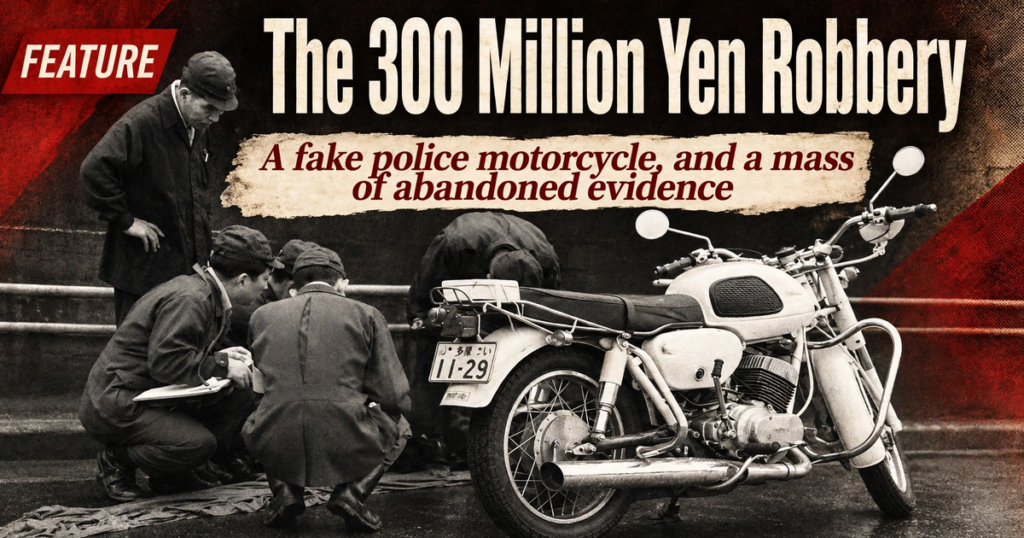
Introduction: 294,307,500 yen disappeared in about three minutes
At around 9:25 a.m. on 10 December 1968, a man dressed to look like a police motorcycle officer stopped a cash-in-transit vehicle on a road in Fuchu, Tokyo. He told the four bank employees inside that a bomb had been placed in the vehicle. The employees got out to inspect it. The man then used a flare to create smoke and drove away in the cash vehicle, taking 294,307,500 yen.
No one was killed or injured. The money was never recovered, and the offender was never arrested. The case became known as the 300 Million Yen Robbery, although the exact amount taken was 294,307,500 yen.
The investigation left behind a large number of clues: a fake police motorcycle, stolen vehicles, fingerprints, banknote serial numbers, a megaphone and other objects. The existence of many items, however, is not the same as having evidence that identifies a particular person. Each item had to be connected to the offender in a way that excluded innocent use or accidental contact.
The case is often called a perfect crime because the offender was never caught. But the more difficult question is why so many clues did not lead to an identity. The story is not only about a dramatic disguise. It is about the limits of evidence when objects cannot be tied to one person.
Although the incident is popularly called a robbery, the legal classification recorded in the reference material is theft. The familiar name should not be taken as a technical description of the offence charged.
A fake police motorcycle stopped the cash vehicle in Fuchu
The money was being transported from the Kokubunji branch of Nippon Trust Bank to Toshiba's Fuchu Works for winter bonuses. TBS News Dig reported that 4,525 employees were due to receive the bonuses. Four bank employees were inside the cash-in-transit vehicle, and the money was divided among three aluminium cases.
On a road north of Fuchu Prison, a man riding a white-painted motorcycle stopped the vehicle. He wore a white helmet and mask and a black leather jacket, creating the appearance of a traffic police officer. A reconstruction of testimony by Hachibei Hiratsuka, published about three years after the incident, described the disguise.
The man told the bank employees that a bomb had been placed in the vehicle. He pretended to inspect underneath it and ignited a flare, making the smoke and flame look like an explosion. The four employees moved away from the vehicle. While they were out of the way, the man entered the driver's seat and drove off with the cash.
The method relied on the employees believing that the man was a police officer warning them of danger. He did not overpower them by force. He used the authority and trust associated with a police uniform to make them leave the vehicle.
A threatening letter had arrived four days earlier
On 6 December, four days before the robbery, a threatening letter demanding 3 million yen was delivered to the branch manager of Nippon Trust Bank. A reconstruction of a 1972 Weekly Shincho article published by Shincho Que reported that the people responsible for the cash transfer knew about the letter.
That background helps explain why the bank employees believed the supposed police officer when he said that the branch manager's home had been bombed and that there was a bomb in the cash vehicle. The threat made the warning seem like a real emergency.
But the existence of the 6 December letter does not prove that the same person or group carried out the robbery on 10 December. No final judicial or official determination established that the two incidents were committed by the same offender. The connection is a theory that must be kept separate from the confirmed facts.
The cash-in-transit vehicle was found, but the money was gone
Police began a wide search after the robbery. According to Hiratsuka's account as reconstructed by Shincho Que, the cash-in-transit vehicle was found about one hour later in a cemetery in Kokubunji, approximately 1.5 kilometres from the scene. The three aluminium cases had been removed.
It is important to distinguish the cash-in-transit vehicle taken from the scene from the vehicle later used to escape. Finding the first vehicle did not mean that the offender had travelled far away. Investigators now had to trace the money and identify the vehicle used after the cases were moved.
On 9 April 1969, approximately four months after the robbery, a vehicle believed to have been used for the escape and the emptied aluminium cases were found in an apartment parking area in Koganei, Tokyo. Fuji Television's chronology and TBS reporting both identify that date as the discovery of the getaway vehicle and cases.
The green Toyota Corolla believed to have carried the cases was itself a stolen vehicle. Police said it had been stolen from a garage in Hino City on 30 November 1968. The fact that the vehicle and its theft location were identified did not establish who had used it. Investigators still needed evidence showing who took it, how it was used and who transferred the money from the cash-in-transit vehicle.
More than 110,000 people were examined, but no suspect was established
A Diet answer on 24 June 1975 disclosed the scale of the investigation. A special investigation headquarters had been set up at Fuchu Police Station. At its largest, it had 197 members. By 23 June 1975, the cumulative number of investigators assigned had reached 160,164. As the limitation period approached, the central investigative team had been reduced to approximately thirty officers.
About 110,000 people had been treated as investigative subjects. This number included people who were not established as suspects. Thirty-two people had been questioned as persons of interest, and compulsory investigative measures had been taken against one person.
These figures show how broadly the police investigated, but they do not mean that 110,000 people were formally accused. Nor does the fact that one person was subject to compulsory measures establish that the person was the offender. A large investigative pool is not the same as a proven suspect.
Only the serial numbers of the 500-yen notes had been recorded
Banknote serial numbers could have helped trace the stolen money. If the numbers had been recorded, a note later deposited at a bank or used in a shop might have been linked to the money taken in the robbery.
In the Diet answer on 24 June 1975, a National Police Agency official said that the serial numbers recorded were those of the 500-yen notes. The status of the serial numbers on the other denominations was not clear. When a committee member asked how many 500-yen notes there were, the official could not provide the number from the materials available at the hearing.
The police therefore could not trace the entire sum by serial number. They had to look for the limited number of notes whose numbers were known and determine whether any appeared in circulation.
This is also important when assessing later stories that the offender spent a large amount of money or exchanged it somewhere. Without objective evidence such as a recorded banknote number, it is not possible to establish that a particular sum was part of the stolen money.
Were there 124 pieces of evidence or 153?
The case is also remembered for the large number of items left behind. Some Fuji Television programmes and features described 153 pieces of evidence. A 2020 Fuji Television programme used a figure of 124.
The available sources do not establish a single reason for the difference. The count may depend on what is treated as one item and whether vehicles, parts and individual objects are included separately. The feature therefore does not force the total into one figure. It is more accurate to say that many items were recovered and to examine the principal objects described in the official record.
The existence of numerous objects does not mean that each had the same evidential value. An object may show how the crime was carried out, but unless it can be tied to a particular person it may not identify the offender. The central issue is not the total number of objects, but whether each item can be connected to a specific individual.
Hachibei Hiratsuka's criticism was his own retrospective view
Hachibei Hiratsuka, a detective in the Tokyo Metropolitan Police Department's First Investigation Division who later joined the inquiry, reflected on the investigation in a 1972 Weekly Shincho article. A 2026 reconstruction by Shincho Que quoted his view that shortcomings in the initial investigation had contributed significantly to the case becoming a mystery.
Hiratsuka argued that large investigations can become disorganised as the number of officers increases and information-sharing between units becomes difficult. Media attention and public pressure can also create a risk that investigators focus on the spectacle of a case rather than carefully checking each piece of evidence.
This was Hiratsuka's personal assessment of the investigation, not an official finding by the police organisation. He joined the special investigation headquarters on 24 April 1969, approximately four months after the robbery. He had not personally conducted the entire initial response. His criticism is valuable as the view of an experienced investigator, but it should not be presented as a final institutional explanation for why the case remained unsolved.
The statute of limitations expired on 10 December 1975
At midnight on 10 December 1975, seven years after the robbery, the statute of limitations for public prosecution expired. The police had conducted a large investigation, but no offender had been arrested and the case did not reach a criminal trial.
The expiry of the limitation period did not mean that a defendant had been acquitted. No person had been indicted as the offender, and no court had issued a judgment of guilt or innocence. The case ended as an unsolved incident for which prosecution was no longer possible under the limitation rules then in force.
The Encyclopaedia Britannica entry in Kotobank also records that the civil limitation period expired on 10 December 1988. That later date concerned civil claims and should not be confused with the 1975 expiry of the public-prosecution limitation period.
The evidence did not establish any of the later offender theories
More than half a century after the robbery, books and television programmes continue to discuss theories about who committed it. These include theories involving a lone offender, several offenders, a particular young person or relatives of people connected with the police.
None of these theories was established in a criminal trial. Being investigated by police, being named in a media report or being the subject of a later author's circumstantial reconstruction does not mean that a person was proven to be the offender.
The use of real names or family relationships in an offender theory can seriously affect the person concerned and their relatives. It is not responsible to present a person as the perpetrator when public records do not establish that conclusion.
What can be stated with confidence is that a cash-in-transit vehicle was taken on 10 December 1968, 294,307,500 yen was stolen, police conducted a large investigation and the limitation period expired on 10 December 1975 without the offender being identified. The offender has never been established in criminal proceedings.
At a glance
Date and time: 10 December 1968, around 9:25 a.m. Location: a road near Fuchu Prison, Tokyo. Amount taken: 294,307,500 yen in winter bonuses for employees of Toshiba's Fuchu Works; 4,525 employees were reported as bonus recipients. Victims: four bank employees were in the cash vehicle; no one was killed or injured. Method: a man disguised as a police motorcycle officer used a bomb warning and a flare to make the employees leave the vehicle, then drove it away. Duration: about three minutes. The cash-in-transit vehicle was found about one hour later, approximately 1.5 kilometres away. A stolen green Toyota Corolla and the emptied cases were found in Koganei on 9 April 1969. Investigation by 23 June 1975: 160,164 cumulative investigators, 197 at peak, approximately 110,000 investigative subjects, 32 persons questioned as persons of interest and one person subject to compulsory measures. Public-prosecution limitation period: expired at midnight on 10 December 1975. Civil limitation period: 10 December 1988. No suspect was arrested, no trial was held and no offender theory has been judicially established.
Original Japanese feature: 三億円事件【特集】|証拠だらけの「完全犯罪」――偽白バイと消えた2億9430万7500円
Last updated:
Related articles
Same case · Case record
The 300 Million Yen Robbery: The Unsolved Theft of Japan's Showa Era
Case record
The King of Comedy Kenichi Takahashi School-Uniform Theft Case: 182 Items, 25 Victims, and a Suspended Sentence
Case record
The Luffy Wide-Area Robbery Cases: Four Separate Leadership Trials and Their Different Legal Stages
Case record