
The Kitakyushu Confinement Murders: How Futoshi Matsunaga Broke a Family and Subjugated Even a Former Police Officer
A former police officer was among the relatives who came under Futoshi Matsunaga's control. Through violence, isolation, financial exploitation and forced family meetings, Matsunaga turned family ties into instruments of domination. Seven people died. The Supreme Court's separate 2011 decisions upheld Matsunaga's death sentence and Junko Ogata's life sentence, while judges disagreed over how her prolonged abuse should affect punishment.
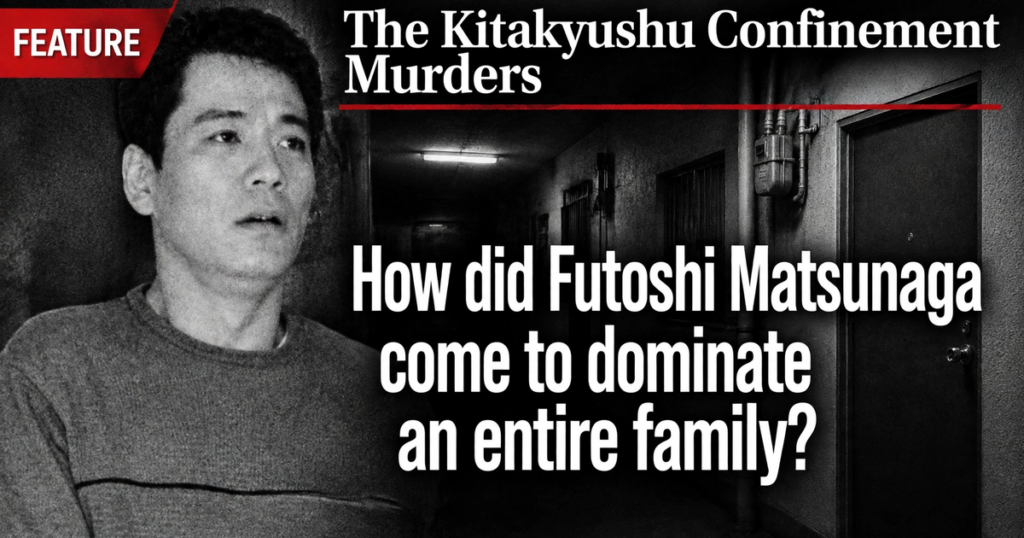
Introduction: A former police officer could not protect his family
A former police officer was among the relatives who became unable to disobey Futoshi Matsunaga. Family members were made to monitor one another and eventually became involved in killings. Why did family ties become not a route to escape, but a means of strengthening control? Two Supreme Court decisions issued on 12 December 2011 preserve the process and the judges' differing views on how to assess the responsibility of an accomplice.
The Kitakyushu Confinement Murders are sometimes described as a case in which one family killed members of its own family. That description leaves out the most important feature: Matsunaga created a situation in which relatives were made to obey through violence and fear. In a separate decision from the judgment upholding Matsunaga's death sentence, the Supreme Court maintained a life sentence for Junko Ogata. Justice Koji Miyagawa's supplementary opinion referred to the fact that Ogata's sister's husband had been a former police officer. Even a man with a job and a family life lost his health and ability to make independent decisions under Matsunaga's control.
Experience in police work does not make a person immune to prolonged abuse. The fact that a former officer was brought into submission warns against dismissing people under coercive control as simply weak.
Seven deaths, but not seven murders in the legal record
The Supreme Court's account identified seven deaths: the first male victim and six members of Ogata's family who died later. Six deaths were legally classified as murder and one as injury causing death. When the case came to light in 2002, bodies had not been recovered. Police had to reconstruct the events by comparing statements with objective records.
The numbers alone do not show how Matsunaga drew the family into his control. The entry point was not an explicit threat to kill relatives. It involved money and the claim that he was protecting a family member.
Money was taken from a family under the pretext of sheltering a daughter
Matsunaga and Ogata were wanted in connection with fraud and other suspected offences and were living as fugitives. They needed money. According to the Supreme Court judgment, they first brought a man they had met into their household, subjected him to routine violence and unreasonable restrictions on food, and made him obtain a large amount of money. After prolonged abuse, he became severely weakened and died without receiving necessary medical treatment.
About two years after that man's death, a similar system of exploitation was directed at Ogata's family home. Matsunaga persuaded Ogata's parents and sister that Ogata had committed a serious crime. He demanded money as payment for hiding and looking after her so that she would not be found by police. He also made the family promise to provide for the household. Ogata's parents, her sister and brother-in-law, and their two children were brought to live together.
The relatives were not initially invited on the explicit announcement that they would be killed. Their wish to protect a daughter or sister was connected to financial demands. Once they had entered the same living environment, repeated assaults, including electric shocks, followed. Matsunaga used the family's desire to protect Ogata, brought them together, demanded money and used violence when they resisted. Family bonds, which might normally help people withstand an outside threat, were turned into the means by which the family was drawn in and controlled.
Work, outside contact and trust within the family were stripped away
Justice Miyagawa's supplementary opinion described how the family had previously gone to work and maintained relationships with relatives and acquaintances. That life changed through Matsunaga's intervention. Family members stopped going to work, lost contact with people outside and moved into a shared apartment. Violence was combined with differences in treatment. Gradually, relatives began to distrust one another, and it became harder to cooperate even while living in the same space.
It is natural to ask why everyone did not escape together. But that question assumes they retained the freedom to think, consult one another and act. The Supreme Court's reasoning recognised that those conditions had been taken away. Prolonged electric shocks and abuse created a psychological state in which disobeying Matsunaga was difficult. The issue was not limited to Ogata; her sister and brother-in-law were also considered to have been placed in such a state.
The convenient word “brainwashing” makes the explanation short, but the judgments describe no supernatural power. They identify concrete actions: financial exploitation, isolation from outsiders, violence, unequal treatment and mutual distrust. These actions appeared separate but were connected in the way they narrowed the family's ability to help one another.
Family members carried out acts; Matsunaga made the decisions
Ogata's father died after Ogata subjected him to electric shocks at Matsunaga's direction. The killings then extended to the remaining relatives: her mother, sister, brother-in-law and two young children. The Supreme Court found that the defendants exploited a situation in which the victims' will had been suppressed and made members of the victims' own family participate in the acts.
Matsunaga did not personally carry out every offence. The Supreme Court judgment concerning him emphasised that he decided on the assaults and killings and caused them to be carried out through Ogata or through his own direct instructions, even where he did not perform the physical act. The court distinguished the identity of the person who carried out an act from the person who decided and led the criminal course of conduct.
When relatives are made to hurt one another, they may no longer be able to trust one another. Control can continue even when the person giving orders is not physically present. The Supreme Court also found that when Matsunaga could no longer obtain money from the family, he killed remaining members in sequence to prevent earlier crimes from being exposed and to avoid interference with his life as a fugitive. A system of control used to extract money became a system of killings intended to silence witnesses.
Junko Ogata was both an offender and a person subjected to Matsunaga's violence
Ogata's position left the courts with a difficult question. She played a serious role in the killings of relatives, and the Supreme Court did not deny that fact. She was directly involved in the killings of her young nephew and niece. At the same time, the courts found that Matsunaga had subjected her to severe violence and restrictions on her movements for a long period, and that the abuse intensified after she tried to escape and was brought back.
At first instance in 2005, both Matsunaga and Ogata were sentenced to death. In 2007, the Fukuoka High Court maintained Matsunaga's death sentence but changed Ogata's sentence to life imprisonment. That did not mean that Ogata had committed no crime. In 2011, the Supreme Court majority considered that Matsunaga was the ringleader, that Ogata had followed him while her ability to make normal judgements was diminished, and that she had made active statements about offences for which evidence was limited, helping clarify the case. The Court concluded that maintaining life imprisonment rather than imposing death was not manifestly unjust.
The distinction is important. A reduction to life imprisonment did not mean that Ogata had no responsibility. The Supreme Court recognised the gravity of her criminal responsibility and that the death penalty deserved serious consideration. It nevertheless reflected the difference between her role and Matsunaga's leadership, as well as the circumstances of her subjection to control.
The same Supreme Court proceedings contained sharply different judicial views
The Supreme Court decision concerning Ogata included not only the majority opinion but also a supplementary opinion by Justice Koji Miyagawa and a dissent by Justice Yutaka Yokota. Their views show that the court's understanding of the case was not unanimous.
Justice Miyagawa examined in detail how the family had been separated from workplaces and the outside world and pushed into a state of mutual suspicion. He referred to psychiatric analysis presented at trial. While reserving that repeated abuse did not explain everything about Ogata, he treated its effects on her mental state as important to sentencing.
Justice Yokota took the view that Ogata's death sentence should not have been avoided. He accepted that she had been abused by Matsunaga but considered that she had acted on her own initiative in pursuit of the shared interest she and Matsunaga had in escaping criminal responsibility. The judges reached different assessments of the weight of her responsibility from the same facts.
Both views began from the seriousness of Ogata's conduct. They differed over how far the effects of domination and violence should influence the choice of sentence. The proceedings show that a claim of having been controlled does not automatically erase responsibility, just as the fact that someone acted under orders does not diminish the responsibility of the person who gave them.
The case became visible only after a 17-year-old girl escaped
In March 2002, a 17-year-old girl escaped from the place where she had been confined and sought help from her grandparents. The investigation began with her confinement and abuse and gradually revealed the deaths of people whose whereabouts had been unknown.
No bodies had been left for investigators to recover. Ogata's later statements were important in clarifying a case with limited physical evidence, as the Supreme Court recognised. But the existence of a confession did not mean that every detail became clear. The long trial examined the relationship between those who physically acted and those who gave instructions, as well as how much freedom of will Ogata had retained.
It is easy to call Matsunaga a monster. That label does not show what he actually did: he connected demands for money to a family's wish to protect a daughter, blocked escape through violence, destroyed trust among relatives and used the hands of people he had driven into submission to carry out further crimes. The Supreme Court record describes the transformation of human relationships into instruments of control. At the centre of the seven deaths was not an inexplicable communal household, but a system of violence and exploitation created by Matsunaga.
At a glance
Main period: approximately 1996–1998; the case came to light in March 2002. Location: Kitakyushu, Fukuoka Prefecture, and surrounding areas. Deaths: seven (six murders and one injury-causing-death offence). Principal defendants: Futoshi Matsunaga and Junko Ogata. First instance: September 2005, death sentences for both. Appeal: September 2007, Matsunaga's death sentence maintained and Ogata's sentence changed to life imprisonment. Supreme Court: 12 December 2011, both outcomes maintained.
Original Japanese feature: 北九州監禁殺人事件【特集】|元警察官まで従わせた男――松永太はいかに家族を壊したのか
Last updated:
Related articles
Same case · Case record
The Kitakyushu Confinement Murders: Seven Deaths Without Recovered Bodies and the Separate Sentences for Futoshi Matsunaga and Junko Ogata

Case record
The Sakai Couple Murder: A Planned Robbery, Two Deaths and a Final Death Sentence
Case record
The Ishinomaki Triple Attack

Case record