
The Kitakyushu Confinement Murders: Seven Deaths Without Recovered Bodies and the Separate Sentences for Futoshi Matsunaga and Junko Ogata
The escape of a 17-year-old girl from an apartment in Kitakyushu in March 2002 exposed a series of confinement, abuse and deaths involving her father and six members of Junko Ogata’s family. No bodies were recovered. The courts found that Futoshi Matsunaga directed the crimes and used prolonged violence to make others carry them out. The Supreme Court left his death sentence and Ogata’s life sentence in place on 12 December 2011.
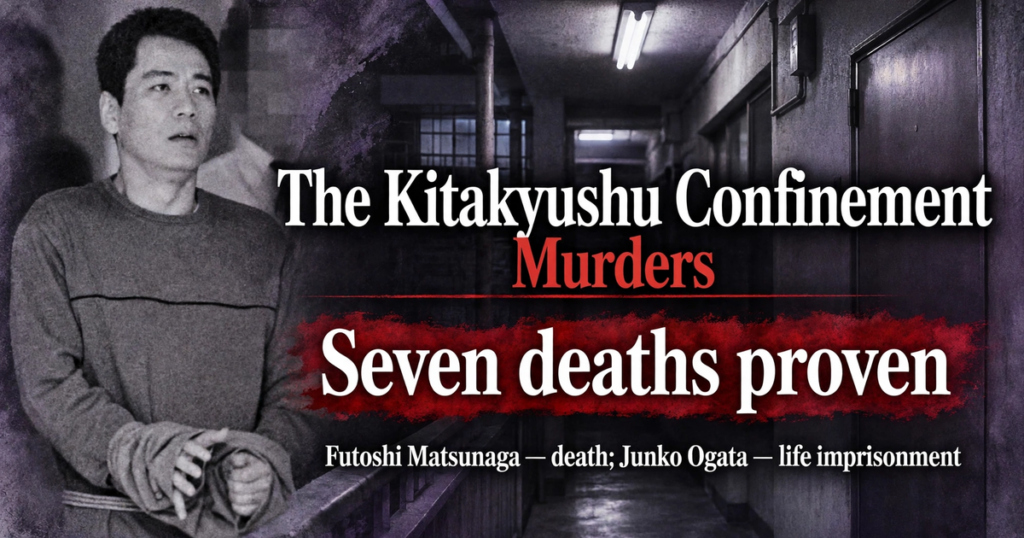
A teenager’s escape exposed a series of deaths
In March 2002, a 17-year-old girl escaped from an apartment in Kitakyushu and sought help from her grandparents. She told police that she had been confined and abused. Her account led investigators to examine the disappearance of her father and six members of the family of Junko Ogata, who lived under the control of Ogata and her common-law partner, Futoshi Matsunaga. The investigation ultimately established that seven people had died. Their bodies had not been recovered, and the full course of events had to be reconstructed from testimony, records and other evidence. The case became known as the Kitakyushu Confinement Murders.
The first victim was the escaped girl’s father
The Supreme Court’s judgment described Matsunaga and Ogata as having confined a 34-year-old man in their home. They repeatedly assaulted and abused him, including by applying electric shocks and imposing unreasonable restrictions on food. He became severely weakened and required medical treatment, but the necessary care was not provided. He died from multiple organ failure. The court treated his death as murder. The judgment described how the pair had drawn him into their household, extracted money from him and continued the abuse until he died. This first death preceded the later sequence involving Ogata’s relatives.
Ogata’s relatives were brought into the same system of control
After the first man’s death, Matsunaga and Ogata drew Ogata’s family into their household. The Supreme Court found that the relatives were made to believe that Ogata had committed a serious crime and were persuaded to provide money and support. Matsunaga then strengthened his control through violence, threats and electric shocks. The family members were made to monitor one another, and some were forced to take part in assaults against other relatives. This was not simply a case in which family members independently turned against one another. The courts examined how Matsunaga created a situation in which people were frightened, isolated and unable to resist his instructions.
The seven deaths had different legal classifications
The Supreme Court distinguished the legal treatment of the six deaths within Ogata’s family. Her 61-year-old father died after being subjected to electric shocks; his death was classified as causing injury resulting in death, rather than murder. Her 58-year-old mother and 33-year-old sister were strangled. Her 38-year-old brother-in-law was left without treatment despite being so weakened by abuse that death was likely. The sister’s five-year-old son and ten-year-old daughter were also killed. Those five deaths were treated as murders. Together with the murder of the escaped girl’s father, the final judicial account therefore involved six murders and one death resulting from injury. The total of seven deaths should not obscure this legal distinction.
No bodies were available to investigators
When the girl escaped, investigators could not rely on recovered bodies or remains to establish the deaths. Her account was an important starting point, but it could not by itself prove every death, cause of death or defendant’s role. Police gathered records from the residences, purchases and movements of the people involved and compared them with the statements given by the girl and later by Ogata. Items believed to have been used in the disposal of bodies were also examined through purchase records. The prosecution had to establish the deaths and the defendants’ responsibility through a combination of testimony and external evidence. The absence of bodies made the investigation and trial exceptionally difficult, but it did not mean that the deaths could not be proved.
Matsunaga was treated as the decision-maker, even when others carried out acts
Matsunaga did not personally perform every assault or killing. The Supreme Court nevertheless found that he decided what would be done, instructed others on how to carry out the crimes and exploited the psychological condition created by prolonged abuse. Ogata and other household members had been subjected to violence that made resistance extremely difficult. Matsunaga used that situation to make them follow his directions, including by acting through Ogata. The court described him as the ringleader and principal driving force. This analysis of joint criminal responsibility is important: Japanese courts do not determine responsibility solely by asking who physically carried out the final act. They also examine who planned, directed and controlled the criminal conduct.
Both defendants received death sentences at first instance
In September 2005, the Fukuoka District Court’s Kokura Branch sentenced both Matsunaga and Ogata to death. The case included not only the seven deaths but also confinement causing injury, fraud and robbery. The first-instance court treated the long duration of the abuse, the severity of the harm and the defendants’ involvement in the deaths as extremely serious. Ogata had herself participated in serious crimes against her relatives, but the proceedings also raised the question of the violence and control she had experienced under Matsunaga. The two defendants’ positions were therefore not identical, even though they initially received the same sentence.
The Fukuoka High Court reduced Ogata’s sentence but maintained Matsunaga’s
On 26 September 2007, the Fukuoka High Court dismissed Matsunaga’s appeal and maintained his death sentence. It quashed Ogata’s death sentence and imposed life imprisonment instead. The court did not find Ogata innocent or deny her serious involvement. It considered the prolonged violence and coercive control to which she had been subjected, as well as the difference between her role and Matsunaga’s role in deciding and directing the crimes. The sentence reflected the court’s assessment that she was not the same kind of principal decision-maker as Matsunaga. Her life sentence was therefore a sentencing distinction, not an acquittal or a finding that she had no criminal responsibility.
The Supreme Court left both outcomes in place in December 2011
On 12 December 2011, the Supreme Court’s First Petty Bench dismissed the relevant appeals. Matsunaga’s death sentence remained in force, while Ogata’s life sentence also became final. The Supreme Court judgment concerning Matsunaga described the repeated abuse, the seven deaths, the concealment and disposal of the bodies, and his role in directing the crimes. It held that his responsibility was exceptionally grave even after considering circumstances in his favour, including the absence of prior convictions. The separate result for Ogata reflected the High Court’s assessment of her subordinate role and the long period of violence she had endured. The final sentences were death for Matsunaga and life imprisonment for Ogata.
The case demonstrates how coercive control can shape criminal responsibility
The case cannot be understood simply as a series of family members killing one another. The courts found a system in which money, freedom and personal relationships were controlled through violence and fear. People who had themselves been victimised were made to participate in crimes against others, while Matsunaga retained the central power to decide and direct the acts. The absence of recovered bodies required investigators to test testimony against independent records rather than accept statements without verification. The final judgments established seven deaths, six murder convictions in the overall sequence and one conviction for causing death by injury, with different sentences for the two principal defendants. Those distinctions are essential to an accurate account of the case.
Original Japanese record: 北九州監禁殺人事件|遺体なき7人死亡を立証し、松永太・緒方純子で分かれた量刑
Last updated:
Related articles
Same case · Feature
The Kitakyushu Confinement Murders: How Futoshi Matsunaga Broke a Family and Subjugated Even a Former Police Officer

Case record
The Sakai Couple Murder: A Planned Robbery, Two Deaths and a Final Death Sentence
Case record
The Ishinomaki Triple Attack

Case record