
The JR Fukuchiyama Line Derailment: 107 Dead, 562 Injured and the Questions of Speed, Safety Systems and Corporate Oversight
On 25 April 2005, a seven-car JR West rapid train derailed in Amagasaki, killing 107 people and injuring 562. It entered a 70 km/h curve at an estimated 115–116 km/h. The investigation examined the driver's actions, an earlier overshoot, the absence of curve-speed ATS and the company's management practices. Three former presidents were prosecuted, but the Supreme Court upheld their acquittals in 2017 because the required specific foreseeability had not been proved.
Introduction: A derailment that killed 107 people
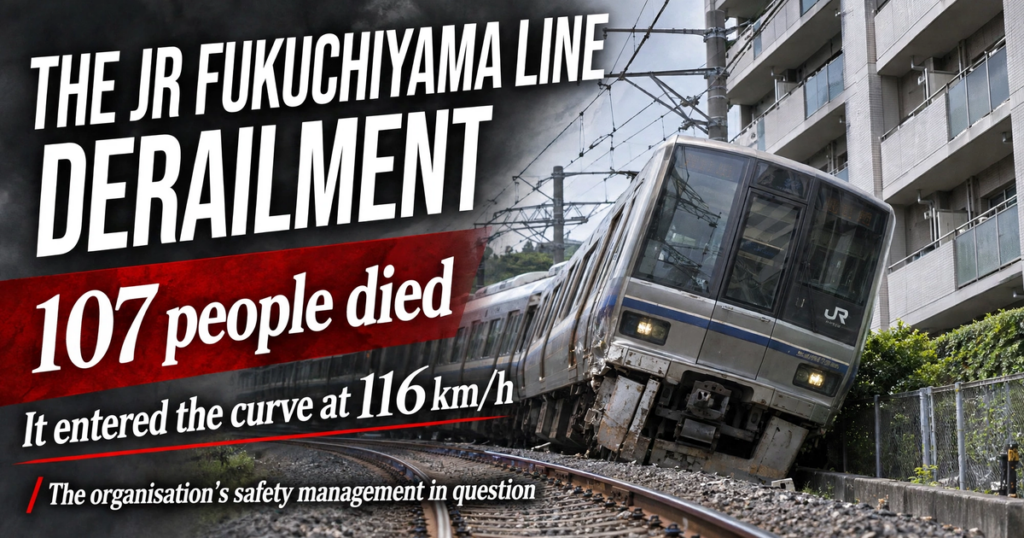
At about 9:18 a.m. on 25 April 2005, a seven-car JR West rapid train derailed in Amagasaki, Hyogo Prefecture. The leading cars struck an apartment building. One hundred and seven people died, including the driver, and 562 were injured.
The train entered a curve with a 70 km/h limit at a speed estimated at about 116 km/h by the accident investigation. The inquiry examined not only the driver's actions but also the absence of curve-speed ATS, the handling of an earlier overshoot and JR West's management practices. Three former presidents were prosecuted, but their acquittals became final in 2017. That legal outcome did not erase the wider safety questions raised by the disaster.
The first five cars left the rails
The train was travelling from Takarazuka towards Amagasaki. The first car overturned to the left after entering the curve; cars two through five also derailed. The first two cars collided with the apartment building beside the track.
The 107 deaths comprised 106 passengers and the driver. The 562 injured included people affected by the derailment and the collision. The crash became one of Japan's most serious post-war railway disasters and prompted scrutiny of both the train's operation and the safety systems around the line.
A 72-metre overshoot at Itami shortly before the crash
At Itami Station shortly before the crash, the train overshot its stopping position by about 72 metres, reversed and stopped. The delay that followed became part of the investigation. The driver spoke to the conductor about reporting a shorter distance than the actual overshoot, and the conductor later gave control a different figure.
The inquiry considered whether the driver was focused on recovering time and worried about company discipline. Earlier that morning, during a non-passenger movement towards Takarazuka, an ATS emergency brake had also stopped the train after a speed restriction was exceeded. The driver reset the system without the required report to control. Investigators considered whether that earlier event added to the pressure before the accident.
The curve had a 70 km/h limit, but no curve-speed ATS
The curve had a radius of about 304 metres and a 70 km/h speed limit. The accident investigation estimated the train's entry speed at about 116 km/h. The Supreme Court's 2017 decision described the alleged speed as about 115 km/h.
The curve did not have ATS with a speed-checking function that could automatically brake a train exceeding the curve's permitted speed. After the accident, installation of such systems accelerated. The Supreme Court noted, however, that the law before the crash did not require speed-checking ATS or ATS installation at every curve. That legal context later mattered in the prosecution of former executives.
Driver management and the pressure to avoid mistakes
JR West used a disciplinary retraining practice known as “nikkō kyōiku,” or day-shift retraining. Drivers who made mistakes could be removed from duty and required to complete written reflections and other instruction. The accident investigation considered whether fear of discipline affected how drivers reported errors and managed their attention.
This was not a finding that company policy alone caused the derailment. The driver's speed and actions remained part of the accident sequence. But the inquiry also examined the company's reporting culture, management practices and response to mistakes. The case showed why railway safety cannot be assessed solely by looking at the final actions of one driver.
The accident investigation itself came under scrutiny
A separate issue arose during preparation of the accident investigation report. JR West personnel contacted members of the accident investigation commission and sought information about the draft report. This concerned the independence of the investigation, not the physical cause of the derailment.
The Japan Transport Safety Board later conducted an external review and published a verification report and recommendations in 2011. The episode raised questions about information controls and the distance that must be maintained between an investigating body and the company under investigation.
Three former presidents faced a criminal trial
Three former JR West presidents—Masataka Ide, Shojiro Minamitani and Tsuyoshi Kakiuchi—were forcibly indicted after decisions by the Committee for the Inquest of Prosecution. They faced charges of professional negligence causing death and injury.
The central issue was whether each man could specifically have foreseen a derailment at this particular curve and had a personal duty to order ATS installation there. The Kobe District Court acquitted them on 27 September 2013, and the Osaka High Court upheld the acquittals on 27 March 2015. On 12 June 2017, the Supreme Court dismissed the designated prosecutors' appeals, making the acquittals final.
The Court considered that curve-speed ATS was not then legally required at every curve and that JR West had not shared an assessment identifying this curve as unusually dangerous. The decision did not find that the three executives could have identified it as a specific high-risk location requiring the instruction alleged by the prosecution.
An acquittal did not mean the company had no safety problems
The acquittals must be distinguished from the broader findings about JR West. Accident investigations and company reviews identified issues involving driver management, safety investment, reporting and information sharing. Those organisational issues did not automatically prove that each former president had committed a criminal offence.
Conversely, the acquittals did not establish that the company had no safety problems. The criminal court had to decide whether a specific duty and foreseeability had been proved against each defendant. The organisational safety review and the criminal trial addressed related but different questions.
Safety measures after the accident
After the accident, JR West accelerated installation of ATS with speed-checking functions and revised operating practices. It restricted drivers' wireless communications while trains were moving in May 2007 and prohibited note-taking while moving in December 2007.
The company also introduced a reporting category for minor errors and warning signs in September 2005, later renaming it “safety reports” in September 2007. These changes aimed to make it easier to share small mistakes before they developed into major incidents.
At a glance
Incident: JR Fukuchiyama Line derailment, Amagasaki, Hyogo Prefecture. Date: 25 April 2005, about 9:18 a.m. Train: seven-car rapid service. Casualties: 107 dead, including the driver, and 562 injured. Curve: about 304-metre radius, 70 km/h limit. Entry speed: about 116 km/h in the accident investigation; about 115 km/h in the Supreme Court's description. The three former presidents were acquitted, and the Supreme Court made those acquittals final on 12 June 2017.
Original Japanese record: JR福知山線脱線事故|107人死亡、116km/hで進入したカーブとJR西日本の組織課題
Last updated:
Related articles
Case record
The Fukushima Prefectural Ono Hospital Case: A Maternal Death, a Doctor's Prosecution and a Final Acquittal
Case record
The Schindler Elevator Death: An Open-Door Movement, a Teenager's Death and Acquittals on Appeal
Case record
The Nagasakiya Amagasaki Store Fire: Fifteen Deaths from Smoke on the Fifth Floor
Case record