
The Kawasaki Noborito Stabbing: Two Killed, Eighteen Injured and a Motive That Died with the Suspect
On 28 May 2019, a knife attack near a school-bus stop in Noborito, Kawasaki, killed 11-year-old Hanako Kuribayashi and 39-year-old Satoshi Koyama and injured 18 others. The suspected attacker, Ryuichi Iwasaki, died after stabbing himself. Police sent the case to prosecutors in September, and the Yokohama District Public Prosecutors Office discontinued the case in November because the suspect had died. No criminal trial was held, and the motive was never established.
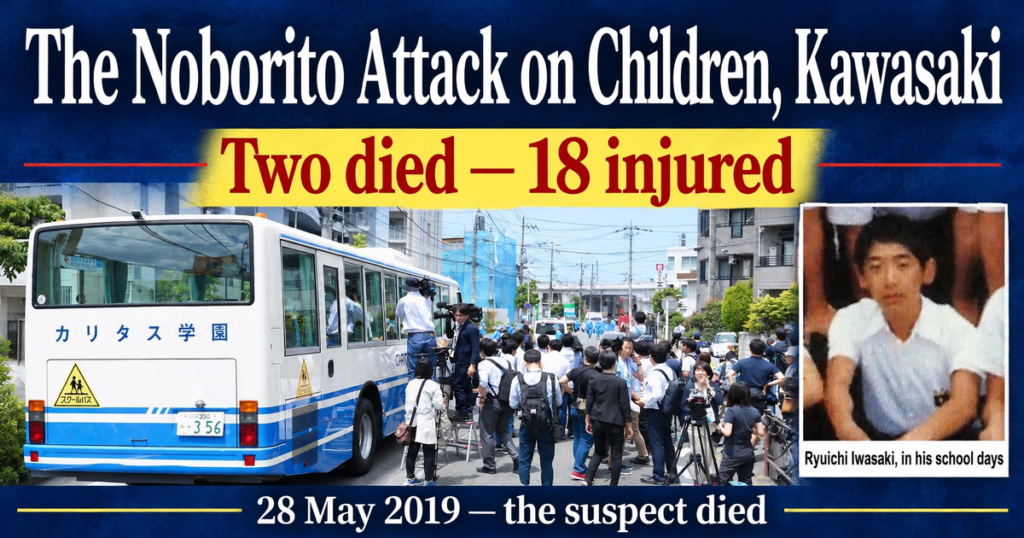
A morning queue for a school bus became the scene of an attack
At about 7:40 a.m. on 28 May 2019, children and adults waiting for a private elementary school bus were attacked with knives in Noborito-Shinmachi, Tama Ward, Kawasaki City. The children attended Caritas Elementary School. The attack killed sixth-grade pupil Hanako Kuribayashi, aged 11, and Satoshi Koyama, aged 39, a parent who had come to see his daughter off and worked for Japan’s Ministry of Foreign Affairs. Seventeen children and one adult were injured, making 18 injured people in addition to the two who died. The total number of people killed or injured was therefore 20.
The suspected attacker died after stabbing himself
The suspected attacker was Ryuichi Iwasaki, aged 51. Immediately after the attack, he stabbed himself in the neck and was taken to hospital, where he died. The death prevented investigators from questioning him and meant that the case could not proceed through an ordinary criminal trial. Police later referred the case to prosecutors with Iwasaki named as the suspect, but the legal status must be described carefully: he was not convicted, and no court determined his criminal responsibility or motive.
The victims were waiting for an ordinary school-bus service
Caritas Elementary School operated shuttle buses between the area near Noborito Station and the school. On the morning of the attack, staff members had accompanied pupils from the station and arranged them in a queue to board the buses. The assault began as pupils were boarding one of the later buses. There was no prolonged confrontation or warning at the bus stop. The attack was sudden, and the time available to recognise the danger and move the children to safety was extremely short. Teachers moved pupils away from the scene and contacted police and emergency services. The large number of casualties in a confined area required emergency responders to coordinate treatment and transport according to the severity of injuries.
Four knives had been brought to the area
Investigators found four knives associated with the attack. Two were believed to have been used in the assault; two more were found in a backpack nearby. The preparation of several weapons indicates that Iwasaki arrived with the means to carry out an attack. A search of his home also produced materials including notes and clues related to knife purchases. However, the investigation did not identify a written plan naming the victims or a statement explaining why the school had been selected. Evidence of preparation does not, by itself, establish the motive behind it.
Police examined whether Iwasaki had visited the area beforehand
Investigators reviewed security-camera footage from railway stations and roads to reconstruct Iwasaki’s movements. Reports cited in the Japanese article said that a person believed to be Iwasaki may have appeared on cameras near the scene four days and six days before the attack. Whether those visits amounted to reconnaissance could not be confirmed by questioning him. Police also examined his school and employment history, personal relationships and movements. They found no established personal connection between Iwasaki and Kuribayashi, Koyama or the other pupils, and no confirmed history of attendance at Caritas Elementary School or a specific dispute with it.
A large investigation did not establish why the school was targeted
The investigation included interviews with people who knew Iwasaki, former classmates and neighbours. The Japanese article cites a report that investigators had spoken to approximately 360 people within a month of the attack while looking for a connection with the school or victims. No direct explanation for the choice of the school emerged. Reports also described Iwasaki as having lived for a long period with limited employment and social contact, and said that relatives had consulted municipal services before the incident. Those circumstances cannot be treated as a proven cause of the attack. No confession, letter or other reliable statement from Iwasaki explained his thinking, and the available evidence did not justify assigning a particular psychological or medical condition as the motive.
The suspect was referred to prosecutors and the case was discontinued
In September 2019, the Kanagawa Prefectural Police sent the case to the Yokohama District Public Prosecutors Office with Iwasaki named as a suspect in murder and other offences, despite his death. In November 2019, prosecutors decided not to indict him because he had died. This was not an acquittal. An acquittal is a judgment delivered by a court after criminal proceedings; no trial took place here. There was no opportunity for a court to hear evidence, determine criminal responsibility or make findings about the suspect’s mental state. The criminal process ended because prosecution of a deceased suspect was not possible.
Schools and the local community continued safety and support measures
After the attack, Caritas Gakuen reviewed school travel arrangements and security procedures and provided psychological support to pupils, parents and staff. The effects were not limited to those physically injured. Children who had witnessed the attack, or who learned that friends had been harmed, could also experience fear and distress. Kawasaki City and local agencies reviewed how schools, police, administrators and residents shared information about children’s safety. In Tama Ward, the 28th of each month became a community child-safety watch day, with municipal employees and residents taking part in monitoring routes used by children. The school also continued longer-term support as pupils returned to ordinary routines.
The absence of a known motive remains part of the record
The attack occurred seven years before the 2026 anniversary, and commemorations continued at the scene and at the school. Flowers were placed at the site, and the school held a memorial Mass attended by pupils and families. The case leaves an important evidentiary boundary. Investigators could reconstruct the attack, identify the suspected assailant, document the weapons and trace his movements, but they could not obtain his account of why he chose the school. Because Iwasaki died before any trial, no court determined his responsibility or mental condition. The most accurate account preserves both what is known—two deaths, 18 injuries, a police referral and non-prosecution—and what remains unresolved: the precise motive.
Original Japanese record: 川崎市登戸児童ら殺傷事件|2人死亡・18人負傷、被疑者死亡で解明されなかった動機
Last updated:
Related articles
Case record
The Kitashinchi Building Arson: Twenty-Six Victims Killed, No Criminal Trial and the Fire-Safety Reforms That Followed
Case record
Sagamihara Care Home Attack: Third Retrial Petition Accepted
Case record
The Tokaido Shinkansen Attack: Kōtarō Umeda Killed, Ichiro Kojima's Life Sentence Final, and Rail-Safety Measures

Case record