The Shunan Five-Person Murders and Arsons: Delusional Disorder, Full Criminal Responsibility and the Supreme Court's Decision
On 21 and 22 July 2013, five residents of the Mitake settlement in Shunan, Yamaguchi Prefecture, were killed and two houses were burned. The defendant, Homi Kosei, was diagnosed with delusional disorder, but the courts found that he retained full criminal responsibility. His death sentence was upheld by the Supreme Court in 2019. A later retrial request was rejected in January 2025.
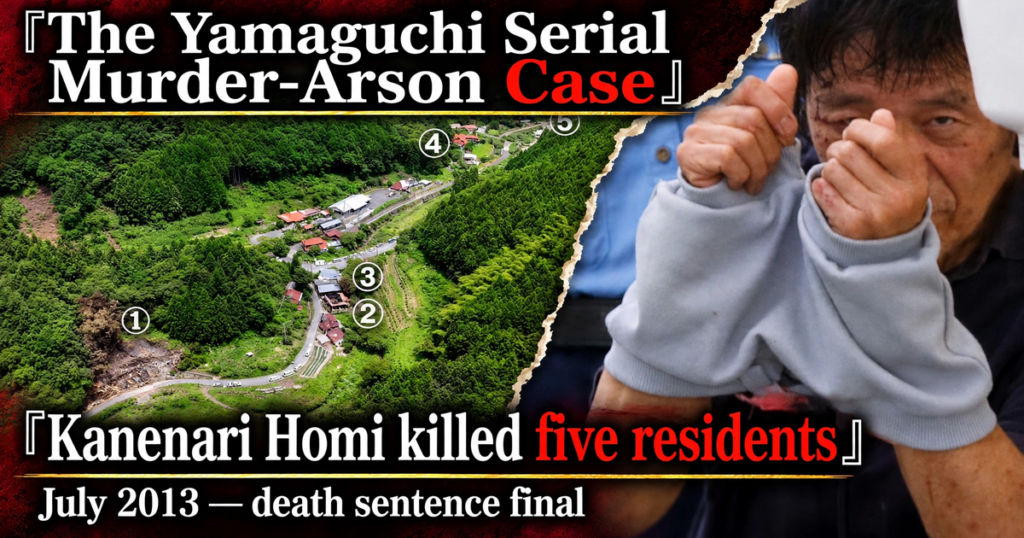
Two house fires revealed the deaths of three residents
On the night of 21 July 2013, two houses in the Mitake settlement of Kanamine, Shunan City, Yamaguchi Prefecture, caught fire one after another. When firefighters and investigators examined the remains, they found three bodies. The next day, 22 July, two more residents were found dead in separate nearby houses. The five people who died all lived in the same small settlement. The incident was not a single house fire with multiple casualties: the deaths were discovered at several homes over the course of the night and the following day, and the later criminal case treated them as part of a connected sequence of murders and arson.
The five victims were members of the same local community
The victims were Makoto Sadamori, aged 71; his wife Kiyoko, aged 72; Miyako Yamamoto, aged 79; Fumihito Ishimura, aged 80; and Satoko Kawamura, aged 73. They were older residents of the same rural community. Later reporting noted that some of them had taken part in local activities, including efforts to improve the area through community planting projects. Their deaths affected a small settlement in which residents knew one another. That context should not be turned into an unsupported claim that the community as a whole caused or provoked the crimes.
Homi Kosei was found in nearby mountains and prosecuted
Police searched for Homi Kosei, a resident of the surrounding area, and found him in woodland on 26 July 2013. Investigators prepared statements in which he was reported to have admitted involvement in the killings and fires, but at trial he denied committing the offences. The difference between statements made during the investigation and the position taken in court is important. By December 2013, prosecutors had indicted him for the murders of all five victims and for arson of two non-inhabited buildings. The case then proceeded to trial, where both the evidence identifying the offender and his mental condition became central issues.
A psychiatric assessment diagnosed delusional disorder
A psychiatric assessment conducted after indictment diagnosed Homi with delusional disorder. The assessment linked his thinking to a belief that neighbours were spreading rumours about him and harassing him. The diagnosis did not, by itself, answer the legal question of criminal responsibility. Japanese criminal law asks whether, at the time of the offence, a defendant's ability to understand right and wrong or to control conduct in accordance with that understanding was absent or substantially impaired. The court therefore had to examine how the disorder affected his choices and actions during the crimes, rather than treating the medical label as an automatic exemption from responsibility.
The courts found that the disorder did not remove his responsibility
The Yamaguchi District Court sentenced Homi to death on 28 July 2015, finding that he had full criminal responsibility. The Hiroshima High Court dismissed his appeal on 13 September 2016. On 11 July 2019, the Supreme Court's First Petty Bench dismissed the final appeal. The Supreme Court accepted that delusional thinking had influenced the formation of his motive, but concluded that he had selected and carried out the offences according to his own values and that the disorder's effect on the crimes was limited. It therefore upheld the finding that he was not legally of diminished responsibility.
The phrase on a notice at his home was not a proven confession
A phrase displayed at Homi's home—often rendered as “Set fires and rejoice in the smoke, country people”—became widely associated with the case. It was sometimes treated in public discussion as though it were a direct declaration of responsibility. Later documentary research suggested that the word used for “setting fires” could also refer to rumours, and that the notice may have expressed resentment about local gossip rather than a confession to arson. The Supreme Court did not base its decision on an interpretation of the notice. Its judgment relied on the evidence of the killings and fires and its assessment of Homi's mental condition. The notice should not be presented as a proven motive statement.
The community also faced harmful claims after the murders
In the years after the crimes, reports and online discussion sometimes portrayed the settlement as a place where Homi had been collectively ostracised or bullied until he was driven to violence. The Supreme Court did not establish that narrative as a fact. It considered Homi's belief that neighbours were spreading rumours or harassing him as part of his delusional thinking, but that is different from a judicial finding that the victims or residents had in fact persecuted him. Later reporting also described defamatory claims directed at the victims, their families and other residents. The victims' conduct and the community's relationships must not be turned into an invented explanation for the killings.
The first retrial request was rejected in 2025
After the death sentence became final, Homi filed a retrial request in November 2019, relying in part on opinions from psychiatrists as new evidence. The Yamaguchi District Court rejected the request in March 2021, finding that the material did not undermine the original assessment of criminal responsibility. The Hiroshima High Court dismissed the immediate appeal in 2022. The defence then filed a special appeal to the Supreme Court, which the Second Petty Bench rejected on 29 January 2025. That ruling ended this retrial proceeding without ordering a new trial. It did not constitute a fresh trial of the murders; the 2019 death sentence remained in force.
The final judgment and the later retrial proceedings are separate
The ordinary criminal case ended when the Supreme Court dismissed Homi's appeal in July 2019, leaving the death sentence final. The later retrial process asked a different question: whether new evidence met the legal threshold for reopening that final judgment. The January 2025 rejection did not re-examine the entire case as if it were another appeal on guilt and sentence. The confirmed judicial outcome remains that Homi was convicted of five murders and two arson offences, was found to have full criminal responsibility despite the diagnosis of delusional disorder, and received a death sentence that remains final. The distinction matters because a retrial application is not the same as a new conviction.
Original Japanese record: 山口連続殺人放火事件|5人殺害、妄想性障害でも完全責任能力とした最高裁判断
Last updated: