The Tokaido Shinkansen Attack: Kōtarō Umeda Killed, Ichiro Kojima's Life Sentence Final, and Rail-Safety Measures
On 9 June 2018, a passenger attacked people aboard the Tokaido Shinkansen Nozomi 265 between Shin-Yokohama and Odawara. Kōtarō Umeda, who intervened to protect two women, was killed; the women were injured. Kojima had planned the attack as a way to spend the rest of his life in prison and said he intended to keep the number of deaths to no more than two. A psychiatric evaluation was conducted, and prosecutors considered seeking the death penalty but ultimately requested life imprisonment. The Yokohama District Court, Odawara Branch imposed life imprisonment on 18 December 2019; the judgment became final on 7 January 2020 after no appeal.
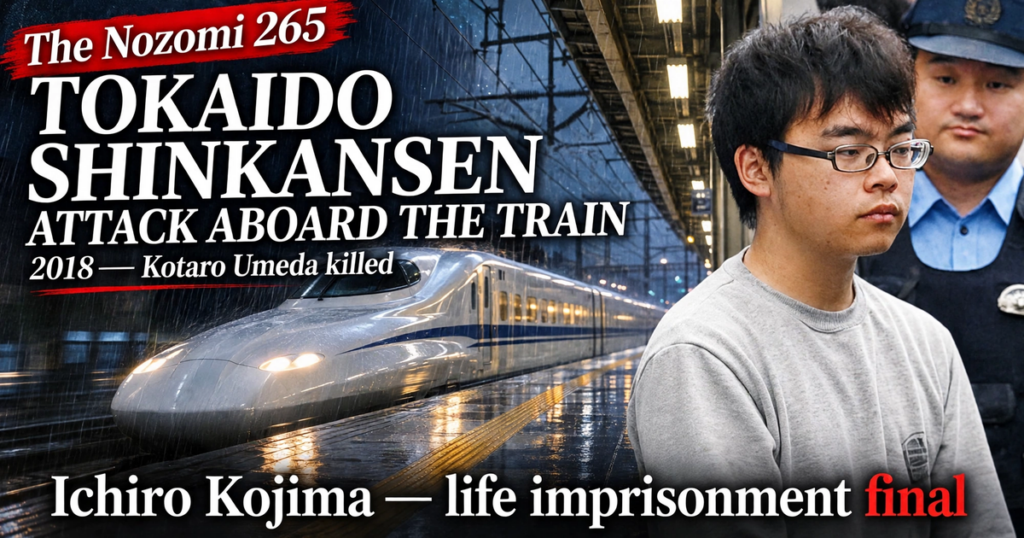
A violent attack aboard a high-speed train
On the night of 9 June 2018, a serious attack took place aboard the Tokaido Shinkansen service Nozomi 265, travelling west from Tokyo toward Shin-Osaka. The train was between Shin-Yokohama and Odawara when a male passenger began attacking people in the carriage with bladed weapons. The incident occurred inside a crowded public transport system where passengers had little room to move away and where the train could not simply stop at the scene. The case is often described as a random or indiscriminate attack, but the judicial record is more specific about the people directly harmed and the sequence that led to the fatal intervention.
Umeda intervened as two women were attacked
Two women were attacked and injured. Kōtarō Umeda, a 38-year-old passenger, intervened in an effort to protect them. He was fatally wounded. His death became the central fact in the murder prosecution, while the injuries to the two women formed part of the wider incident. Reports and court proceedings identify Umeda as the person who stepped in when other passengers were under attack. His intervention should not be romanticised as a cinematic act; it was a split-second response in a confined carriage, and it cost him his life.
The train was stopped and passengers were evacuated
Railway staff and emergency responders had to manage the aftermath while protecting other passengers. The train stopped at Odawara, and police arrested the attacker at the scene. Passengers were moved out of the affected carriage and the injured were taken for medical care. The incident caused disruption to a major intercity route and raised immediate questions about how quickly railway staff could identify a violent emergency, communicate with the train crew, and secure a carriage. It also showed the limits of relying on passengers to intervene: people nearby may be the first to respond, but they are not a substitute for trained emergency procedures.
Kojima was prosecuted for murder and attempted murder
The accused was Kojima Ichiro. Prosecutors brought the case on the basis that he had deliberately attacked passengers and killed Umeda, while also injuring the two women. The case was not treated as an accident or as a single act of self-defence. The prosecution relied on the circumstances of the attack, the weapons used, the victim's injuries and the defendant's conduct. In Japanese criminal procedure, an indictment is the formal act that places a charge before a court; it is not itself a finding of guilt. The distinction is important when describing the period between the arrest in June 2018 and the judgment delivered the following year.
Kojima planned the attack to spend the rest of his life in prison
Kojima explained that he wanted to spend the rest of his life in prison rather than return to society. He had considered the likely sentence and planned an indiscriminate attack as a way to obtain a life sentence. The victims were strangers in the carriage; the attack was not a spontaneous dispute with them.
He said he intended to limit the number of deaths to two
Kojima said that he believed killing three people would make a death sentence more likely, and that he therefore intended to keep the number of deaths to two. One passenger, Kōtarō Umeda, died, while the two women survived with injuries. His account showed that he had considered the likely penalty and the number of victims before the attack.
A psychiatric evaluation was considered, and prosecutors weighed the death penalty
A psychiatric evaluation was conducted during the investigation and its findings were considered in the criminal proceedings. Prosecutors reportedly considered seeking the death penalty, but ultimately requested life imprisonment. The court sentenced Kojima to life imprisonment. The evaluation and the prosecution's sentencing decision should be distinguished from any claim that the defendant lacked criminal responsibility.
The Yokohama District Court, Odawara Branch imposed life imprisonment
On 18 December 2019, the Yokohama District Court, Odawara Branch sentenced Kojima to life imprisonment, granting the prosecution's request. The court assessed the planned nature of the attack, the indiscriminate targeting of passengers, Umeda's death and the injuries to the two women. The first-instance court was the Yokohama District Court, Odawara Branch. The judgment became final on 7 January 2020 after no appeal was filed.
The judgment became final in January 2020
The life sentence became final on 7 January 2020 after the period for appeal passed without an appeal being filed. That procedural point is different from saying that the Supreme Court upheld the sentence. There was no Supreme Court judgment on the merits in this case. The correct description is that the first-instance judgment became final because the parties did not pursue an appeal. This distinction is particularly important for international readers, who may assume that every final criminal judgment in Japan must have been reviewed by the Supreme Court. Japanese criminal cases can become final after the appeal period expires.
Railway rules on knives were tightened after the attack
The attack led to renewed scrutiny of how passengers could carry knives on trains. The Ministry of Land, Infrastructure, Transport and Tourism revised guidance in 2018, clarifying that knives must be secured so that they cannot be used immediately and that carrying them in a manner that creates a danger to other passengers is prohibited. This was not a blanket ban on every knife or tool, and it should not be described as such. The legal and administrative response focused on safe packaging and transport, alongside communication between railway operators and law-enforcement agencies.
Security cameras and the limits of prevention
A later railway-security measure required surveillance cameras on newly manufactured railway rolling stock from October 2023. The measure did not mean that every existing train was retrofitted overnight. It was part of a broader approach to improve the ability to identify incidents, reconstruct events and support rapid response. Cameras cannot guarantee that an attack will be prevented, and the 2018 case should not be reduced to a simple failure of camera coverage. The more accurate lesson is that railway safety depends on several layers: clear rules on dangerous items, staff training, emergency communications, passenger assistance, and evidence systems that help investigators understand what happened.
The legal outcome and the public response must remain distinct
The criminal case against Kojima ended with a final life sentence. The later policy changes were administrative responses to a public-safety problem, not additional penalties imposed on him. Likewise, the fact that Umeda intervened does not make every passenger responsible for confronting an attacker. For readers outside Japan, the case illustrates how a single violent event can produce both a criminal prosecution and a separate review of transport security. The confirmed core remains one passenger killed, two women injured, the attacker arrested at the scene, and a life sentence that became final in January 2020.
Original Japanese record: 東海道新幹線車内殺傷事件|梅田耕太郎さん殺害、小島一朗の無期懲役確定と鉄道安全対策
Last updated: