
The 1985 Paraquat Poisoning Cases: Poisoned Drinks, Vending Machines and 78 Reported Incidents
In 1985, poisoned drinks were found in and around vending machines across Japan. The National Police Agency recorded 78 soft-drink poisoning incidents involving 37 people who swallowed contaminated drinks, 17 of whom died. The statistics included different poisons and incidents, not one proven offender or one single series.
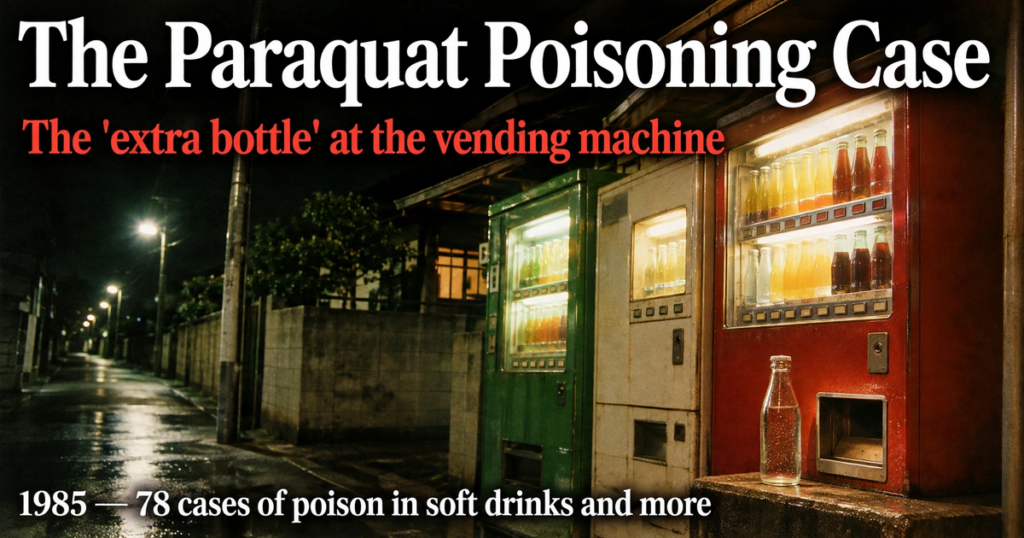
A drink left near a vending machine could become a deadly trap
In 1985, Japan experienced a series of poisonings involving soft drinks left in or around vending machines and other public places. A container that appeared to be an ordinary purchase, a forgotten bottle or an extra drink could be picked up by someone who had no reason to suspect that it had been tampered with. Paraquat, an agricultural herbicide then in circulation, was among the poisons involved. The incidents were not confined to one town or one vending-machine operator. Similar reports emerged from widely separated areas, turning an apparently ordinary part of daily life into a source of public anxiety.
A Fukuyama incident on 30 April became one of the earliest widely reported cases
On 30 April 1985, a truck driver from Okayama Prefecture used a vending machine along a road in Fukuyama, Hiroshima Prefecture. He noticed a small bottle placed on top of the machine, separate from the drink he had bought. He took the bottle home and drank from it. His condition deteriorated rapidly, and he died on 2 May. Paraquat was detected in his body. The case showed how a container left where a passer-by could mistake it for a forgotten or extra purchase could expose an unrelated person to a lethal danger. Similar reports emerged in different regions months later.
The official total was 78 incidents, but it did not describe one proven offender
The National Police Agency's 1986 White Paper recorded 78 incidents involving toxic substances mixed into soft drinks and similar products during 1985. They occurred across one metropolis, two prefectures and 22 other prefectures. In 36 of those incidents, 37 people swallowed the contaminated drinks; 17 died. These figures are often repeated as if they represented 78 paraquat murders committed by one person. That is not what the official statistic says. The category included different toxic substances and incidents that did not all involve drinks placed beside vending machines. It was a national count of poisoning incidents, not a proven single-offender series.
Paraquat was only one of the substances involved
Paraquat was an agricultural herbicide that was available through ordinary commercial channels at the time. The wider 1985 statistics also included other toxic substances. This matters when comparing the police total with later lists that count only deaths attributed to paraquat-contaminated drinks near vending machines. Some later summaries refer to a narrower number of victims, while the police White Paper counted the broader category of soft-drink and related poisonings. The different totals are not necessarily contradictory; they measure different groups of events. A careful account must identify which set of incidents is being counted before stating a death toll.
The poisoning reports spread beyond vending machines into other public places
The National Police Agency's report also described a series of incidents in Mie Prefecture between 5 November and 12 December 1985. Containers of drinks believed to contain paraquat were left at elementary schools, nursery schools and children's parks in places including Tsu, Suzuka, Ise and Kameyama. Investigators recorded 21 incidents involving a total of 41 containers. These events show why the broader poisoning wave cannot be reduced to vending-machine cases alone. As public awareness of the method spread, similar conduct appeared in different locations and could be copied by people whose identities and motives were unrelated.
Police and industry organizations issued warnings and changed procedures
As reports accumulated, police, beverage manufacturers and vending-machine operators strengthened public warnings and inspections. Consumers were told not to drink a container simply because it was found beside a machine or appeared to be an extra product. Notices and warning stickers were placed on machines, and operators were encouraged to pay attention to the condition of the product outlet. The response also involved the supply chain. Because paraquat and other agricultural chemicals were sold through retail channels, authorities called for closer attention to the purpose of purchases and the records kept by sellers of toxic substances.
The incidents created a public-safety problem beyond the original crimes
The danger was not limited to the victims who had already swallowed a poisoned drink. Once the method became widely known, other people could imitate it, and every unattended bottle could generate fear. The episode exposed the vulnerability of public spaces where people routinely collect food and drink without interacting with a seller. It also demonstrated that product safety depends on more than the factory seal: a drink can be contaminated after it leaves the manufacturer. The warnings that followed encouraged people to reject unverified containers and made the checking of vending-machine outlets part of everyday public-safety advice.
The principal perpetrators were not identified in court
By the end of 1985, the wave of reports had subsided, but the major vending-machine poisoning incidents had not produced a single identified and convicted offender. The official 78-incident total should not be used to imply that one person committed every poisoning. The evidence supports a broader picture of multiple incidents, different poisons and the possibility of imitation, with many individual perpetrators remaining unidentified. The Paraquat Poisoning Cases are therefore best understood as a nationwide group of poisoning events that exposed weaknesses in the handling of toxic chemicals and in public-space product security. Their unresolved nature is part of the historical record, not a gap to be filled by speculation.
Original Japanese record: パラコート毒物混入事件|自販機の「余分な一本」と1985年の飲料毒物混入78件
Last updated:
Related articles
Case record
The Kitashinchi Building Arson: Twenty-Six Victims Killed, No Criminal Trial and the Fire-Safety Reforms That Followed
Case record
The Ikeda Elementary School Attack: Eight Children Killed, a Death Sentence and Lasting Changes to School Safety
Case record
The Fukagawa Random Murder Attack: Four Deaths, a Seven-Hour Hostage Crisis and Diminished Responsibility
Case record