
The Murder of Misa Kato: A One-Victim Death Sentence Finalized by Withdrawal of Appeal
Misa Kato, 27, was killed by former co-worker Sumida on 30 September 2011. He was convicted of robbery-rape, robbery-murder and offences involving her body. His death sentence became final when he personally withdrew his appeal on 28 March 2013; it was carried out in 2017.
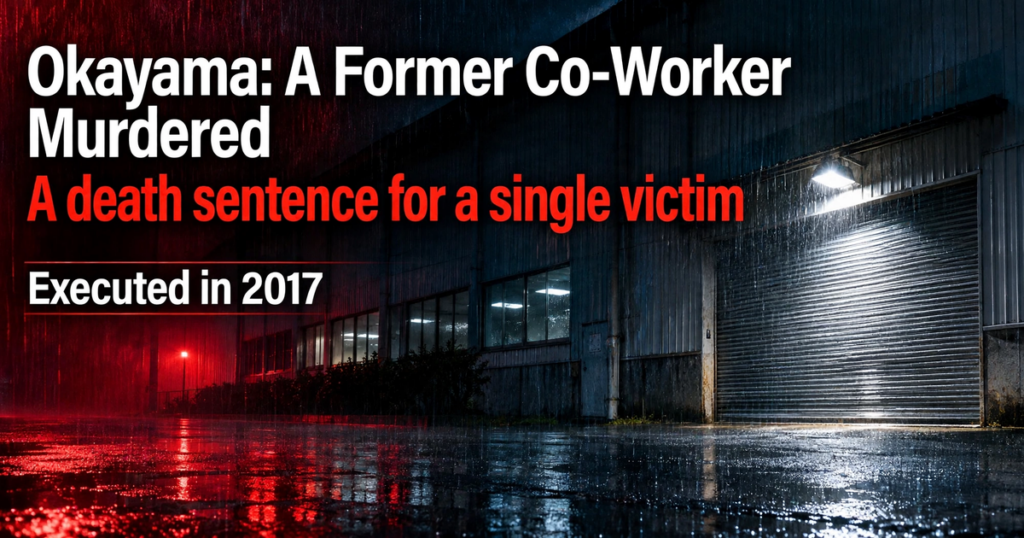
A former co-worker was used to arrange a meeting at a company warehouse
On 30 September 2011, Misa Kato, a 27-year-old temporary worker, was killed at a company warehouse in Kita Ward, Okayama City. The defendant, Sumida, was a former co-worker. Their prior employment relationship gave him a point of contact through which he could arrange to meet her. The case was not an attack by a complete stranger encountered by chance. The prosecution said Sumida intended to commit sexual violence and take property, and that the meeting led to sexual assault, robbery and murder. After the killing, he transported Kato's body to Osaka City, where he damaged it and disposed of the remains at multiple locations. The indictment therefore covered a sequence of offences before and after the death.
The prosecution included sexual violence, robbery and offences involving the body
Sumida was prosecuted for robbery-rape, robbery-murder, destruction of a corpse and abandonment of a corpse, among other offences. The case was not limited to the question of whether he had caused Kato's death. The court also considered the purpose of the attack, the taking of property, the sexual violence and the steps taken afterward to conceal the crime. The Ministry of Justice's 2017 announcement concerning the execution described the offence as involving the robbery and rape of a woman, her murder and the cutting up and disposal of her body. The English account need not reproduce graphic details. The legal significance lies in the sequence and the additional offences, which formed part of the sentencing assessment.
Sumida admitted the principal allegations at the lay-judge trial
The trial began in February 2013 under Japan's lay-judge system, in which professional judges sit with citizens selected from the public to decide serious criminal cases. Sumida admitted the charged conduct. As a result, the central issue was not whether he was the person who committed the offences, but what sentence should be imposed. The prosecution sought the death penalty. The defence argued that Kato was the only victim, that Sumida had no prior criminal record and that there remained a possibility of rehabilitation. The court had to consider those matters alongside the planning, the purpose of the attack, the manner of killing and the actions taken to conceal the crime afterward.
The Okayama District Court imposed the death penalty on 14 February 2013
On 14 February 2013, the Okayama District Court sentenced Sumida to death, accepting the prosecution's request. Presiding Judge Kōsuke Morioka concluded that the seriousness of the offence could not be outweighed by the fact that there was only one victim or that Sumida had no prior convictions. The judgment considered the planned nature of the attack, the sexual and financial motives, the killing and the subsequent destruction and disposal of the body. The decision attracted attention because it was a death sentence in a one-victim murder case and because Sumida had no prior criminal record. However, the number of victims was only one factor in the sentencing analysis. The court evaluated the entire sequence of criminal conduct and the defendant's prospects for rehabilitation.
The defence appealed, but Sumida personally withdrew the appeal
After the death sentence was announced, defence counsel filed an appeal on the same day. Ordinarily, the case could then have proceeded to the Hiroshima High Court's Okayama Branch, where a second-instance court would review the factual findings and sentence. That review did not occur. On 28 March 2013, Sumida personally withdrew the appeal. The withdrawal ended the appellate proceedings and caused the first-instance death sentence to become final. There was no High Court judgment affirming the death sentence and no Supreme Court ruling in this case. It would therefore be incorrect to describe the outcome as a death sentence upheld through two or three judicial levels. The legal route was first-instance death sentence, personal withdrawal of the appeal and finality.
Finality and execution were separate events
After the appeal was withdrawn in March 2013, Sumida was held at Hiroshima Detention House under a final death sentence. Finality meant that the ordinary appeal process had ended; it did not mean that the sentence was carried out immediately. More than four years passed before the execution. The distinction is important in Japanese criminal procedure because the date on which a sentence becomes final and the date on which the Ministry of Justice carries it out are separate events. The record should also avoid implying that the High Court or Supreme Court independently assessed the merits of the death sentence. The appeal was withdrawn by the defendant himself, so there was no appellate judgment on the sentence.
The execution took place on 13 July 2017
On 13 July 2017, the Ministry of Justice announced that Sumida and another death-row prisoner, Masakatsu Nishikawa, had been executed. Sumida was 34. The execution took place at Hiroshima Detention House. The legal sequence in his case is therefore the killing of Kato on 30 September 2011, indictment for robbery-rape, robbery-murder and offences involving the body, admission of the charges at trial, the Okayama District Court's death sentence on 14 February 2013, the defendant's withdrawal of the appeal on 28 March 2013, finality and execution on 13 July 2017. No appellate court affirmed the first-instance judgment because no appeal remained before it.
The case became a debate about the death penalty in a one-victim murder
The case is often discussed through the question of how a death sentence could be imposed when one person was killed and the defendant had no prior convictions. The judgment did not create a rule that one-victim murder automatically warrants death. It considered the full circumstances: the planned sexual and financial attack, the killing, the treatment and concealment of the body, the defendant's conduct and the prospects for rehabilitation. The procedure also matters. The sentence became final not because a higher court rejected an appeal, but because Sumida withdrew it. An accurate account must preserve both points: the court's reasons for choosing the death penalty and the unusual procedural route by which the sentence became final.
Original Japanese record: 岡山元同僚女性殺害事件|加藤みささん殺害、被害者1人でも死刑とした量刑判断と執行
Last updated:
Related articles
Case record
The Nagasaki Stalking Murders: Two Family Members Killed, Three Police Forces Criticised and a Final Death Sentence
Case record
The Kodaira Murders: Ten Murder Charges, Seven Convictions and a Postwar Pattern of Predation
Case record
The Nara First-Grade Girl Murder: A Child Abducted on Her Way Home and a Death Sentence Final by Appeal Withdrawal
Case record