
The Yamato Serial Robbery Murders: Two Planned Killings and Different Sentences
Shoji and a female accomplice killed two women, aged 54 and 42, in Yamato City in August and September 2001. Shoji's death sentence became final in December 2007 and was carried out in August 2019; the accomplice received life imprisonment.
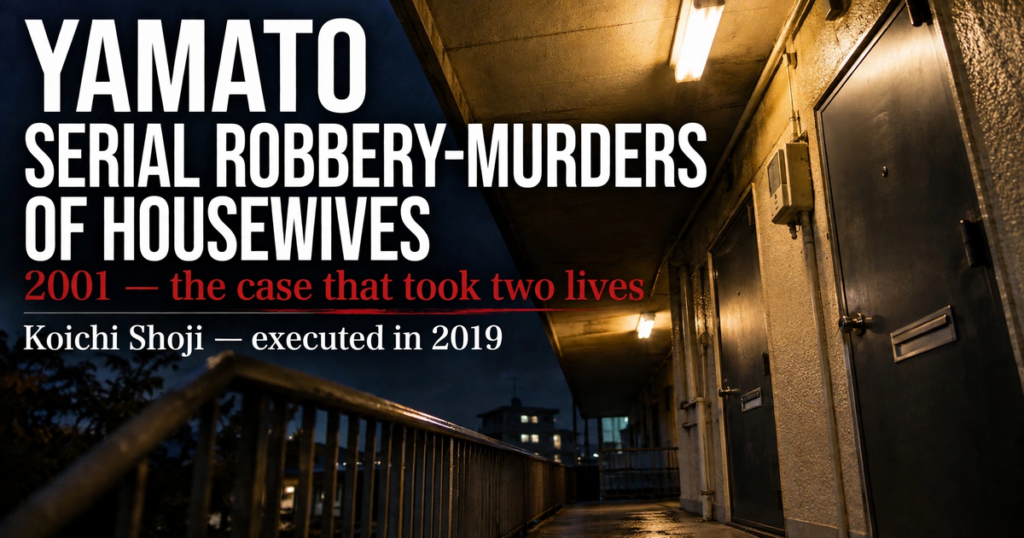
Two women were killed in Yamato City within three weeks
On 28 August and 19 September 2001, two women aged 54 and 42 were attacked in Yamato City, Kanagawa Prefecture. They were robbed and killed by Shoji and a female accomplice. The Supreme Court later found that the two had divided roles and planned the sexual violence, robbery and killings in advance. The offences were not treated as two accidental deaths following unrelated burglaries. The court found that the defendants had selected the victims and entered their homes with a settled plan to commit serious offences. The two women were identified in the Supreme Court judgment by age rather than by name. The case is often described through the difference between the death sentence imposed on Shoji and the life sentence imposed on his co-defendant.
A prior attack on a 60-year-old woman formed part of the sentencing record
Before the two fatal attacks, Shoji had committed a separate robbery and sexual offence against a woman he knew, who was then 60. He entered her home, sexually assaulted and injured her, and took approximately 120,000 yen and two cash cards. He later used the cards to withdraw approximately 4.25 million yen. This earlier offence did not result in a death, but the Supreme Court considered it important when assessing Shoji's criminal history and repeated conduct. He also had a prior conviction for a similar robbery and sexual offence. The earlier attack helps explain why the court's sentencing analysis did not focus only on the two deaths in Yamato. It considered a wider pattern of targeting women for sexual and financial purposes.
The first murder on 28 August was planned as a robbery and sexual attack
For the first fatal offence, Shoji and the accomplice targeted a 54-year-old woman. The Supreme Court found that they had planned to commit sexual violence, kill her and take her property. They entered the home and assaulted her. The planned sexual offence was not completed, but the woman was killed. The defendants took a backpack containing approximately 230,000 yen in cash and three cash cards, and they used the cards to withdraw a further 409,000 yen from an ATM. The court rejected the idea that the killing was an unexpected reaction to resistance. It found that the plan included the possibility and intention of killing the victim from the outset. This finding was important to the legal characterization and to the sentence.
The second victim was killed on 19 September
Approximately three weeks later, on 19 September 2001, Shoji and the accomplice entered the home of a 42-year-old woman. The Supreme Court found that they intended to commit sexual violence, kill her and take her property. They restrained her, subjected her to sexual violence and killed her. They then took 60,000 yen in cash and bankbooks and other property. The two deaths occurred in the same city within a short period. The court emphasized that the victims had done nothing to bring the attacks upon themselves, that the defendants had divided roles and prepared the offences, and that the killings destroyed two family lives. The court did not treat the second death as an unrelated offence or a spontaneous escalation of the first.
The explanation involving a spiritual adviser was not the court's definitive finding of motive
Shoji referred during the proceedings to statements attributed to a spiritual adviser, including a claim that killing five people would bring happiness. That statement has sometimes led to the case being described as a murder committed because of a spiritual prediction. The Supreme Court did not simply adopt that explanation as the established motive. Its final judgment focused on the planned sexual violence, robbery, killings and division of roles. Shoji also argued that he had acted alone and that killing, rather than robbery, had been his primary purpose. The final judgment rejected the attempt to separate him from the accomplice and found a shared plan that included taking property. A defendant's account of motive must not be presented as though it were the court's finding.
The District Court imposed different sentences on the two defendants
On 30 April 2003, the Yokohama District Court sentenced Shoji to death. The female co-defendant received life imprisonment, even though prosecutors had sought the death penalty for her as well. The court assessed their roles and individual responsibility rather than treating the same offence results as requiring identical sentences. On 7 September 2004, the Tokyo High Court maintained both outcomes: Shoji's death sentence and the accomplice's life sentence. The co-defendant's life sentence subsequently became final. Shoji appealed further, challenging matters including criminal responsibility and the severity of the sentence. The different outcomes were therefore not the result of one defendant being acquitted; both were convicted, but their sentences differed.
The Supreme Court considered the co-defendant's life sentence but upheld death for Shoji
On 6 November 2007, the Supreme Court's Third Petty Bench rejected Shoji's appeal. It considered the planned nature of the two killings, the short interval between them, the prior attack on the 60-year-old woman and Shoji's similar criminal history. The Court also considered matters in his favour, including his admissions to some facts, expressions of remorse and the fact that his co-defendant had received life imprisonment. It nevertheless concluded that these circumstances did not justify replacing the death sentence. The sentence became final on 5 December 2007. The distinction between the Supreme Court's decision date and the date of finality is important; the latter followed the post-judgment procedure and was not the same day as the ruling.
Shoji's death sentence was carried out in August 2019
Shoji remained under a final death sentence until 2 August 2019, when he was executed at Tokyo Detention House. The co-defendant's life sentence remained a separate legal outcome. The case is sometimes retold through the claim about a spiritual prediction, but the final judicial findings centered on the planned robbery and sexual attacks, the two killings, the prior similar offence and the division of roles. The courts also expressly considered the difference in sentences between Shoji and his accomplice. An accurate account must therefore preserve both the factual findings and the separate procedural outcomes: two women killed in 2001, a death sentence for Shoji, life imprisonment for the co-defendant, finality in December 2007 and execution in 2019.
Original Japanese record: 大和連続主婦強盗殺人事件|庄子幸一の死刑と共犯者の無期、2019年執行まで
Last updated:
Related articles
Case record
The Kanagawa Two Robbery Murders: An Acquittal Reversed and a Death Sentence Later Upheld

Case record
The Four-Prefecture Four-Murder Case: Twelve Years for the First Killing and Death for Three Later Murders
Case record
The Kawasaki Chinese Six-Person Attack: A Robbery Followed by Three Murders

Case record