
The Takefuji Hirosaki Branch Fire: Five Employees Killed and the Finding of Eventual Intent
On 8 May 2001, Kobayashi set fire to a consumer-finance branch in Hirosaki after a cash demand was refused. Five of nine employees died and four were injured. The courts found eventual intent to kill; his death sentence became final in 2007 and was carried out in 2014.
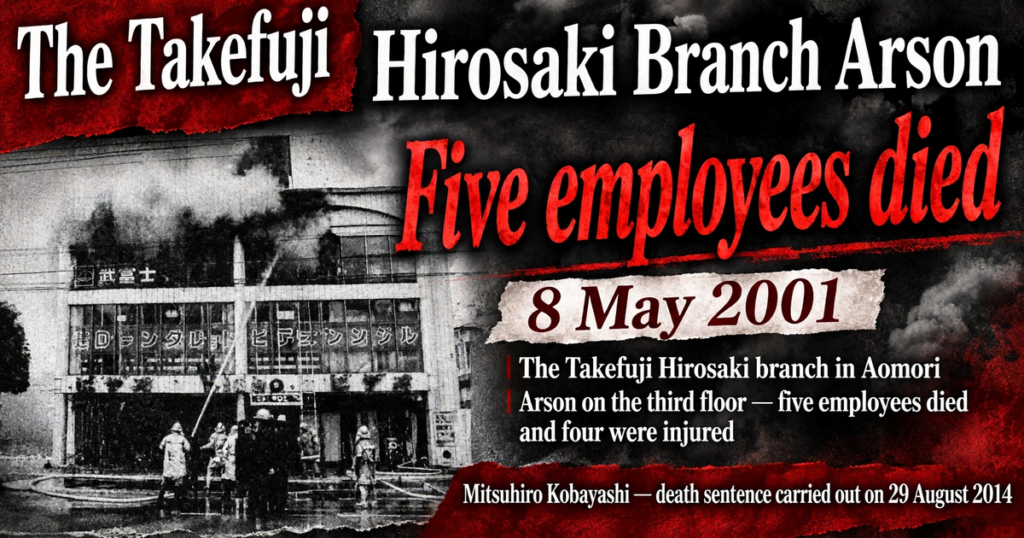
A robbery attempt at a Hirosaki finance office became a fatal fire
At about 10:49 a.m. on 8 May 2001, Kobayashi entered the Hirosaki branch of Takefuji, a consumer-finance company, in Tamachi, Hirosaki City, Aomori Prefecture. He brought approximately four litres of a fuel mixture whose main component was gasoline. He spread the liquid inside the third-floor office and demanded cash. The employees refused. Rather than leave without the money, Kobayashi ignited the fuel and fled. Nine employees were inside the branch. Five died and four were injured. The intended robbery did not succeed, but the fire turned an ordinary workplace into a deadly enclosed space. The case was prosecuted as robbery-murder and related offences, and the courts later examined whether Kobayashi had the intent required for murder. The fire blocked the normal exit route from the third-floor premises. People working nearby brought a ladder and helped four employees escape through a window; those rescued also suffered serious burns and other injuries. The rescue did not reduce the responsibility for the five people who could not escape.
The number of employees and the location shaped the danger
The office was on the third floor, and the employees were working in the branch when the fire started. The fuel was spread around the counter area and the entrance. Once ignited, flames and smoke spread rapidly through the premises. The nine people inside did not have the time or safe route needed to escape the danger. Five employees died; the other four suffered injuries of varying severity. The figures should not be reduced to a generic description of a fire with multiple casualties. The victims were employees at their ordinary place of work, and the fire was deliberately started after the cash demand was rejected. The robbery itself remained an attempt because no money was taken.
Debt and gambling were part of the background, not an excuse
Kobayashi was 43 and worked as a taxi driver in Aomori Prefecture. The case record described serious financial pressure, including housing-loan obligations and debts connected with gambling on bicycle races. He had become unable to manage his finances and sought money from the consumer-finance branch. Those circumstances help explain the immediate background to the attempted robbery, but they do not lessen the responsibility for the decision to ignite a highly flammable liquid in a room occupied by employees. The distinction is important. Financial difficulty can form part of the factual context considered by a court, but it does not make a violent crime inevitable or justify an act that placed the lives of everyone in the office at extreme risk.
The central legal issue was whether Kobayashi accepted the risk of death
Kobayashi disputed that he intended to kill the employees. His position separated the act of setting the fire from an intention to cause their deaths. The courts examined the amount and nature of the fuel, the enclosed office, the presence of employees, the speed with which the fire could spread and the decision to ignite it after the cash demand was refused. They concluded that he recognized the grave possibility that people inside would die and nevertheless proceeded. Japanese criminal law recognizes intent not only where a defendant specifically desires a particular person's death, but also where the defendant recognizes the possibility of death and accepts that result. This is often described in English as eventual intent or dolus eventualis. It was the basis for the murder finding in this case. The court also considered Kobayashi's experience working at a gas station. That background made it difficult to accept that he did not understand how rapidly a gasoline-based mixture could ignite and spread inside a confined room.
The investigation took approximately ten months
Kobayashi was not arrested at the scene. Investigators examined witness information, vehicles seen near the branch, objects left at the location and the suspect's movements before and after the fire. Newspaper material found at the scene was reportedly examined for printing and distribution clues. The police also investigated the purchase of the fuel mixture and checked the vehicle information. No single item solved the case on its own. The investigation brought together the paper, vehicle, fuel purchase and inconsistencies in accounts of the suspect's movements. On 4 March 2002, approximately ten months after the fire, police arrested Kobayashi on suspicion of robbery-murder and arson. His arrest allowed the case to proceed to criminal trial.
The Aomori District Court imposed the death penalty in February 2003
On 12 February 2003, the Aomori District Court sentenced Kobayashi to death. The court considered the five deaths and four injuries, the high risk created by spreading gasoline-based fuel in an occupied indoor space, the attempted robbery and the decision to set the fire after the employees refused to hand over money. The defence continued to contest the finding of intent to kill. On 19 February 2004, the Sendai High Court dismissed the appeal and maintained the death sentence. The case was not treated as a fire in which deaths were merely accidental consequences of an otherwise separate robbery. The courts found that the risk of fatal harm was so obvious, and was accepted by Kobayashi, that the legal requirements for murder were satisfied.
The Supreme Court rejected the final appeal and the sentence became final
On 27 March 2007, the Supreme Court's Third Petty Bench rejected Kobayashi's final appeal. A subsequent petition to correct the judgment was also rejected, and the death sentence became final in April 2007. The Supreme Court's reasoning maintained the finding of eventual intent: the danger of setting fire to a gasoline-based mixture in an occupied office was not remote or abstract. Kobayashi had ignited the mixture while employees remained inside. The court also considered the seriousness of the consequences, the selfish motive and the absence of any justification for exposing the employees to that danger. The final judgment therefore distinguished the failed theft from the completed murders and injuries caused by the fire.
The sentence was carried out in 2014
On 29 August 2014, Kobayashi's death sentence was carried out at the Sendai Detention Branch. The Ministry of Justice announced that two death-row prisoners, including Kobayashi, were executed that day. He was 56. His criminal proceedings ended with the execution. The legal sequence is an attempted robbery followed by deliberate arson, five deaths and four injuries, arrest in March 2002, a death sentence from the Aomori District Court in 2003, dismissal of the appeal in 2004, rejection of the final appeal in 2007, finality in April 2007 and execution in August 2014. Describing the case simply as an arson that caused five deaths would omit the courts' central finding about accepted lethal risk.
Original Japanese record: 武富士弘前支店強盗放火殺人事件|3階店舗を炎が塞いだ5人死亡と小林光弘の死刑執行
Last updated:
Related articles
Case record
The Komae Robbery Resulting in Death: Kinuyo Oshio's Killing and the Separate Trials of Local Operatives and Overseas Organisers
Case record
The 300 Million Yen Robbery: The Unsolved Theft of Japan's Showa Era

Case record
The 2008 Akihabara Attack: Seven Deaths and the Supreme Court's Sentencing Decision
Case record