
The Dazaifu Woman's Death: Financial Control, Repeated Assaults and Police Warnings
Rumi Takahata, 36, died in October 2019 after about a month of violence and coercive control. Two defendants were convicted of injury resulting in death, confinement and extortion, not murder; the case also raised questions about eight police-recorded consultations before her death.
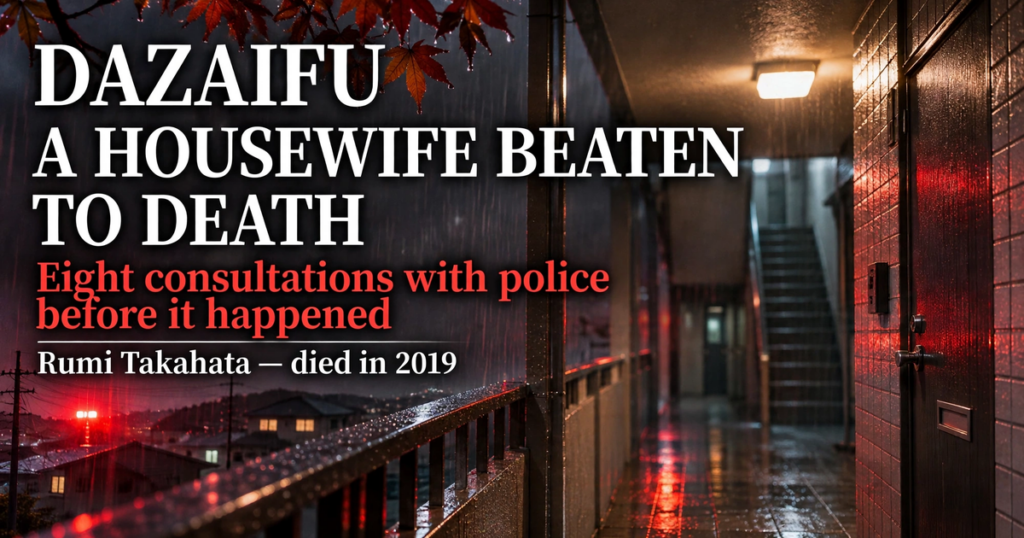
Takahata was found dead in a car in Dazaifu on 20 October 2019
Early on 20 October 2019, 36-year-old Rumi Takahata was found dead in the rear seat of a car parked at an internet café in Dazaifu, Fukuoka Prefecture. The reported cause of death was traumatic shock associated with bruising to the lower body. The investigation and later court proceedings established that the fatal violence had not been confined to the final hours of her life. For about a month, Takahata had been subjected to repeated assaults and coercive control while her relationships with family members deteriorated. The two principal defendants were Miyuki Yamamoto and Hayate Kishi. They were prosecuted for injury resulting in death, unlawful confinement, extortion and related offences. The distinction in the charge is important: the defendants were not convicted of murder. The court's findings concerned a prolonged pattern of violence and confinement that resulted in Takahata's death.
Financial demands became a means of controlling her life
The Fukuoka High Court examined how Yamamoto used money demands to isolate and control Takahata. The process included making her assume responsibility for her brother's debt, increasing what was said to be money owed for host-club expenses, and invoking fear of a person described as a former member of an organized crime group. Takahata borrowed from her family and relatives to meet the demands. Her relationships with family members deteriorated, and the court found that her relationship with her husband was also damaged. She came to live at the residence of Yamamoto and Kishi, where her daily life and mental state were increasingly controlled. The case was therefore not treated as an ordinary disagreement over a private loan. The court found a combination of extortion, threats, violence and isolation that made it difficult for Takahata to leave the situation voluntarily.
Repeated assaults and confinement continued for about a month
The court found that Takahata was assaulted repeatedly over approximately one month. Wooden swords and other objects were used, and the violence continued even as she became physically weakened. The confinement did not depend only on whether a door was locked or whether she was ever seen outside the residence. The court considered the combined effect of threats, fear of further violence, isolation from family and control over food, clothing, shelter and everyday decisions. In those circumstances, the fact that she may have left the residence on some occasions did not mean she was free to end the relationship. The legal concept of unlawful confinement can involve the practical suppression of a person's freedom of movement; it is not limited to a person being locked in a room at every moment. The court's findings focused on the actual conditions under which Takahata lived and the degree to which she could act independently.
The two defendants had different roles in the fatal violence
The High Court did not treat Yamamoto and Kishi as having identical roles. Yamamoto was regarded as the central figure in the financial control. She obtained money from Takahata, separated her from family members, controlled the household and not only assaulted her herself but also directed Kishi to use violence. Kishi was found to have repeatedly assaulted Takahata, including the severe blows to the lower body that directly contributed to her death from traumatic shock. Both defendants were responsible for the injury resulting in death and the confinement, but the court described their conduct and contribution separately. This distinction mattered to the sentences. Yamamoto's sentence also reflected multiple extortion and attempted-extortion offences involving Takahata, her husband and acquaintances. The High Court treated seven such offences as part of the case and referred to more than 4.89 million yen in completed extortion losses.
The District Court imposed 22 years and 15 years in March 2021
On 2 March 2021, the Fukuoka District Court sentenced Yamamoto to 22 years' imprisonment and Kishi to 15 years. The central offences were injury resulting in death and unlawful confinement. Yamamoto's sentence also reflected the series of extortion and attempted-extortion offences. Both defendants challenged aspects of the findings, and prosecutors appealed the acquittal on the separate charge of abandoning a corpse. The corpse had been moved in a car after Takahata died. The prosecution argued that the movement of the body constituted corpse abandonment under Article 190 of the Penal Code. The legal issue was distinct from the defendants' responsibility for the assaults and confinement. A court can find conduct morally blameworthy or relevant to sentencing without concluding that every separate statutory offence has been proved.
The High Court upheld the sentences and rejected the corpse-abandonment appeal
On 3 December 2021, the Fukuoka High Court dismissed the appeals by the prosecution and both defendants. It found no unreasonable error in the District Court's assessment of the injury resulting in death, confinement or the sentences. The High Court also upheld the acquittal on the corpse-abandonment charge. It considered that moving the car with Takahata's body did not amount to the kind of concealment prohibited by Article 190, given the circumstances described in the judgment, including the absence of an additional act of covering or hiding the body and the eventual intention to call emergency services. The court nevertheless treated the defendants' conduct after her death, including their efforts to protect themselves, as relevant to sentencing. No further appeal was filed, and the 22-year and 15-year sentences became final. The legal outcome must be described as convictions for injury resulting in death and related offences, not murder.
The family had contacted police before the death, but the counts differ
The case also prompted scrutiny of the response by Saga Prefectural Police before Takahata died. Her family had repeatedly contacted Tosu Police Station about the situation. Television Nishinippon reported that the family counted 11 consultations or contacts. Saga Prefectural Police, after reviewing its records, identified eight recorded consultations. These figures come from different counting methods and should not be collapsed into a single number. The police explained that the information had mainly been understood as a financial dispute and that officers had not recognized an immediate threat of physical harm to Takahata. In January 2021, the prefectural police chief reviewed an audio recording made by the family during a consultation and maintained the police explanation. After the case, the police reviewed how consultations were recorded and how officers followed up when people were asked to return. The discrepancy between eight and 11 does not erase the fact that the family had sought police assistance before the death.
Yamamoto died in prison; Kishi's sentence became final
Yamamoto served her 22-year sentence at Fumoto Prison in Saga Prefecture. Television Nishinippon reported in November 2022 that she had become ill during the summer and died at the age of 43. Her death occurred while she was serving a fixed-term sentence. Kishi's 15-year term became final after the High Court dismissed the appeals in December 2021. The case should not be described as a murder conviction. The courts found that repeated assaults, confinement and extortion created a coercive environment that ended in Takahata's death. The police consultation issue is separate: it concerns what information was received before the death and how authorities assessed it.
Original Japanese record: 太宰府主婦暴行死事件|高畑瑠美さんへの金銭支配と暴行、事件前の警察相談8回
Last updated:
Related articles
Case record
The Kudo-kai Four Civilian Attacks: The Death Sentence Overturned and the Supreme Court Appeals Still Pending

Case record
The Kitakyushu Hospital Director Abduction-Murder: 950,000 Yen Stolen, a 20-Million-Yen Demand and Two Executions

Case record
The Nishitetsu Bus Hijacking: Fifteen and a Half Hours, One Death and a Medical Juvenile Disposition

Case record