
The Yamanashi–Niigata Serial Murders
Mitsuo Fujishima killed two people in Yamanashi and Niigata Prefectures five days apart in March 1986. The first victim was his former wife's 73-year-old aunt; the second was a 26-year-old man known to his former wife. Fujishima's death sentence became final in 1995 and was carried out in December 2013.
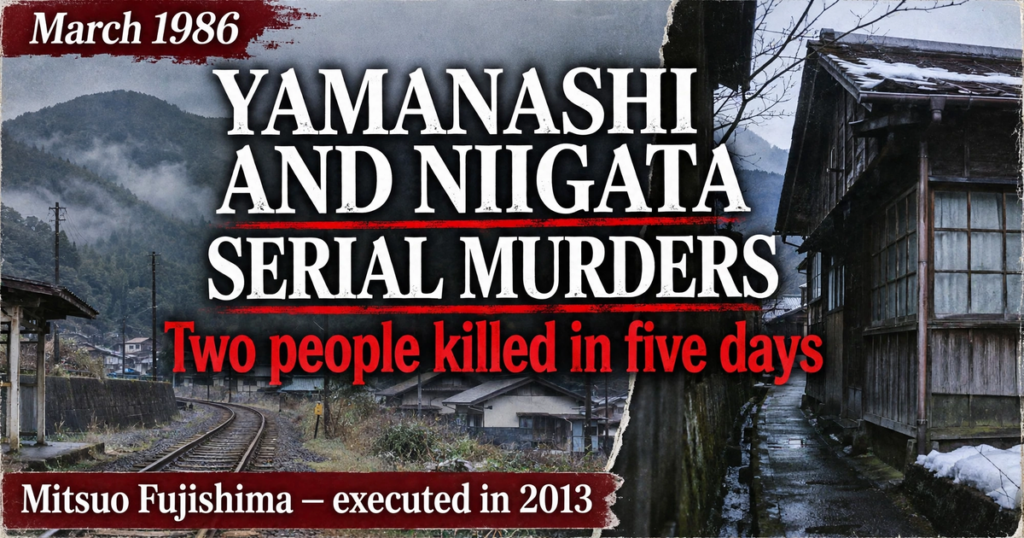
Two people were killed five days apart
The Yamanashi–Niigata serial murders took place on 6 and 11 March 1986. The defendant, Mitsuo Fujishima, was 27 at the time. The first victim was a 73-year-old woman in Yamanashi Prefecture, the aunt of Fujishima's former wife. Five days later, he killed a 26-year-old man in Niigata City who was an acquaintance of the former wife. The two killings were close in time but occurred in different prefectures and involved different victims. The courts treated them as connected offences committed by the same offender.
The first victim was killed to prevent a report to police
The first killing occurred on 6 March in Yamanashi. The victim was related to Fujishima's former wife. The official account of the case described the killing as an effort to silence her because Fujishima feared that she would report him to police. The victim had no responsibility for the offences or conduct that Fujishima wanted to conceal. The killing was therefore treated as a crime motivated by self-preservation and fear of arrest, rather than as an act arising from a dispute in which the victim had played an active role.
A second killing followed in Niigata on 11 March
On 11 March, only five days after the first murder, Fujishima killed a 26-year-old man in Niigata City. The man was known to Fujishima's former wife. The Japanese article describes the two killings as part of a sequence linked to the fear of police reporting and arrest, as well as the effort to escape the consequences of the first crime. The five-day interval is important: this was not a single incident with two victims at one location, but a second murder committed after the first offence had already created a risk of detection.
The case included the concealment of bodies and flight
The charges included murder and disposal of bodies. After the killings, Fujishima took steps to conceal what had happened and continued to evade arrest. The authorities later described the offences as murders committed to prevent police reporting and arrest. The two victims were not killed in the same place or on the same day, and the investigation had to connect separate scenes in Yamanashi and Niigata. The court considered the killings, the concealment and Fujishima's conduct afterward as parts of the same criminal sequence.
The Kofu District Court imposed the death penalty in 1987
On 6 July 1987, the Kofu District Court sentenced Fujishima to death. The court considered that two people had been killed within a short period in different prefectures and that the offender had concealed evidence and continued to flee. The defendant's upbringing and other personal circumstances were also considered as matters that could favour him. They did not outweigh the seriousness of the two murders, the motives and the conduct after the killings. The sentence was a first-instance judgment and could still be appealed.
The Tokyo High Court upheld the sentence
Fujishima appealed, but on 15 December 1988 the Tokyo High Court dismissed the appeal. It left the death sentence in place. The appellate court considered the connection between the two murders: the first crime created a risk that the authorities would be informed, and the second killing followed within days as part of the attempt to avoid the consequences. The defendant then sought review by the Supreme Court. The case was not final at the time of the High Court judgment because the appeal process continued.
The Supreme Court dismissed the final appeal in June 1995
On 8 June 1995, the Supreme Court dismissed Fujishima's appeal. The judgment maintained the death sentence imposed by the lower courts. It considered the two deaths, the motive of silencing people and avoiding arrest, and the conduct after the offences. The death sentence became final after the Supreme Court decision and the ensuing procedural steps. Approximately nine years had passed since the two murders in March 1986. Fujishima was then held as a person whose death sentence had become final.
More than eighteen years passed between finality and execution
Fujishima was not executed soon after the Supreme Court ruling. More than eighteen years passed between the final death sentence in 1995 and the execution in 2013. Amnesty International Japan referred to the long period between finality and execution in a statement issued around the time of the execution. The interval illustrates that a final death sentence and the carrying out of the sentence are separate events. A death sentence becomes legally final through the court process, while the execution occurs later under a separate procedure.
Fujishima was executed at Tokyo Detention House in 2013
On 12 December 2013, Fujishima's death sentence was carried out at Tokyo Detention House. He was 55. Another death-row inmate, Ryoji Kagayama, was executed at Osaka Detention House on the same day. The case's legal sequence should therefore be stated precisely: the murders occurred on 6 and 11 March 1986; the Kofu District Court imposed death in July 1987; the Tokyo High Court dismissed the appeal in December 1988; the Supreme Court dismissed the final appeal in June 1995; and the execution took place in December 2013.
The five-day interval explains the serial nature of the case
The title 'serial murders' refers to two separate killings committed within five days, not to a single event with two victims. The first victim was the former wife's aunt, and the second was a male acquaintance of the former wife. The connection was the offender's attempt to avoid police reporting and arrest. The case also illustrates why the sentence date, finality date and execution date should not be collapsed. Fujishima received a death sentence in 1987, that sentence became final in 1995, and it was carried out in 2013.
Original Japanese record: 山梨・新潟連続殺人事件|5日後に2人目を殺害、藤島光雄の死刑確定から18年後に執行
Last updated:
Related articles
Case record
The Tokyo–Saitama Child Abduction and Murder Case: Four Victims and a Long Trial Over Criminal Responsibility
Case record
The Kiyoshi Okubo Murders: Eight Women Killed in Forty-One Days
Case record
The Fujisawa Murders of Five People, Including a Mother and Her Daughters
Case record