
The Dotonbori Three-Victim Stabbing
Three 17-year-old boys were stabbed at a building near Dotonbori in Osaka on 14 February 2026. One died and two were seriously injured. Ryuga Iwasaki was arrested, rearrested on further allegations and indicted in June 2026; the Japanese article's latest stated position is that no judgment had been delivered.
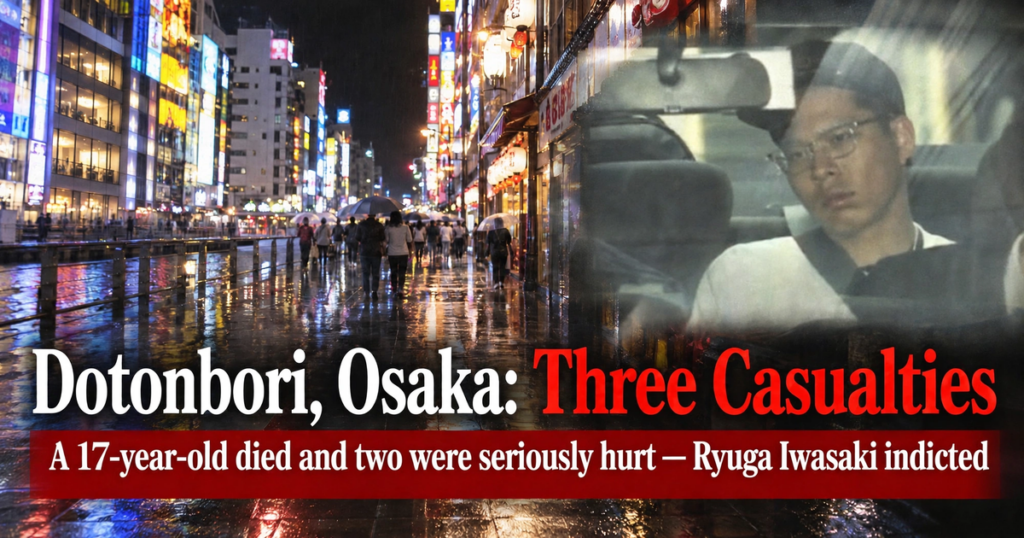
Three teenagers were stabbed in central Osaka
At approximately 11:55 p.m. on 14 February 2026, three boys, all aged 17, were stabbed on the first floor of a multi-tenant building in Shinsaibashisuji 2-chome, Chuo Ward, Osaka City. The location is in the Minami entertainment district, near Dotonbori and Ebisubashi. One of the boys, Ryunosuke Kamata, a company employee from Tawaramoto in Nara Prefecture, died. The two other boys suffered serious injuries. The incident was therefore a three-victim attack with one death, not three deaths.
Kamata died and the other two victims survived
Kamata suffered stab wounds to the chest and neck and was taken to hospital, where he died. Reports cited by the Japanese article described a wound that penetrated the heart. The other two boys were also stabbed in the chest and abdomen. One, from Yao City, was at one point unconscious; the other, from Kashiwara City, suffered injuries expected to require approximately three weeks to heal. Both later recovered sufficiently to leave hospital. Their names were not publicly identified in the article. Reports cited by the Japanese article said that, shortly before the attack, Iwasaki had allegedly engaged in nuisance behaviour toward a woman and that Kamata and others had warned him. Investigators examined whether that confrontation contributed to the attack. This remains a reported investigative account, not a motive established by a court judgment.
The police arrested Iwasaki the following day
Osaka Prefectural Police arrested Ryuga Iwasaki on 15 February 2026 on suspicion of murdering Kamata. Iwasaki was apprehended in a street in Osaka's Naniwa Ward, roughly ten hours after the attack. Reports said that he was carrying a folding knife when he was found. Police investigated the relationship between that item and the attack; the fact that an object was found on him should not be overstated as a final judicial finding about the weapon used.
The first arrest concerned the death of one victim
The initial arrest was based on suspicion of murdering Kamata. At that stage, the police were investigating the death and the circumstances of the two other boys' injuries. An arrest on suspicion is a procedural step that permits investigation and detention under Japanese criminal procedure; it is not a conviction. The suspect is not legally treated as guilty merely because the police have arrested him. The prosecution must later decide whether the available evidence justifies bringing formal charges.
Iwasaki was rearrested over the injuries to the other boys
On 6 March 2026, police rearrested Iwasaki on suspicion of attempted murder of the two surviving boys and related violations of the Swords and Firearms Control Act. By then, both injured teenagers had been discharged from hospital. One had briefly been unconscious, but neither died. The distinction between the one completed homicide and the alleged attempted killings is reflected in the charges. The number of deaths must not be inflated simply because the prosecution alleged an intent to kill all three victims.
A reported refusal to leave the detention facility did not stop the case
On 17 February, Iwasaki reportedly refused to leave the detention facility for transfer to the Osaka District Public Prosecutors Office. Police sent the investigation papers to prosecutors without physically transferring him at that time. Media reports described the episode as a refusal of transfer or a refusal of being sent to prosecutors. It did not mean that the investigation or the criminal process had ended. Subsequent police action included the further arrest, examination and formal indictment.
The prosecution ordered an examination detention
From 19 March to 22 June 2026, the Osaka District Public Prosecutors Office placed Iwasaki in examination detention. This procedure, known in Japan as kantei ryuchi, allows a psychiatric assessment to be conducted where the authorities need information relevant to criminal responsibility or the ability to stand trial. The specific findings of the examination were not publicly disclosed in the Japanese article. It would therefore be inaccurate to assign Iwasaki a diagnosis or to speculate about the conclusions.
The Osaka District Public Prosecutors Office indicted him on 26 June
After the examination detention ended, prosecutors indicted Iwasaki on 26 June 2026. The charges listed in the article were murder, attempted murder, violations of the Swords and Firearms Control Act, and a violation of the Minor Offences Act. The indictment formally brought the case before the criminal court. It did not establish guilt. At trial, the prosecution would have to prove the allegations and the defence would have the opportunity to challenge the evidence.
The article did not report a judgment
The Japanese article was updated on 28 August 2026 and stated that Iwasaki had been indicted and was awaiting criminal trial, with no judgment delivered as of the article's stated reference date. The available record used for this translation does not establish a later verdict. Accordingly, this English entry does not describe him as convicted, acquitted or sentenced. It records the arrest, rearrest, examination detention and indictment as procedural events, while leaving the outcome open.
Arrest, indictment and conviction are different legal stages
Japanese criminal procedure distinguishes suspicion, arrest, referral to prosecutors, indictment, trial judgment, appeal and finality. An indictment means prosecutors have decided to seek a criminal judgment; it is not a finding by a court. A defendant remains entitled to contest the charges, and the court must decide whether the prosecution has proved each offence. This distinction is especially important here because the alleged offences include one completed murder and two attempted murders, but the Japanese article did not yet report a judgment.
Original Japanese record: 大阪・道頓堀3人死傷事件|17歳の少年3人が刺され、岩崎龍我被告を殺人などで起訴
Last updated:
Related articles
Case record
The Nishinari Yakiniku Restaurant Manager Killing: From an Assault Arrest to a 17-Year Custodial Sentence

Case record
The Takatsuki Murder of Naoko Takai

Case record
The Sakai Couple Murder: A Planned Robbery, Two Deaths and a Final Death Sentence

Case record