
The Konohana Pachinko Parlor Arson Murders
On 5 July 2009, Sunao Takami set fire to a busy pachinko parlor in Osaka's Konohana Ward. Five people died and ten others were injured. The trial examined his mental condition, criminal responsibility and the constitutionality of execution by hanging. His death sentence became final in February 2016 and was carried out at Osaka Detention Center on 21 August 2026.
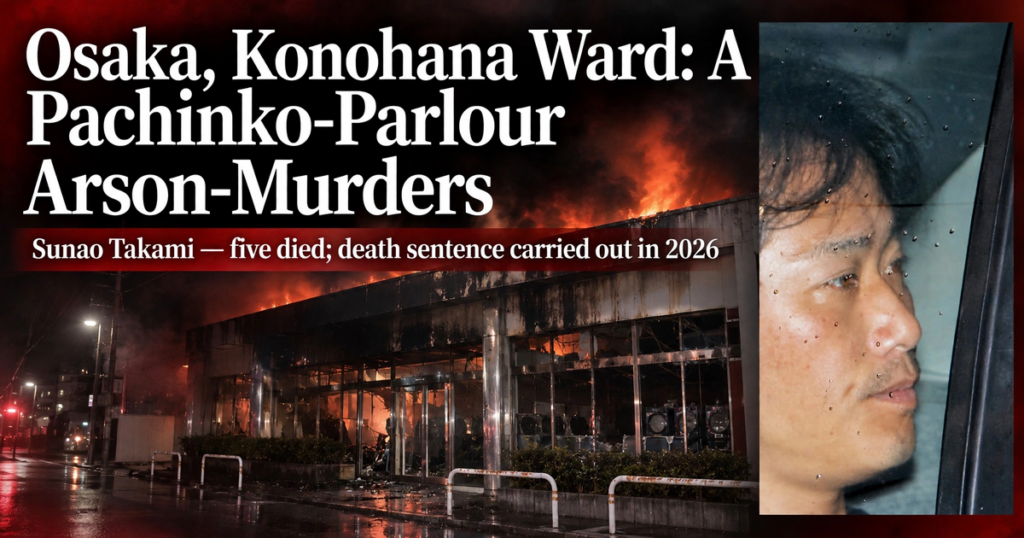
A fire at an operating pachinko parlor killed five people
On the afternoon of 5 July 2009, a fire was deliberately set inside a pachinko parlor in Shikanjima, Konohana Ward, Osaka City. Sunao Takami spread gasoline inside the operating business and ignited it. The fire spread rapidly through the premises. Five customers and employees died, and ten other people suffered injuries ranging from minor to serious. The victims were people who happened to be at the business; they had no personal connection with Takami.
Takami chose a busy Sunday to expose many people to danger
The final judgment found that Takami planned to kill an unspecified number of people and selected a pachinko parlor on a Sunday when it was likely to be crowded. He brought gasoline, entered the premises, set the fire and left. The court treated the method as a deliberate attempt to cause mass casualties, not simply an arson incident in which deaths were an unintended side effect. The five deaths and ten attempted murders were assessed as separate results of the same planned attack.
Takami surrendered in Iwakuni the following day
On 6 July, the day after the fire, Takami went to a police station in Iwakuni, Yamaguchi Prefecture, and surrendered. Osaka police investigated how he obtained the gasoline and how he travelled to the pachinko parlor. He was charged with arson of an inhabited building, murder, attempted murder and related offences. The surrender was part of the investigative chronology; it did not resolve the legal questions concerning his mental condition or the degree of criminal responsibility.
The trial focused on mental illness and criminal responsibility
The Japanese article explains that Takami had symptoms of a mental disorder before the incident and held delusional beliefs that other people or groups were harassing him. His employment and personal life had become unstable. The defence argued that these symptoms had placed him in a state of diminished capacity and should prevent or reduce a death sentence. The prosecution relied on the preparation of gasoline, selection of a crowded location and his actions before and after the fire as evidence that he retained the ability to understand and control his conduct.
Three psychiatric assessments reached different conclusions
Three psychiatric assessments were considered during the proceedings. They agreed that Takami had a mental illness, but differed on the diagnosis and the effect of the symptoms on his conduct. Two assessments considered that he retained the ability to choose and control his actions despite the delusions. Another concluded that schizophrenia-related delusions had substantially impaired his ability to control his behaviour. The court did not adopt the latter assessment. It considered his ability to distinguish delusion from reality over time and his purposeful preparation on the day of the fire.
The court found full criminal responsibility despite the disorder
The Osaka District Court concluded that Takami could recognize the wrongfulness of his actions and control his conduct. The presence of a mental illness did not automatically mean that he lacked criminal responsibility. The court considered that he obtained gasoline, chose a location with many people, carried out the arson and left the scene while taking steps to protect himself. It found that the mental symptoms had influenced his motive but had not deprived him of the capacity required for criminal responsibility.
The defence also argued that hanging was unconstitutional
A distinctive issue in the trial was the method of execution. The defence argued that execution by hanging violated Article 36 of Japan's Constitution, which prohibits cruel punishments. It asked the court to avoid imposing death on that basis. On 31 October 2011, the Osaka District Court rejected the constitutional argument and sentenced Takami to death. The court considered the constitutional claim as part of the criminal trial, but it did not find that hanging was prohibited by the Constitution.
The district court imposed death for five murders and ten attempted murders
The district court placed greatest weight on the five deaths and ten injured people. The victims had no relationship with Takami and were targeted only because they were inside a busy business. The use of gasoline in an operating shop created a serious risk that the fire would spread and prevent people from escaping. The court considered the mental disorder as a factor relevant to the motive, but found that it did not substantially reduce criminal responsibility. The scale and nature of the attack supported the death sentence.
The Osaka High Court upheld the sentence in July 2013
Takami appealed the district court judgment. On 31 July 2013, the Osaka High Court dismissed the appeal. It maintained the findings concerning his criminal responsibility and the sentence. The High Court also rejected the argument that execution by hanging was unconstitutional. Takami then appealed to the Supreme Court, continuing to challenge the assessment of his mental condition and the legality of the execution method.
The Supreme Court dismissed the appeal in February 2016
On 23 February 2016, the Supreme Court dismissed Takami's final appeal. It upheld the findings that he had carried out a planned indiscriminate attack, that five people had died and ten others had been subjected to attempted murder, and that his mental condition did not eliminate criminal responsibility. The constitutional challenge to hanging was also rejected in light of the Supreme Court's existing case law on the death penalty. His death sentence became final in 2016.
The sentence was carried out on 21 August 2026
For many years after the Supreme Court decision, the legal status of the case was a final but unexecuted death sentence. On 21 August 2026, the Ministry of Justice announced that Takami's death sentence had been carried out at Osaka Detention Center. He was 58 years old. The execution occurred approximately ten and a half years after the sentence became final and around seventeen years after the fire. The case must therefore be described as an executed death sentence, not simply as a death-row case.
The final record distinguishes the five deaths from the ten attempted murders
The final criminal findings involved five completed murders and ten attempted murders. The ten people who survived were not counted as additional deaths. The case also involved separate legal questions: whether Takami had criminal responsibility despite a mental disorder, whether hanging was constitutional and whether death was an appropriate sentence. The district court, High Court and Supreme Court all upheld the death sentence, and the Ministry of Justice later carried it out on 21 August 2026. These stages should not be collapsed into one event.
Original Japanese record: 大阪此花区パチンコ店放火殺人事件|5人死亡・10人負傷、絞首刑の合憲性を争った裁判と2026年死刑執行
Last updated:
Related articles
Case record
The Osaka Private Video Booth Fire: Sixteen Deaths, a Final Death Sentence and a Second Retrial Denial
Case record
The Osaka Sisters Murder: A Planned Robbery, Two Deaths and a Death Sentence Final by Appeal Withdrawal
Case record
The Ikeda Elementary School Attack: Eight Children Killed, a Death Sentence and Lasting Changes to School Safety

Case record