
The Kashiwa Serial Street Attacks
Late on 3 March 2014, four men were targeted in a series of attacks within a short distance in Kashiwa, Chiba Prefecture. Ikema Hiroya, aged 31, was killed, another man was injured, and two other men were robbed of a wallet and a car. Seiju Takei was arrested two days later. The courts rejected his diminished-responsibility argument and upheld a life sentence, which became final in October 2016.
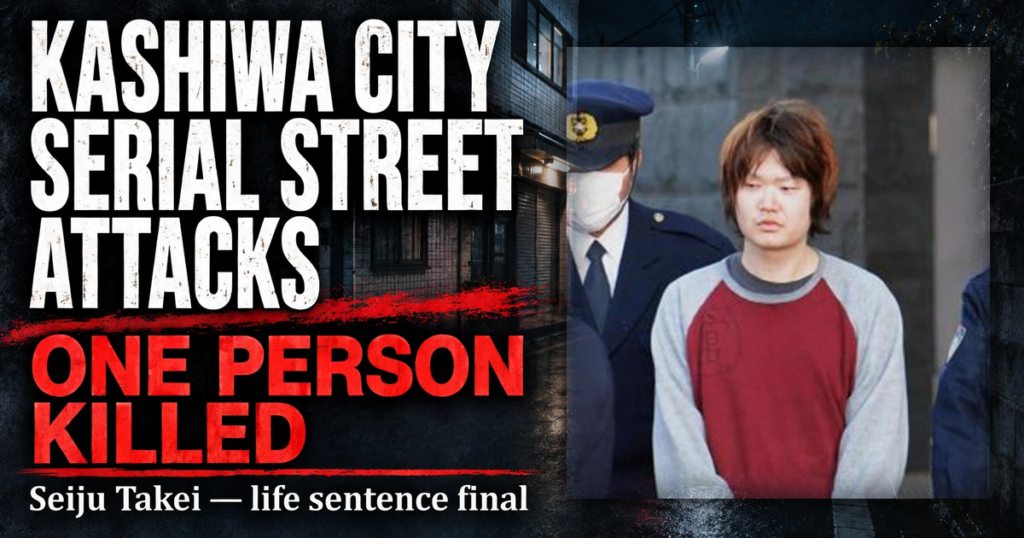
Four men were targeted in a short series of attacks
Shortly after 11:30 p.m. on 3 March 2014, a series of incidents occurred in a residential area of Akebono, Kashiwa, Chiba Prefecture. Four men were affected within an area of about 100 metres. Ikema Hiroya, aged 31, was stabbed in the neck and back and later died. Another man was injured. A third man had his wallet taken, and a fourth lost his car. The incidents were close together in time and location, but the physical injuries and property offences were not identical.
The legal case involved physical attacks and property offences
The phrase serial street attacks can suggest that every person was physically assaulted in the same way. The evidence described in the Japanese article is more specific. One man died, another was injured, and two others were robbed of property, including a car. The car was later found in a convenience-store parking area in Kashiwa. The courts treated the death as robbery-murder and considered the other conduct under the relevant robbery and injury offences. The distinction between the four people affected and the two physically injured is important.
Takei lived in the same apartment building as Ikema
Takei Seiju lived in the same apartment building as Ikema, whose home was about twenty metres from the place where he was attacked. The connection became relevant to the investigation, but it was not the only evidence. Police examined security-camera footage, witness accounts, movements of the stolen car and the sequence of attacks. The investigation considered how one person could move between the locations and whether the incidents were connected by a common purpose to obtain money or property.
Takei presented himself to the media as a witness
One unusual feature was Takei's behaviour before arrest. On 4 March, he spoke to reporters for more than half an hour and said that he had seen the incident from his apartment. He also claimed to have recorded video and provided it to police. The Japanese article, citing contemporary reporting, states that he had not in fact provided such a video to investigators. This public performance attracted attention, but it was not itself proof of guilt. The criminal case depended on evidence gathered by police and tested in court.
Police arrested Takei on 5 March
On 5 March 2014, police brought Takei in for questioning, searched his home and arrested him that evening on suspicion of robbery-murder. The investigation compared his movements with camera footage and witness accounts. His proximity to the victims and statements to the press were considered alongside evidence about the attacks and stolen property. The arrest was an investigative measure based on suspicion; guilt was determined later in the criminal proceedings.
The trial focused on criminal responsibility
The trial by lay judges began in May 2015. Takei admitted the charged conduct. The main dispute concerned his mental condition and whether he had been able to understand and control his actions. The defence argued that mental illness and medication had weakened his ability to judge right from wrong and restrain himself. The prosecution argued that his conduct showed he could act toward the goal of obtaining money and property and make purposeful choices during the sequence of offences.
The Chiba District Court imposed life imprisonment
On 12 June 2015, the Chiba District Court sentenced Takei to life imprisonment, as requested by the prosecution. The court found a strong intent to kill Ikema and treated the repeated attacks and robbery offences as serious. It did not accept the argument that Takei's mental condition substantially reduced his criminal responsibility. The legal test was not whether his statements or behaviour appeared unusual, but whether he could understand the nature and wrongfulness of his actions and act in accordance with that understanding.
The Tokyo High Court upheld the sentence
Takei appealed, continuing to challenge the assessment of his mental condition and the sentence. On 30 March 2016, the Tokyo High Court dismissed the appeal. It accepted the first-instance conclusion that Takei had retained full criminal responsibility. The court considered that his actions were organised around the purpose of obtaining money or a vehicle and that he responded to circumstances in a way consistent with purposeful decision-making. The High Court therefore left the life sentence in place.
The Supreme Court dismissed the final appeal in October 2016
Takei then appealed to the Supreme Court. On 11 October 2016, the Supreme Court's Third Petty Bench dismissed the appeal. The life sentence imposed by the Chiba District Court and maintained by the Tokyo High Court became final. The Supreme Court did not impose a different sentence. It declined to overturn the lower courts' decisions, which had treated Takei as fully criminally responsible for the robbery-murder and related offences.
The final record distinguishes the four affected men from physical injuries
The final case record concerns four men: Ikema was killed, one other man was injured, and two more were robbed of a wallet and a car. Four people being targeted does not mean that four people were stabbed or physically injured. The case also illustrates the difference between media attention and legal proof. Takei's interview as an apparent witness became widely known, but the courts based their conclusions on evidence about the offences, his purposeful conduct and his criminal responsibility. The life sentence became final in 2016.
Original Japanese record: 柏市連続通り魔殺傷事件|池間博也さん死亡、竹井聖寿の無期懲役確定まで
Last updated:
Related articles

Case record
The Osaka Minami Double Murder: A Death Sentence Overturned and Life Imprisonment Upheld
Case record
The Ikebukuro Street Attack: Two Women Killed, Six Injured and the Death Sentence for Hiroshi Zoda
Case record
The Kawasaki Serial Stabbing Attacks
Case record