The Nagoya Elderly Couple Robbery-Murder Case
An elderly couple were killed in their home in Nagoya in March 2017, and a wallet was taken. The central legal issue was whether the defendant had already intended to take property when he killed them. An initial life sentence for murder and theft was set aside and the case was remanded. A later district-court panel imposed a death sentence, but the defendant died while appealing, so that sentence never became final.
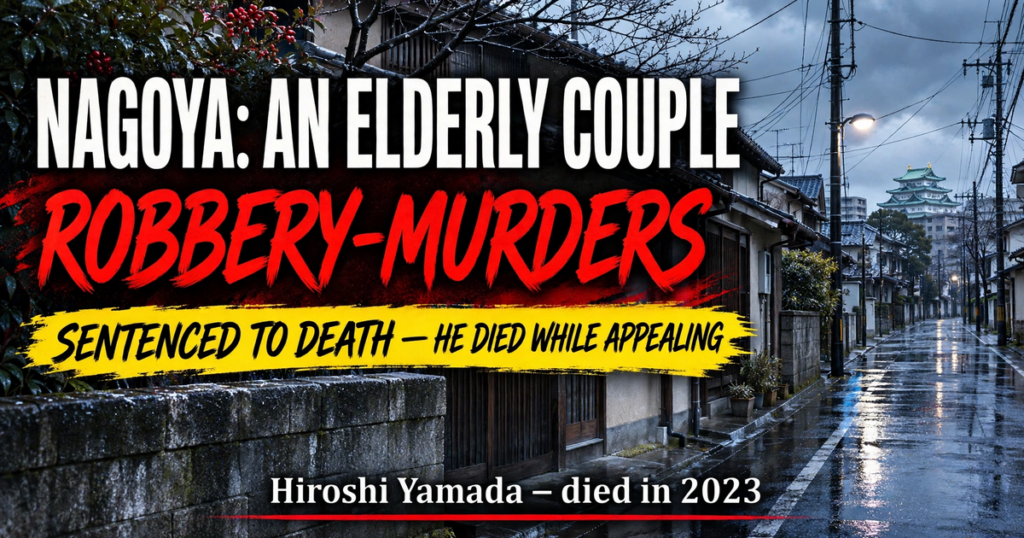
An elderly couple were killed in their home in March 2017
On 1 March 2017, Katsuo Oshima, aged 83, and his wife Tamiko, aged 80, were killed at their home in Minami Ward, Nagoya. Their bodies were found with multiple knife wounds. A wallet containing a small amount of cash had been taken from the residence. The defendant was Hiroshi Yamada, whose former surname was Matsui and who lived nearby. The investigation established that the couple had been killed and property removed, but the legal relationship between the killings and the taking of the wallet became the central issue.
The investigation considered whether the offender knew the household
The home showed signs of disturbance, but there was little clear evidence that an unknown intruder had forced entry. Investigators examined doors and windows, blood traces and the couple's movements before the deaths. Yamada lived nearby and knew the couple. Police compared his movements, clothing and possessions with security-camera footage and other records. The inquiry did not rely on proximity alone. It considered forensic material, the condition of the residence, the missing wallet and the explanations Yamada gave after he was taken into custody.
The missing wallet raised a question about the purpose of the killings
The wallet contained only a modest amount of money, reported in the article as at least about 1,200 yen. The amount did not determine the legal classification. The issue was whether Yamada intended to obtain property when he used violence against the couple, or whether he took the wallet after the killings for another reason. Under Japanese law, robbery-murder requires the taking purpose to be connected to the violence. A later taking of property does not automatically prove that the killings were committed for that purpose.
Yamada was arrested on suspicion of robbery-murder
Police arrested Yamada on suspicion of robbery-murder, and prosecutors initially charged him with that offence. The prosecution relied on the killings, the taking of the wallet, the condition of the home and surrounding evidence. Yamada's statements about why he went to the house, the order of events and when he noticed the wallet changed during questioning. Investigators compared those accounts with blood traces, camera footage, the location of the property and his movements. The dispute was not simply whether he killed the couple; it concerned the purpose associated with the killings.
The first district-court trial resulted in life imprisonment
In 2019, the Nagoya District Court found that Yamada had killed the couple and taken property, but did not accept that the prosecution had proved a robbery purpose at the time of the killings. It convicted him of murder and theft and imposed life imprisonment. That judgment treated the two offences separately. The difference between robbery-murder and murder followed by theft was legally significant because the former requires a specific relationship between the violence and the purpose of taking property.
The High Court set aside the first judgment and remanded the case
On 10 January 2020, the Nagoya High Court quashed the first-instance judgment and remanded the case to the district court. The High Court did not simply replace the life sentence with a death sentence. It concluded that the first trial's assessment of the evidence and the robbery purpose required further examination. The remand meant that a new district-court trial had to reconsider the issue. The legal process returned to the trial court rather than ending with a final appellate sentence.
The remand trial imposed a death sentence in March 2023
On 2 March 2023, the Nagoya District Court, sitting in the remand proceedings, found robbery-murder and sentenced Yamada to death. The court accepted that the taking of property was connected to the killings. This was a new first-instance judgment after remand, not a final sentence from the High Court. Yamada appealed immediately. While the appeal remained pending, the death sentence was not final. The fact that a district court imposed the death penalty must be kept separate from whether the sentence became legally final.
Yamada died while his appeal was pending
Yamada died on 13 December 2023, aged 49, while the appeal against the remand-trial death sentence was pending. The High Court consequently did not deliver a final appellate judgment on the merits. The proceedings were dismissed because of the defendant's death. The death sentence was never final. It is therefore incorrect to describe Yamada as a person whose death sentence had become final or to suggest that the Supreme Court upheld it. The case ended through the procedural consequence of his death before appellate review was completed.
The distinction between a sentence and a final sentence is essential
In Japan, a district-court judgment may be appealed, and a death sentence remains subject to the applicable review process. A remand judgment is still a first-instance judgment, even if it imposes the most severe penalty. Here, the defendant appealed the 2023 sentence and died before the High Court could decide the appeal. The proceedings were then dismissed. The correct legal description is that a death sentence was imposed but did not become final. This is not the same as a death sentence being confirmed and later carried out.
Original Japanese record: 名古屋老夫婦強盗殺人事件|無期判決を破棄差し戻し、山田広志は死刑判決控訴中に死亡
Last updated: